


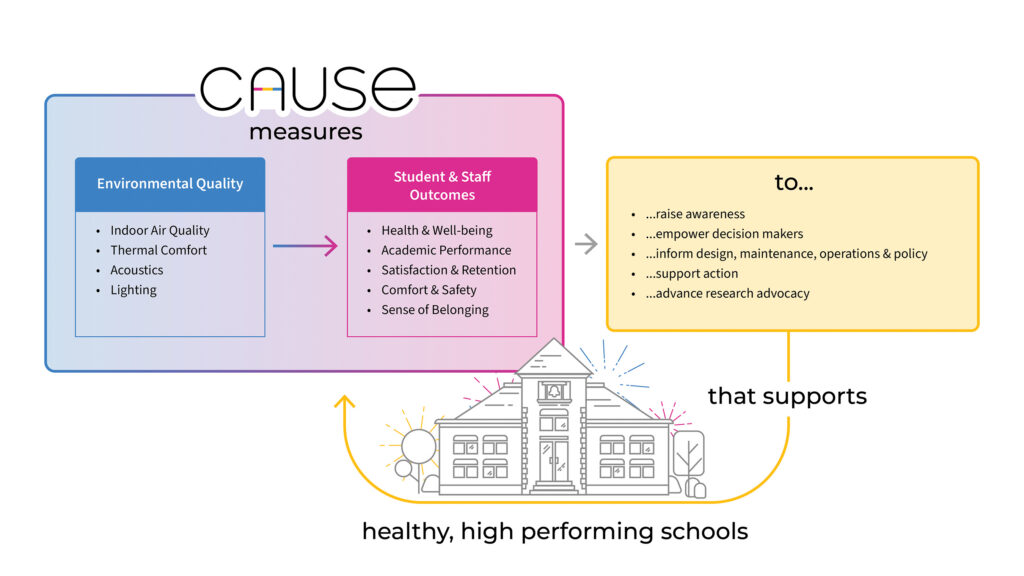
In this edition of “What Gets Measured Gets Better”, we focus on lighting and its impact within school environments. As the Coalition for the Advanced Understanding of School Environments (CAUSE) gains ground in the industry, this topic is just another facet of how we can look at physical infrastructure not just as a commodity but as an asset.
Imagine a classroom where students have great access to natural light throughout their day, inspirational and restorative views to green space, the ability to provide the exact lighting levels needed where they need it, while also controlling annoying and disabling glare. Anything beyond basic illumination is often thought of as an extra benefit, but these design strategies are actually critical to the success and well-being of students and teachers (e.g., improving circadian health through exposure to natural and circadian lighting, optimized for different age groups and building conditions).
Here are four critical factors shaping how lighting quality in schools builds better futures.
1 .Effective teaching and learning require good quality lighting.
A variety of research links the impacts of daylight access, lighting quality, and views to performance and wellbeing within school environments. Access to good quality daylighting, comparing classrooms with limited daylight access to those with optimal daylight access, has been shown to improve student performance and learning rates for reading by up to 20% and for math up to 26%1,2. Daylighting (potentially supplemented with the right electric lighting and controls3,4,5) can also help regulate our sleep/ wake cycle (circadian rhythm)6, something that is particularly important for adolescents7. Lighting levels have been shown to influence memory8. Views of nature9, as well as views of plants indoors10, have also been reported as positively impacting student attention.
Know the facts:Good lighting quality and daylight plus views to nature can significantly improve student health, performance, and attention.
2. Effective learning environments require integrated daylighting and electric lighting systems.
Good lighting design for schools11 involves the use of strategies such as skylights, light tubes, clerestory windows, traditional windows, light shelves, vertical fins, louvers, shades, and the appropriate glazing to maximize daylight access while minimizing glare and unwanted heat gain/loss. Additionally, integrating high-efficiency electric lighting and controls is crucial. Electric lighting should complement the use of daylight, and be furnished with features such as continuous dimming control, occupancy sensors, photocells, and spectral power distributions that reduce energy consumption, optimize circadian system functioning12, and enhance the learning environment. These controls should be easy to use and maintain, ensuring that school environments can adapt to different activities and times of day.
Know the facts: Effective learning environments that optimize lighting quality and thermal comfort require integrated electric lighting and daylighting solutions that have been coordinated with the building envelope and HVAC system.
3. We must address the inequities in good quality lighting that exist within our nation’s schools.
There is, however, an underlying equity issue. Schools in lower-income rural and urban environments typically are faced with older facilities having disproportionately more deferred maintenance issues13. These often include a lack of adequate daylighting access (contributed to by schools still in use from the 1970s and early 1980s, built with limited windows in response to the energy crisis of the time), as well as lighting systems incapable of meeting current best practices (and in some cases unable to even provide adequate lighting levels). Daylighting access and improvements to lighting systems beyond standard illumination levels also tend to fall lower in the priority list compared to addressing things like HVAC and roofing problems when limited funds do become available. In the end, these deficiencies in lighting/daylighting tend to impact vulnerable student populations the most.
Know the facts: Inequities in daylighting, views to nature, and lighting quality disproportionately impact the most vulnerable student populations in lower-income rural and urban environments.
4. Improving lighting environments requires their evaluation.
As schools strive to provide a more equitable educational system and facilities that support well-being, examining a school’s lighting environment, and how that varies from building to building, is vital. Pre- and post-occupancy evaluation studies, like the open-source tool being developed by CAUSE, provide valuable insights into lighting performance and their impacts on students and teachers. For example, a previous school POE estimated that glare (driven by poorly controlled daylight) was negatively impacting student learning (indicated by such things as test scores) by up to 1.50%14. Such evaluations help schools, district administrators, and designers assess the effectiveness of existing and newly implemented lighting strategies and, importantly, allow for actionable, justified actions to create healthier and more supportive learning environments for all. Access to daylight/views and good quality electric lighting is crucial for student success. By prioritizing lighting and evaluating its effectiveness, we’re investing in their future.
Know the facts:Evaluating lighting conditions, pre- and postoccupancy, is crucial for creating effective learning environments— you can’t manage what you don’t measure.
Better lighting in schools isn’t just a design luxury—it’s a foundational element for student and teacher success. With district dollars increasingly being stretched, effective and easily maintained daylighting/electric lighting systems, whose performance has been verified through post-occupancy evaluations, become even more important. Quality daylighting and electric lighting systems support circadian health and improve attention, performance, and wellbeing. However, disparities in lighting conditions that exist in our nation’s schools highlight a pressing equity issue that must be addressed, especially in underserved communities, because every student deserves an effective, engaging, and healthy learning environment.
References
- Heschong, L. Daylighting and Human Performance. ASHRAE J (2002).
- Group, H. M. & Heschong, L. Daylighting in Schools: Reanalysis Report. https://www.researchgate.net/publication/332059024_CALIFORNIA_ENERGY_ COMMISSION_Daylighting_In_Schools_Reanalysis_Report (2003).
- Choi, K., Shin, C., Kim, T., Chung, H. J. & Suk, H.-J. Awakening effects of blue-enriched morning light exposure on university students’ physiological and subjective responses. Sci Rep 9, 345 (2019).
- Chellappa, S. L. et al. Non-Visual Effects of Light on Melatonin, Alertness and Cognitive Performance: Can Blue-Enriched Light Keep Us Alert? PLoS One 6, e16429- (2011).
- Figueiro, MG et al. Circadian-effective light and its impact on alertness in office workers. Lighting Research & Technology 51, 171–183 (2018).
- Reid, K. J. & Zee, P. C. Chapter 58 – Circadian rhythm sleep disorders. in Handbook of Clinical Neurology (eds. Montagna, P. & Chokroverty, S.) vol. 99 963–977 (Elsevier, 2011).
- Figueiro, MG et al. Measuring circadian light and its impact on adolescents. Lighting Research & Technology 43, 201–215 (2010).
- Castilla, N., Higuera-Trujillo, J. L. & Llinares, C. The effects of illuminance on students’ memory. A neuroarchitecture study. Build Environ 228, 109833 (2023).
- Tennessen, C. M. & Cimprich, B. Views to Nature: Effects on Attention. J Environ Psychol 15, 77–85 (1995).
- Raanaas, R. K., Evensen, K. H., Rich, D., Sjøstrøm, G. & Patil, G. Benefits of indoor plants on attention capacity in an office setting. J Environ Psychol 31, 99–105 (2011).
- Chauca, M. et al. Improvement of student performance based on the lighting conditions of learning spaces: A systematic review analysis. Journal of Infrastructure, Policy and Development 8, 10619 (2024).
- Ebaid, M. A. Improving Circadian Light Exposure Through Architectural Daylighting Design in School Classrooms. MSA Engineering Journal 3, 38–54 (2024).
- Filardo, M. 2021 State of Our Schools: America’s PK–12 Public School Facilities. (2021).
- Harmon, M. Creating Environments that Promote Efficiency and Sustainability: Anthropological Applications in the Building/Construction Industry. in 2012 ACEEE Summer Study on Energy Efficiency in Buildings (American Council for an Energy-Efficient Economy (ACEEE), Washington, D.C., 2012).