

A New Book Connecting the Sciences of People and the Wisdom of Non-Architects to Pragmatic Architectural Design
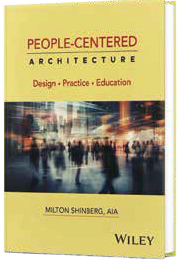
Milton Shinberg’s People-Centered Architecture: Design, Practice, & Education arrives at a moment when the architectural profession is grappling with how best to reconcile intuition, aesthetics, and evidence. With remarkable clarity, Shinberg demonstrates how architecture can be enriched by integrating human sciences—cognitive neuroscience, psychology, and behavioral studies—without losing the art and empathy that make it resonate. The book positions itself not as a rigid manual, but as a framework for rethinking design in ways that are both pragmatic and profoundly humane.
Architecture at the Intersection of Science and Practice
Shinberg’s authority on the subject comes from decades of professional and academic experience. As principal-in-charge of more than 35 school projects with partner Salo Levinas, he brings a seasoned perspective on the real-world challenges of designing in the educational realm. This foundation enables him to connect theory with practice, showing how research can be applied to resolve everyday design dilemmas without sacrificing creativity.
One of the book’s defining qualities is its ability to make complex scientific findings accessible to non-specialists. Shinberg translates research on perception, cognition, and environmental experience into actionable design strategies. Rather than reducing design to formula, he encourages architects to deepen their understanding of the sciences of people—proposing that beauty is not just a subjective ideal but an essential, knowable, and research-informed aspect of architecture.
Key Themes and Arguments
Among the central themes explored:
- The value and limits of intuition: Shinberg acknowledges intuition as a vital spark in design thinking, but warns against letting initial impressions substitute for evidence or analysis.
- Listening to non-architects: The book outlines techniques for capturing the often hidden insights of clients, stakeholders, and users, using structured dialogue, imagery, and storytelling.
- Cautions on evidence-based design: While endorsing the power of research, Shinberg warns of its potential misuse when conclusions are oversimplified or misapplied without deeper examination, leading to unintended consequences.
- Empathy as design’s highest aim: He positions empathy and wisdom as central to “wise architecture,” pushing the profession beyond logistics to creating environments where people can flourish.
Illustrative Case Studies
The book is grounded in concrete examples. In one compelling case, Shinberg demonstrates how designing classrooms for neurodiverse students leads to better environments for all learners. By designing for those who are highly distractible, architects can create flexible solutions that serve both unique and universal needs, a principle he encapsulates as “the extremes inform the means.”
Another case explores the profession’s reputation and responsibility. Shinberg argues that architecture’s public perception improves in proportion to the satisfaction of its clients and users. Helping people feel “at home” in designed spaces, he contends, is not an incidental benefit but the ultimate test of professional success.
This book is a must-read for architects and designers at any stage of their career. His inspiring and practical narrative makes even the most complex concepts accessible. Along the way, he offers aspiring and experienced professionals a fresh perspective to reignite their passion for architecture.

— Andrea de Paiva, Architect, Urban Planner and Author
Director of NeuroAu at the University of Brasilia
Reception and Impact
The book has earned early praise from both design leaders and researchers. Stefan Behling, Senior Executive Partner at Foster + Partners, notes: “Shinberg has done something truly impressive. He has managed to translate and develop a practical framework for architectural thinking and design, grounding in the latest research on human perception and cognition. His ideas and insights offer a fresh perspective, helping to clarify many aspects of my own approach to design.”
-Similarly, Zacharia Djebbara, a cognitive neuroscientist and faculty member at Aalborg University, observes: “In this groundbreaking work, Milton Shinberg cuts through the fog about architecture’s effects on the human mind, offering instead a clear journey into the science of how buildings shape our brains and behavior. Moving seamlessly between cognitive neuroscience, psychology, and architecture, Shinberg reveals the hidden processes behind why some spaces uplift us while others leave us cold.”
Such endorsements underscore the book’s reach across disciplines, affirming its value not only for practitioners but also for researchers and educators seeking to understand architecture’s impact on human well-being.
Conclusion
People-Centered Architecture is not exhaustive, nor is it intended to be. It avoids checklists and prescriptive formulas, instead offering perspectives, strategies, and ways of thinking that broaden how architects engage with the people they design for. By weaving together research, case studies, and practice-based insights, Shinberg advances a vision of architecture that is both intellectually rigorous and deeply empathetic.
For architects, educators, and anyone interested in how the built environment shapes human experience, this book is both a challenge and an invitation: to design with greater understanding, to listen more deeply, and ultimately, to create spaces that help people thrive.