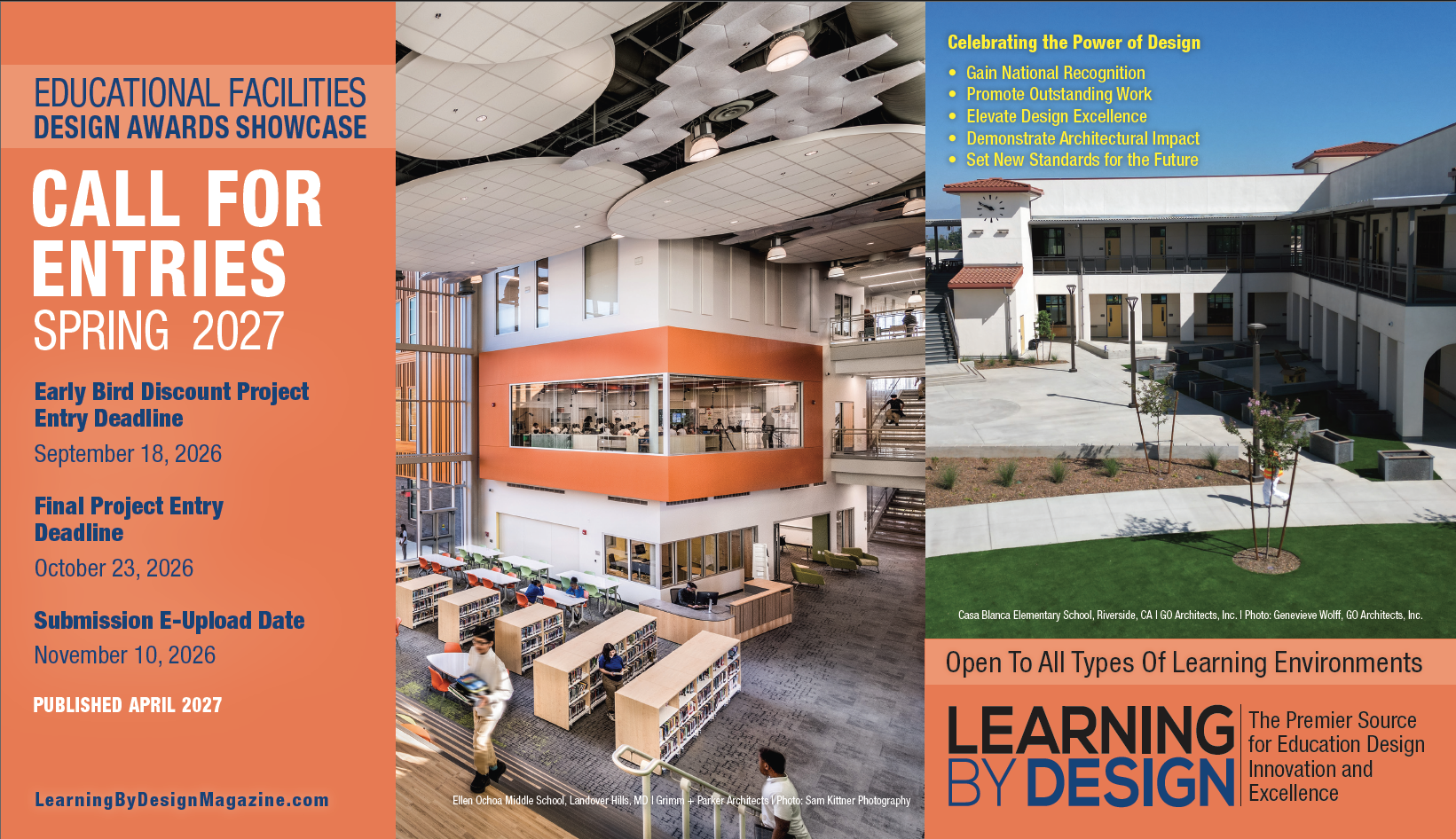



September 18, 2026
October 23, 2026
November 10, 2026
September 18, 2026
October 23, 2026
November 10, 2026
April, 2027
Through more than three decades of dedication to the best of educational building science, Learning By Design Magazine celebrates the inherent interdependence of learning and design as the fundamental basis for our experiences in life.
Enter Learning By Design magazine’s SPRING 2027 EDUCATIONAL FACILITIES DESIGN AWARDS OF EXCELLENCE program, delivering to school and university facility design leaders a comprehensive compendium featuring state-of-the-art educational facility architecture, campus planning, and interior design.
Learning By Design is not a trade publication, but rather a sought-after, pure design-focused, and knowledge-based trusted resource that education executives value as their armchair guide to school and college architecture and design.
Awarded projects featured in the Learning By Design Spring 2027 edition will be celebrated for being innovative, unique, and improving the quality of life for their community. Allow Learning By Design to honor and promote your work while setting new aspirational standards!
Open to: Architecture, Planning and Interior Design Firms, Education Institutions, Construction Companies, Landscape Architects, Manufacturers, and Facility Design Consultants.
Projects of any size are eligible for entry, including new construction, rehabilitation, and unbuilt designs. Entries may include private or public PreK, elementary, middle, combined-level, and high schools; Career Technical Education facilities; two- and four-year colleges and universities; libraries; community centers; outdoor environments; and learning spaces of all scales, from small nooks to comprehensive educational settings.
For built projects, construction must have been completed within four years of the final submission deadline (November 2026). For unbuilt projects, an active client commitment is required, with project completion scheduled within two years of the final submission deadline. Portions of the project may already be under implementation; however, the entire project need not be completed at the time of entry. To qualify for the Renovation category, at least 25% of the project’s total area must consist of renovated space.
Auditoriums and Music Rooms; Athletic and Sports and Fitness Facilities; Art and Design Schools; Cafeterias and Dining Halls; Career Technical Education Centers; Classrooms; Commons; Community Centers; Combined-Level Schools; Dormitories and Residence Halls; Early Childhood Centers; Elementary Schools; Clinics and Health Centers; Entire Buildings; E-Sports Facilities; Exhibition Spaces; High Schools; Historic Preservation Projects; Libraries and Media Centers; Maker Spaces; Modular Buildings; Multi-Use Buildings; Outdoor Spaces, Playgrounds, and Classrooms; Performing Arts Centers; Postsecondary Schools; Science Centers; School Prototypes; Single Spaces; Special Needs and Sensory Spaces; STEM/STEAM Environments; Student Unions; and Other Educational Facilities.
The Learning By Design awards are a peer-juried program. A pool of 4–6 architects, designers, and education professionals are drawn by recommendation of the Association for Learning Environments (A4LE), the Association for University Interior Designers (AUID), and by Learning By Design.
From the highest scoring projects the jury will bestow Grand Prize, Citation of Excellence, and Honor Awards drawn from the seven Award Types. All other projects deemed worthy of emulation and of contemporary standard will receive an Outstanding Project Award. Personalized commemorative certificates will be given to all award recipients.
All projects will be submitted anonymously; project jury files or text containing firm name or contact information will not be seen by the jury.
| Total Number of Pages | Early Bird Rate Deadline: September 18, 2026 |
Regular Rate Deadline: October 23, 2026 |
|---|---|---|
| 1 Page | $2,100 | $2,400 |
| 2 Pages | $2,000/page ($4,000 total) | $2,300/page ($4,600 total) |
| 3 Pages | $1,975/page ($5,925 total) | $2,190/page ($6,570 total) |
All projects will be judged and scored based on the level the submission meets the following criteria.
The extent in which the design addressed, met, and overcame specific project challenges and goals by use of innovative solutions
How did the design meet the organization’s strategic program vision, goals and bottom line, while supporting the needs of the key stakeholders and the fundamental components of contemporary education design?
The extent in which concepts of sustainable and wellness design was employed throughout the entire project built environment. How will the interventions impact the occupants and the community served. What is the projected ROI and overall Facility-Life-Cycle savings?
The manner in which the design supports and enhances current and future pedegologic learning methods or components that contribute to the student and teacher experience. Especially in core learning spaces.

Entire Environment > 100,000 sq. ft.
Entire Environment < 100,000 sq. ft.

Entire Environment > 100,000 sq. ft.
Entire Environment < 100,000 sq. ft.

Climate Action
Unbuilt Project
Adaptive Reuse
Renovation, Historic Preservation
Single Space <2000 sq. ft.

Go online to: https://bydesign.secure-platform.com/a and create an account. If you are a previous Learning By Design participant, use your existing login details.
Once logged in, complete an Entry Form for your first project. If you are entering multiple projects, continue to add project registrations until all projects have been saved.
Finalize your entry by paying by credit card through the shopping cart, or requesting an invoice.
Once your entry is finalized, you will receive an email confirmation of your order along with detailed instructions for accessing and completing the Submission Form for each project entered.
Project Submission Forms are due by November 10, 2026. 6. Project Award notifications are expected in early December 2026. Publication proofs will follow, and the Spring 2027 edition will be mailed in April 2027.
Your Submission Form is where you will upload project images, descriptive text, statistical details, and contact information to be used for the awards judging process and ultimate publication in the magazine.
A general-public project overview, plus a specified number of high-resolution photographs corresponding to the publication package selected, including the required word count and image quantity for the project’s page layout.
All featured projects receive maximum national exposure before 44,000+ education decision makers, PLUS FREE marketing enhancements: