

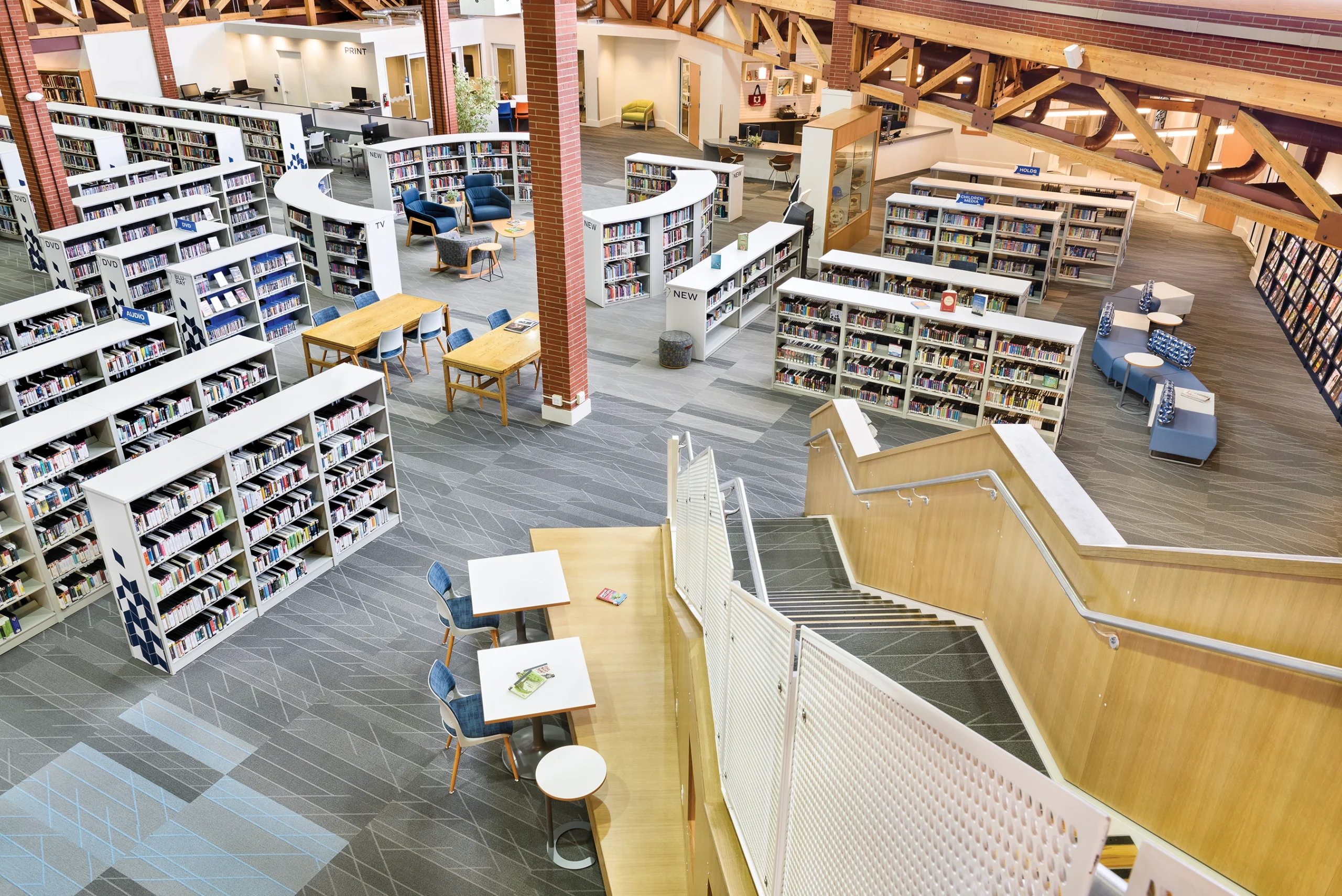
As the needs of communities evolve libraries are transforming to support more diverse and engaging experiences.
The library and its role in the academic and wider community has evolved at a rapid pace. Both in academic and community scenarios, the library has now defined itself as the “third space” and the “go to” place to fulfill multiple needs.
KI partnered with StudioFYNN on an extensive national research program to explore fundamental shifts in higher education, the evolving role of libraries within the broader community, and the critical importance of enhancing user experiences to attract and retain library users.
At the core of a library’s mission today is to support this considerable breadth of needs and to enrich the user experiences in an increasingly technological era. To achieve this, libraries must focus on key drivers that shape and enhance user experiences.
1. Entrance and Vestibule
Humans have a clear sense and response to personal, intimate, social, and public space. Architecture has evolved to support us in our transition between these very different sensory experiences.
In library design, we are seeing a greater importance placed on the vestibule and its function. The entrance space sets the tone for the entire library experience and is not only the point of entry for an individual but may become a place of congregation and gathering for those who meet to experience the library in a group.
As library functions and services become more complex, the vestibule has also evolved as a first point of contact for key information, book returns, wayfinding, navigation and laptop and battery bank rental. These activities often extend the time that the user spends in the vestibule thus creating an ideal place and space for sharing of information and the exhibition of multimedia displays or art works.
2. Exhibit and Share
Often our focus in the design of academic and community spaces is to support the process of learning and the acquisition of knowledge. Something that is often lacking in this scenario is how to share and exhibit the results and outcomes of this work with a wider audience over longer periods of time. The library has emerged as an ideal place to serve this purpose, both in physical and digital formats as it can function as gallery, exhibition space, launch venue, event space, and periodical showcase.
Across both academic and community libraries, we see an emergence of this new functionality facilitated by both the overall architecture and the furniture elements, often in unison.
3. Information and Discovery
Users of libraries are often searching for information and navigating through multiple spaces. There is an emerging trend to make this initial wayfinding and informational experience more digital and less human or librarian based. We see the emergence of multiple forms of informational terminals and repositories for book return and kiosks for the rental of laptops or other technological needs reducing the role of the traditional librarian information desk.
From a user experience point of view, however, a learning curve exists and indicates a need for the human touch with the provision of information to assist with guidance. There should also be consideration for how generational and accessibility factors may influence ease of use and comprehension.
4. Partition, Acoustics, and The Quite Space
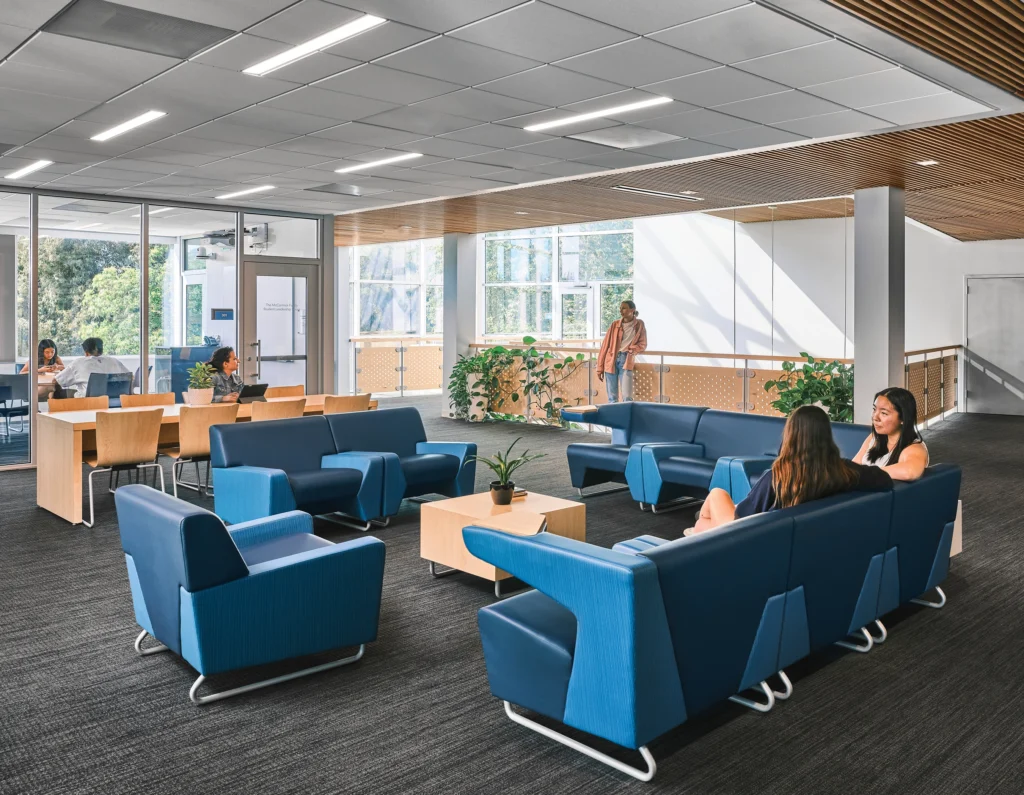
One of the greatest challenges for the library is the provision of acoustic solutions and partitions to support a variety of needs including: group collaboration, individual work and the desire for a quiet and reflective space.
Acoustic management through wall partitions and the inclusion of materials such as PET provide effective overall acoustic dampening. Partitions with material translucencies and visible sight lines can be used to eliminate distractions and create a sense of privacy while also allowing those outside to understand a space is occupied.
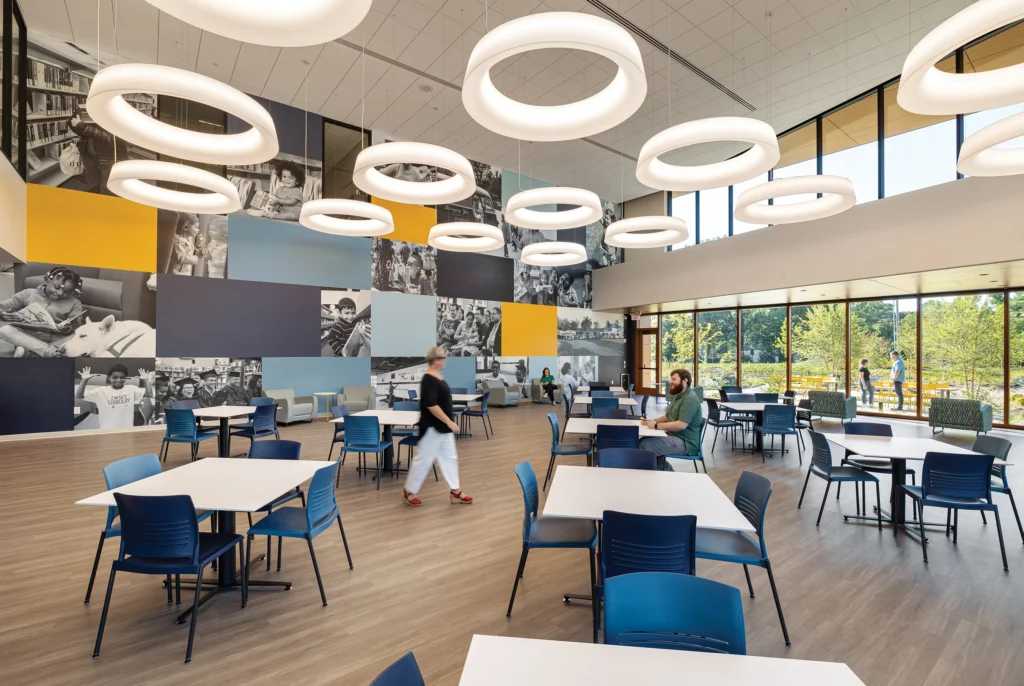
In addition to these considerations, the demands of the library space often require the repurposing of spaces to accommodate complex requirements including open event spaces.
5. Generational Awareness
According to the Institute of Museum and Library Services, community libraries serve 96.4 percent of the US population, illustrating the importance of the services they provide. Libraries today must design for multi-generational use, and it is not solely a question of scale of furniture. Different age groups present varying educational, cognitive, developmental, technological savvy, accessibility, and neurodivergent characteristics, hence, there is considerable variation in how needs are met, and experiences are curated.
6. Materiality
Comfort and materiality are intrinsically connected, as are posture and place. The materials used in libraries in both interiors and furniture are becoming increasingly important in the support and facilitation of needs and experiences.
Good design and intelligent material choices are intrinsically connected to support desired functionality, aesthetics, cleanability, and the positive tactile experiences that materials can elicit for the user.
Materiality is also one of the strongest influencers of the sustainability story. As libraries are signature spaces often representing the flagship of an institution or community, the sustainability of the materials used in furniture design are as important as the form and function of the object itself.
“The architects are considering breaking the library into different zones to better serve various user groups, such as teens, talkative groups, and quiet study areas. This zoning would help manage the diverse needs of the community more effectively.”
Community Library Director
7. Serviceability, Hygiene, and Wear
Libraries are high traffic spaces; they are also shared usage zones meaning they have multiple users daily. These factors, combined with multiple types of usage over longer time durations, create considerable wear on furniture elements. Institutions are looking for products that are easy to service, clean, and repair- which all extend the product lifecycle thus supporting better sustainability practices and reducing long term costs.8. Power Delivery, Obsolescence, and Technological Infrastructure
As library users shift more to the use of personal tech devices as opposed to shared computer terminals, obsolescence becomes a greater issue, and the need for more flexible and dynamic power supply arises.
Effective power delivery must be considered at the architectural and build stage. However, floor, wall and ceiling based electrical outlet solutions have their limitations as they do not serve the needs of flexible and reconfigurable spaces very well.
Induction charged portable battery packs and hardwiring power delivery into furniture elements have emerged as possible solutions to this problem but have their limitations in terms of cost, maintenance, and facility management.
“The 3D printers are a significant draw for the community, with many kids and adults interested in learning how to use them. The library has hired a team to conduct classes on 3D printing due to high demand.”
Community Library Director
9. Maker spaces
Libraries have made significant transformations in recent years to accommodate entirely new services and technologies. The emergence of maker spaces has boomed in library spaces and are a somewhat unorthodox addition to the traditional perception of the library. Some libraries are now building the maker space into the architectural plan with partitions or walls that manage noise and dirt while being able to isolate the space for security or supervision protocols.
10. Customization
Planning for and facilitating the complex needs of libraries requires multiple solutions often provided for by multiple vendors and sources. Customization is frequently driven by the Architecture and Design Community’s knowledge and contacts in the custom fabrication world, allowing them to achieve a more complete vision beyond standard product specification. The ability to customize furniture often helps libraries and institutions fulfill unique needs, reflect their brand, and enhance the overall user experience.
In Conclusion
We live in a complex world where furniture design is part of a dynamic ecosystem of stakeholders and needs where user experience is a significant driver of any solution for the library.
Understanding what experiences and needs should be served in a library is foundational for how design concepts and plans are generated, specified, and implemented.
Therefore, the experience is the interrelation of elements and how they come together to form a whole aligning user needs and desires with institutional objectives, purpose, and brand.
It is imperative that the future of library design accommodate a deep understanding and awareness of user experience factors.
This article provides an abbreviated overview of our findings. For comprehensive access to our full white paper and supplemental information, please scan the QR code below.

We also wish to thank the following institutions for their support in this research:
- City University of New York, Baruch College
- The New School, New York
University Center Library
Vera List Center Library - Katonah Village Community Library, Westchester, New York
- New Canaan Community Library, New Canaan, Connecticut
- New York Public Library
Stephen A. Schwarzman Building
Stavros Niarchos Foundation Library - Charles Library at Temple University, Philadelphia, Pennsylvania
- University of Pennsylvania
Van Pelt Library
Holman Biotech Commons
The Maker Space at Tangen Hall
Biotech Commons

KI and Furnishing Knowledge are registered trademarks of Krueger International, Inc.