

well-run school districts are always looking for ways to extend resources to optimize positive learning outcomes for students, educators, and communities. In the face of ever-mounting economic and social pressures, school districts, designers, and builders across the country are reconsidering the long-term maintenance implications of choices made during product specifications.
“Large school districts like Fulton County Schools in Atlanta, Dallas ISD, and the San Diego Unified School District are making a return to VCT after having installed LVT flooring in their facilities during the last 10 years or so,” says Christy Reed, Vice President, Commercial Central Region of AHF Products. AHF Products offers a full portfolio of hard-surface commercial flooring, including resilient sheet and LVT, Vinyl Composition Tile (VCT) solid and engineered hardwood and porcelain tile products, under well-known brands such as Crossville Tile®, Armstrong Flooring®, and AHF Contract®.
From a School Standard to a New Flooring Era
The first Armstrong Flooring branded VCT came out in 1947 when the plant opened in Kankakee, Illinois, where VCT is still produced today. Eventually, VCT became virtually synonymous with American education, covering corridors, classrooms, and cafeterias in schools across the U.S.
Luxury Vinyl Tile (LVT) came to market about 20 years ago, promising lower maintenance, more design options, including the realistic look and texture of natural hardwood, stone, and textile visuals. LVT can be procured in a virtually endless array of colors and patterns.
“LVT and VCT both use binders, resin, and limestone to create durable, long-lasting flooring, but their compositions differ significantly. What most people do not realize is that VCT is 85% natural limestone, with a small percentage of binders and resins—the opposite is true of LVT. For a school setting, VCT is a better choice thanks to its inherent durability and through-color construction,” Reed explains.
Durability, Repairability, and Lifecycle Value
School districts that switched to LVT for sustainability reasons were originally sold on reduced annual maintenance costs because the district wouldn’t have to strip and polish hundreds of thousands of square feet of floors in their schools every summer.
“As trends in sustainability and experiential learning took hold, designers and school districts saw LVT as lower maintenance and less institutional than VCT,” says Reed. As it turns out, now that those LVT floors have been in use for 5 to 10 years, the loudest voices calling for a return to VCT are those of the district’s facilities team.
VCT is so tried and true that Armstrong Flooring VCT installed in the 90s, 80s, and even the 70s still sustains the scuffle of students of every age in hallways, classrooms, and auditoriums across the U.S. Armstrong Flooring VCT tiles contain integral color chips that produce a top-to-bottom true-through color pattern that allows the floor’s surface to remain the same for generations with annual maintenance.
“In most cases, annual maintenance is all that is required. Damaged VCT tiles can be repaired in place. Stains and scuffs residing on the polish layer are easily removed during summer maintenance. School districts are very familiar with scratch whitening repair that allows them to restore individual tiles without having removed them,” continues Reed. “Leading the industry, Armstrong Flooring offers a 30-year warranty on VCT installed using our recommended adhesives, which are specially designed and tested to adhere our tiles to a variety of substrates with certainty we stand behind.
Design Flexibility
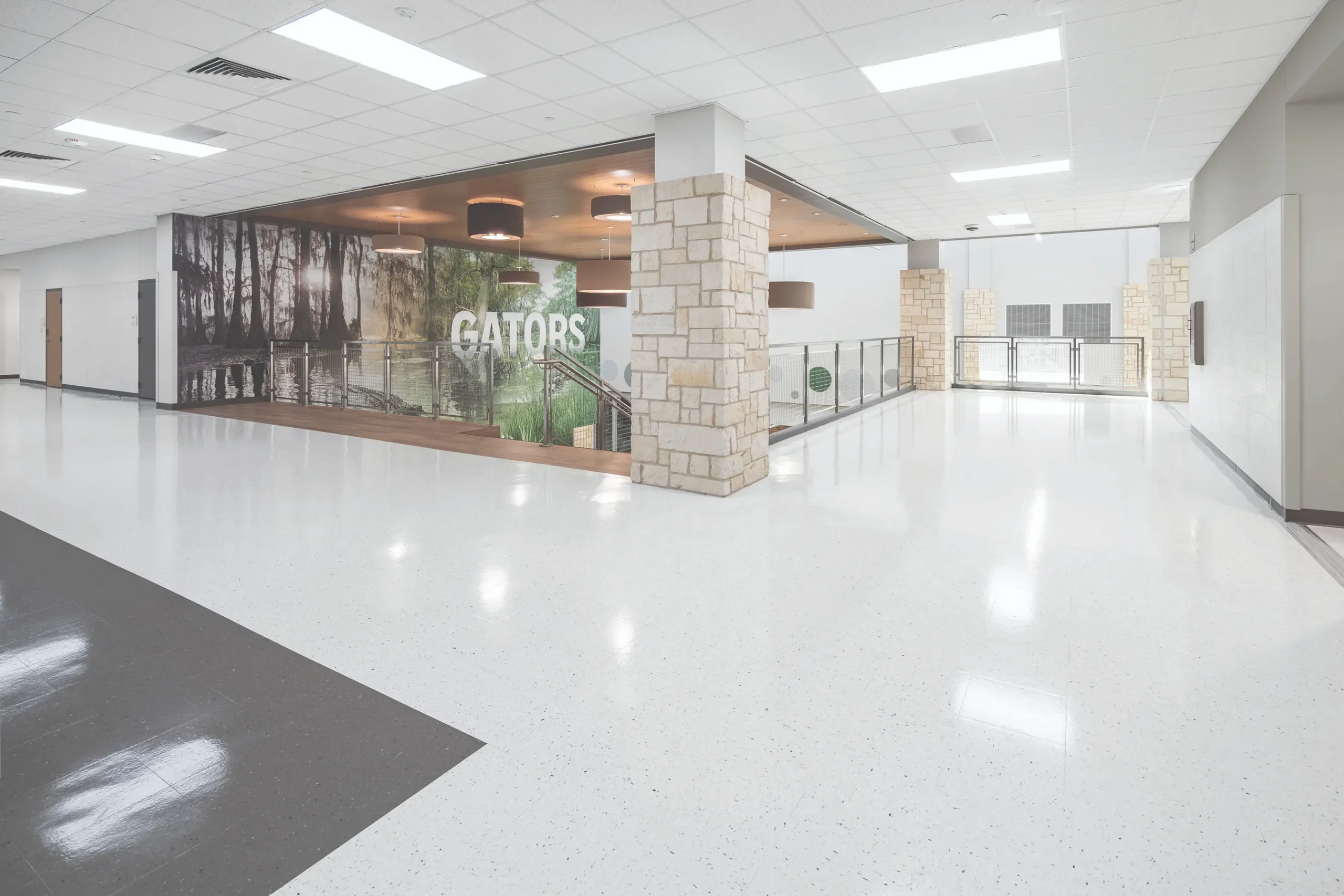
When it comes to aesthetics, VCT offers designers almost limitless possibilities, from flowing linear patterns and organic looksto visual navigation cues tailored to educational spaces of every kind. According to Robin Murphy, Business Development Manager for AHF Products and an accredited interior designer, she remains amazed by the creativity designers bring to VCT flooring. Despite helping designers specify VCT for nearly 30 years, Murphy continues to see school floors transformed with dinosaurs, maps, puzzles, math equations, color-coded wayfinding, and logos that enhance a sense of purpose, place, and pride. “What I love most about helping designers and school districts specify flooring is seeing the many ways materials are used. Armstrong Flooring’s 12″ x 12″ square VCT tiles are manufactured in the industry’s largest color palette of more than 120 options, allowing designers to create an endless array of patterns and shapes. Using WaterJet Technology, even school mascots and detailed insignias can be created,” says Murphy. “When a tile does have to be replaced, the virtually perfect squareness of Armstrong Flooring’s VCT allows the school’s maintenance team to easily pull up and replace just the damaged area without affecting adjacent tiles.”
Armstrong Flooring is proudly
American made, born, and raised.
Domestically Sourced
Along with VCT’s many positives, the only Armstrong Flooring VCT is manufactured in the USA with U.S. and global content. Armstrong Flooring is proudly American made, born, and raised.
“Armstrong Flooring VCT is produced domestically. When a purchase order is filled for a contractor or a school district, it arrives at the job site by highway. With no straits, canals, or oceans between us, we ship direct from Illinois,” says Reed. “So, designers, school districts, and contractors can be sure of product availability and delivery schedules at a lower environmental impact than foreign products.”
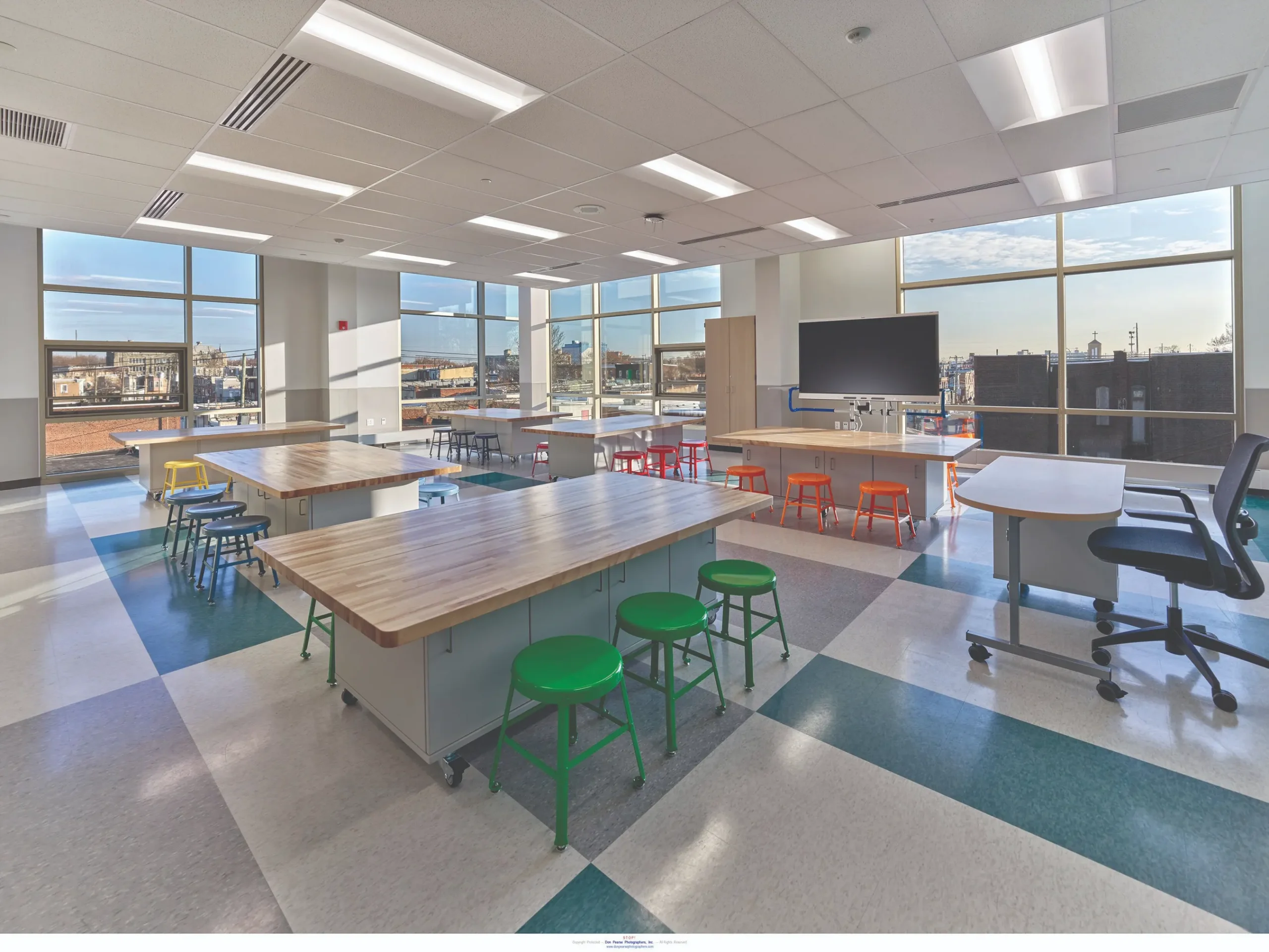
At Pierce High School in Blackshear, GA, everyday learning is articulated in vibrant, engaging configurations. Geometric patterns in earthtones animate daylit classrooms where tables, chairs and stools on castors allow learning activities to reconfigure spontaneously.
“VCT from Armstrong Flooring is engineered to last 30 years or more with regular maintenance,” finishes Reed. “With all the challenges that school districts face today, the last thing they should have to worry about are their floors.”