
We are wired to be social. From the moment we are born, we seek interaction and connection with others. As infants and toddlers, we form attachment relationships, developing the ability to experience and express our emotions. During early childhood, we form our first friendships while developing self-regulation and social understanding. These friendships combined with our relationships with teachers and other adults help us develop empathy and social skills during middle childhood. And inextricably tied to these relationships, social experiences, and developments is our ability to learn.
Over the past thirty years, school districts across the U.S. have incorporated social and emotional learning (SEL) programs to help students be “ready to learn”—to manage their emotions, including stress and anxiety, while developing healthy identities, making caring decisions, and forming and maintaining positive relationships. And the evidence supporting incorporating SEL is clear: Across all grade levels, from preschool to high school graduation, and across all abilities and backgrounds, students experience sustained positive impacts, including academic performance, when engaged in SEL programs.
But brain science also tells us something else – It is through in-person, face-to-face social interaction that we learn best.
Being Social Is Our Superpower
The reason we learn best while interacting with others may be evolutionary. As a species, we have always relied on cooperation and collaboration with each other to survive and thrive.
Research shows that our brain’s default mode is social. As explained by Dr. Matthew Lieberman, Director of the Social Cognitive Neuroscience Lab at UCLA and author of Social: Why Our Brains Are Wired to Connect, being social is our superpower. Our capacity for cooperation and collaboration comes from our ability to imagine how other people will feel and respond, to in essence “mindread” them. When we learn new information, our brains motivate us to “act like information DJs” and share it with others. Most notable, however, might be our brain’s ability to feel social pain in the exact same way we feel physical pain, acting as our social glue to each other. Our social brains tie us together.
Socially “Gated” Brains
We and our social brains are also born ready to learn. As babies, we learn through our senses and through our bodies, and how our social brain assists our ability to learn throughout our lifetime. As studied by Dr. Patricia Kuhl, Co-Director of the University of Washington Institute for Learning and Brain Sciences, in-person social interaction is essential for babies between six-to-twelve months old to learn language. Repeat the same communication by an adult to a baby via video in lieu of in-person interaction and the baby learns nothing. As infants, our social brain “gates” language learning.
As we grow into our school-age years, research again shows we learn best during active interaction and less during passive observation. In-person student communication and collaboration engage the social brain, turning on parts of the brain that lie dormant when we are alone.
So, what does understanding our default-mode social brain mean for school design?
Design for Being in Community, Always and Everywhere
Just as incorporating SEL programs provides positive outcomes across all ages and students’ experiences, so does incorporating places for socialization and being in community with each other throughout school designs.
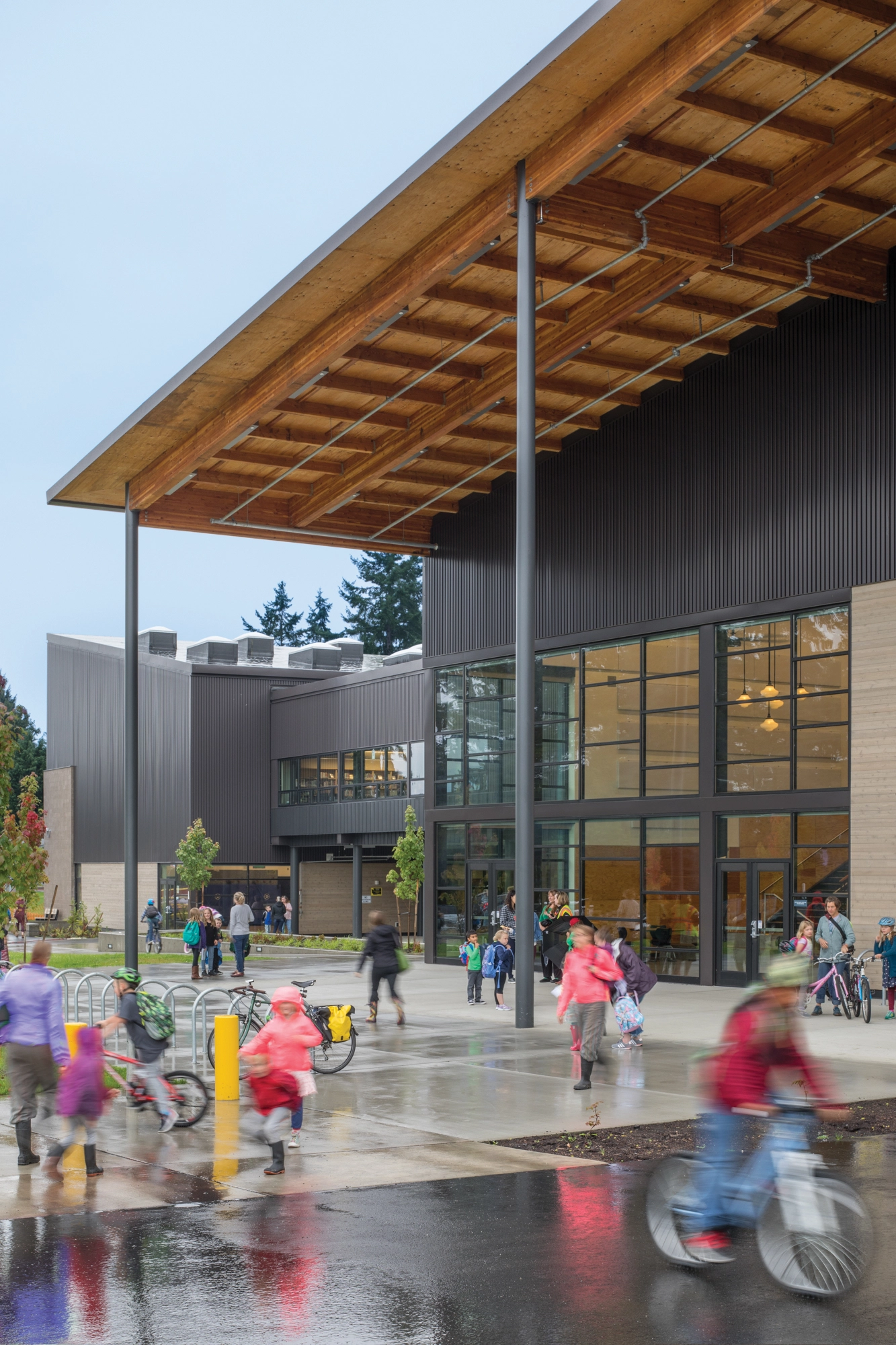
At Salish Coast Elementary School in Port Townsend, WA, students and families have a place to gather and bond at the beginning and end of the school day. Photo: Lara Swimmer
Students, Staff, and Families in Community
Students learn best, and educators teach best when they feel safe and supported in a positive school climate that fosters strong relationships and a sense of community. Nurturing community happens both inside the school building and outside when arriving to and departing the school campus. Creating safe, easy-to-supervise places for students and their families to gather, like in the photo of the Commons entrance plaza at Salish Coast Elementary School, supports not only bonds between students, but between their parents and caregivers as well. For many, elementary school provides one of their longest community experiences throughout their school years.
Designing for the social and emotional health and well-being of educators and staff can be complex given their diversity in experience, working style, and student interactions. Yet recognizing and providing for common needs can be highly impactful in supporting our professionals at schools. Creating a supportive school climate includes supporting teachers’ as well as students’ SEL needs. Places for staff interaction—whether they are able to recenter oneself, bounce ideas off each other, or simply gather—are often limited to moments in break rooms that can often be busy and difficult to customize. Much like student “cave spaces,” educators also need places for reflection and collaboration throughout the day. While many school districts will identify teacher planning areas that are distributed throughout the school, other considerations include anticipating different needs in the design of break rooms or having spaces that can flex between use by students and by staff, as seen in the photo of small group meeting spaces off the Commons area of Peperzak Middle School.
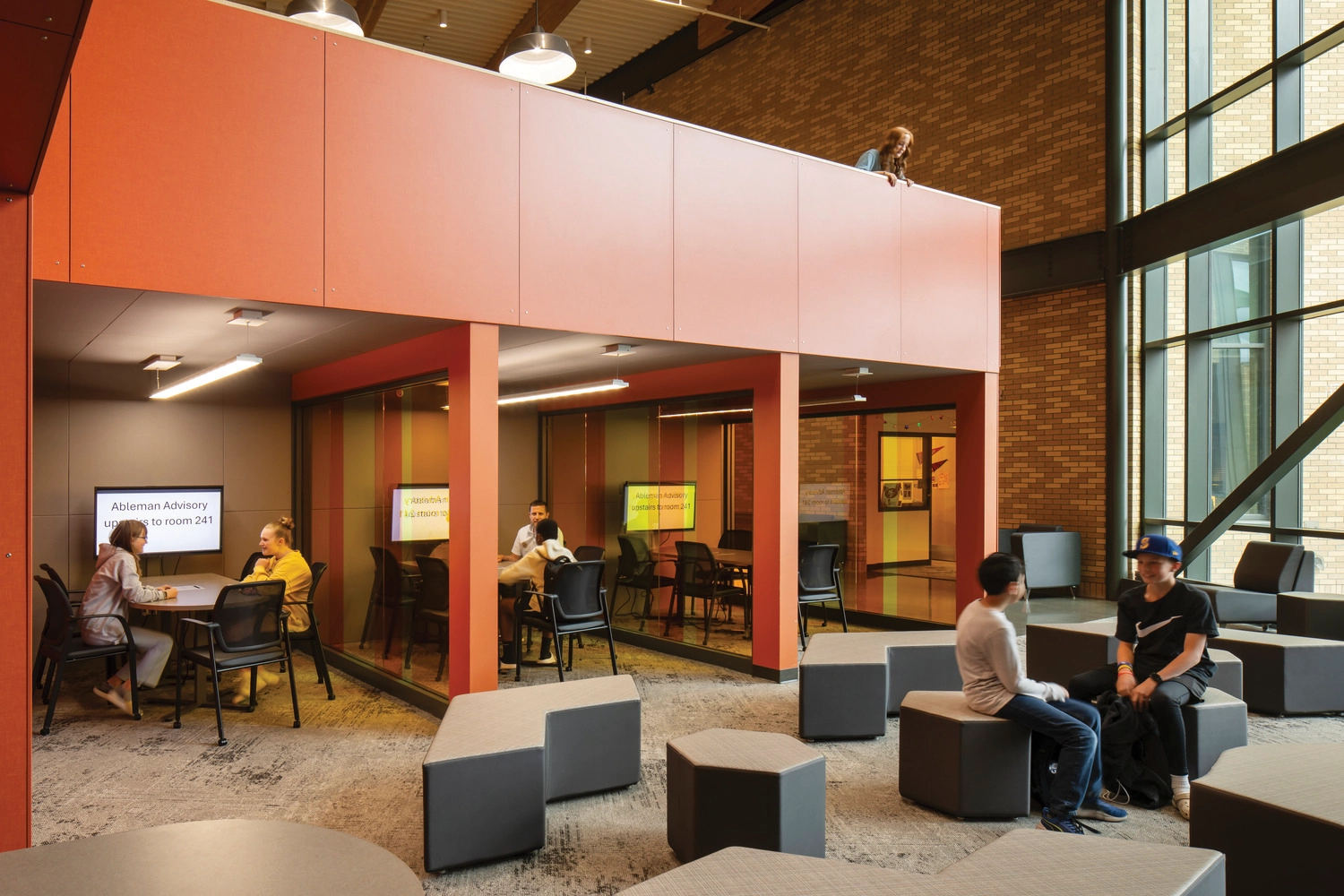
Central “cave space” meeting areas off the Commons at Peperzak Middle School in Spokane, WA support both student and staff socialization and collaboration needs. Photo: Lara Swimmer
Active, Social Learning in Community
During adolescence, students desire both autonomy and connectedness, seeking relationships and community that fosters deep connections with adults and peers—which builds their social networks, and gives opportunities to practice decision making. Unfortunately, the structure of many middle and high schools provides the opposite—emphasizing competition and social comparison through sift and sort practices, students experience a loss of autonomy and difficulty forming relationships with adults who support more and more students.
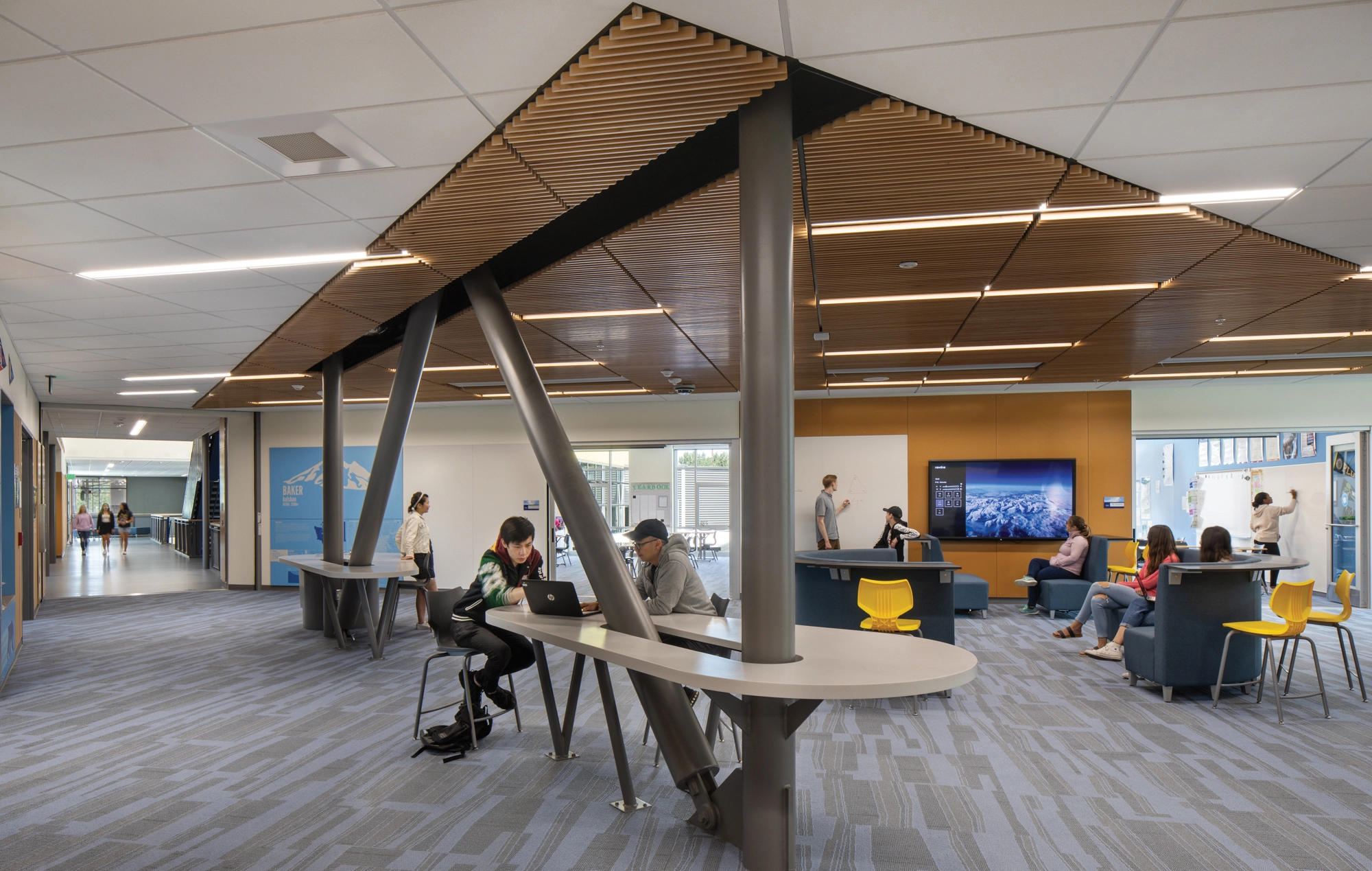
At Surprise Lake Middle School in Milton, WA, shared learning areas surrounded by classrooms serve each interdisciplinary cohort, providing a sense of community and identity while also supporting social learning and student agency. Photo: Lara Swimmer
School models that embrace social learning, with students actively collaborating and communicating in community with each other, catalyze deep learning and increase students’ positive experiences and feelings of well-being. At Surprise Lake Middle School, all students belong to one of six interdisciplinary cohorts. As shown in the photo, the school’s design supports these smaller learning communities by arranging each cohort’s classrooms around a shared learning area and connecting them with wide visual and physical connections to each other. Multiple monitors and markerboard surfaces support small group student collaboration and problem solving, while a variety of seating options give students choice and agency in finding a place where they learn best within an environment where they feel safe and known.
Learning is social. As we continue to create and evolve spaces for learning and spaces for community, we must remember that they are one and the same.
Being in Community post-pandemic
Students spent twice as much time online during the pandemic than they did before it, and a national survey of high school seniors shows time spent gathering with friends dropped from 44% in 2010 to 32% in 2022 after the pandemic. Students returned to school with greater difficulty self-regulating and interacting with each other. These impacts are still seen for high school students who were in lockdown during their middle school years, missing a critical early exposure to extracurricular activities resulting in lower club participation and with many interactions still predominantly online.
School spaces that support being in community often serve a variety of purposes throughout a building’s life. One example, as seen in the photos of Sammamish High School, is that its atrium not only serves as a connection point between three floors, bringing daylight into most circulation areas, but it also serves as that “third place” in the school thoughtfully designed to support small group collaborative work, large group gatherings and presentations, as well as club activities such as hip hop club with room to work on their routine in the space. The atrium’s central location responds to a secondary student’s intrinsic desire to be seen, while its flexible design provides opportunities for student-led learning and community gathering.
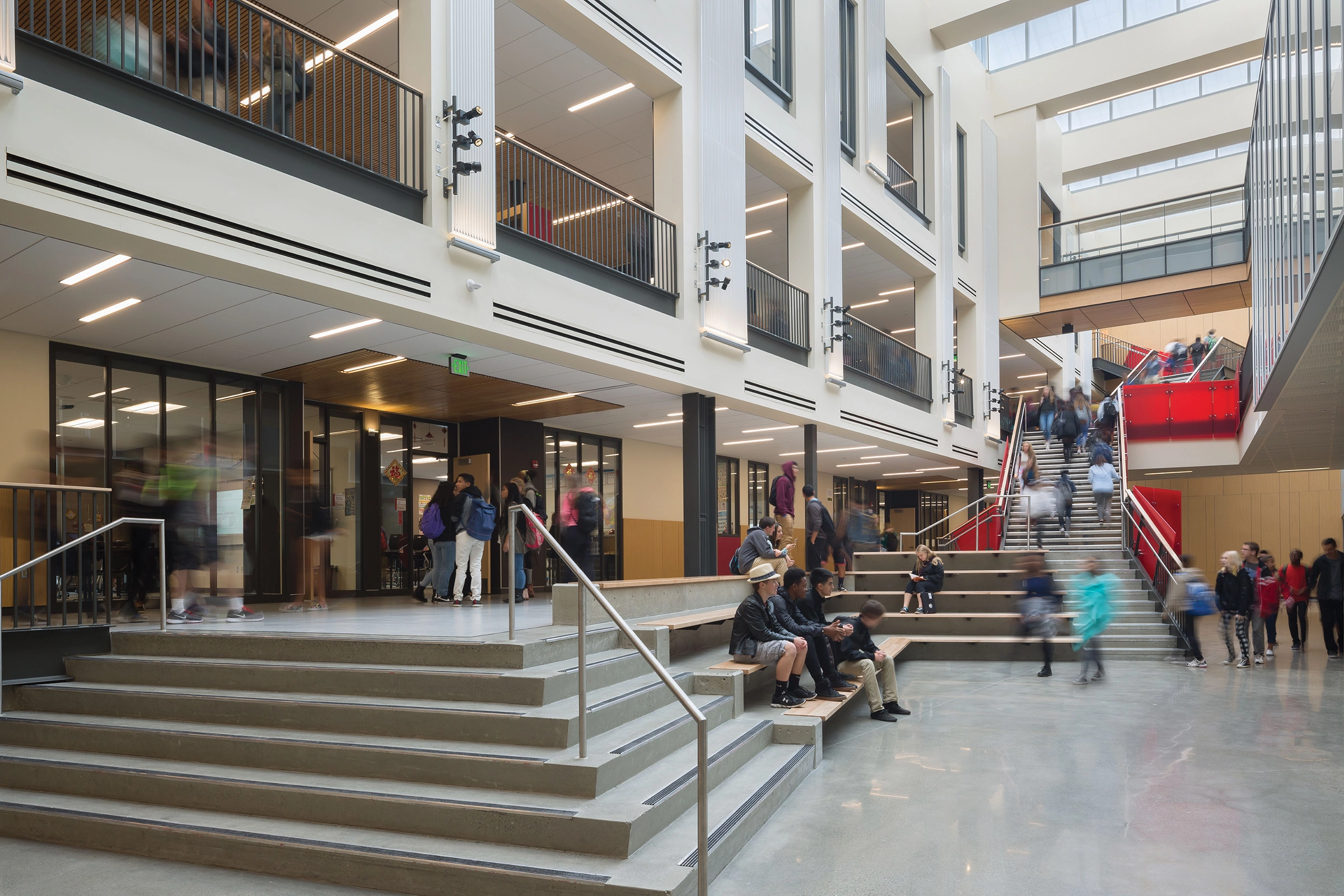
The central atrium space at Sammamish High School in Bellevue, WA supports a variety of scales and types of student socialization activities. Photo: Lara Swimmer
Better, and Smarter, Together
Learning is social. As we continue to create and evolve spaces for learning and spaces for community, we must remember that they are one and the same. Deep learning is fostered through our interaction and connection with one another, and our desire to be connected, in-person, is at the essence of our humanity. Our schools should reflect that.