



A significant portion of public school budgets are spent on technology using funds raised through local bond elections and levies. Bonds and levies are both voter-approved measures that raise local property taxes, but for different purposes. These measures are placed on the ballot by district school boards to be approved or defeated by the voting public or taxing authority. A levy is a short-term, local property tax passed by the voters of a school district, generating revenue for the district to fund specific expenses. Levies are typically approved for a period of one to six years.
A technology levy is a type of capital project levy requiring local voter approval through either a referendum or ballot measure to raise property or sales taxes.
Operating levies cover day-to-day expenses such as classroom supplies, subscriptions, services, utilities, and daily maintenance. Capital levies are voter-approved local taxes used to fund specific physical assets such as infrastructure, facility improvements, and technology. A bond is essentially a voter-approved loan to pay for large-scale, long-term capital projects such as school buildings, buses, and technology and infrastructure systems. Bonds typically have a pay off period of 15 to 30 years.
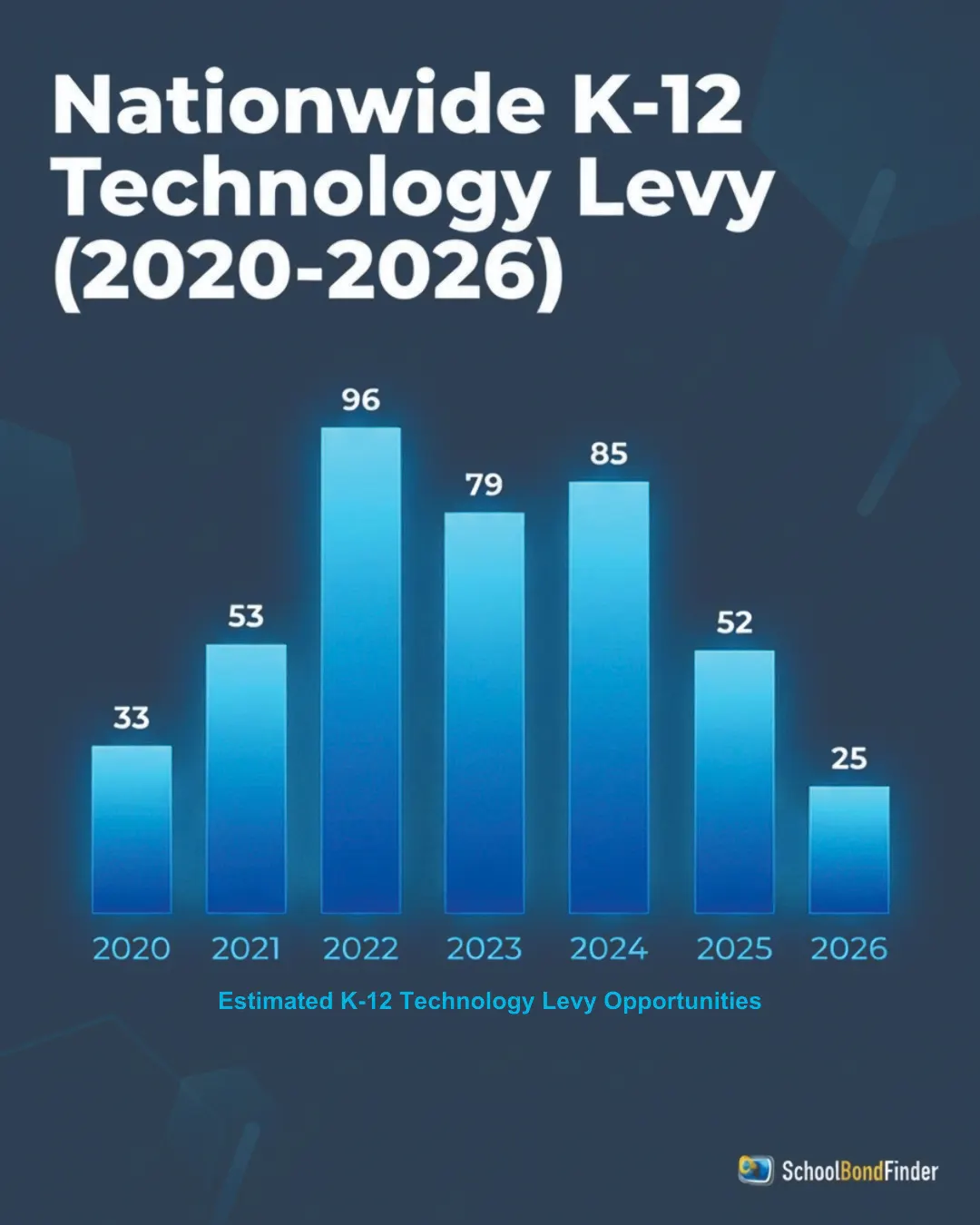
A technology levy is a type of capital project levy requiring local voter approval through either a referendum or ballot measure to raise property or sales taxes. The funds can only be used for designated expenses. They provide dedicated funding for school districts to purchase devices, upgrade network infrastructure, and maintain software licensing. The average duration of a technology levy is 4–6 years with taxes collected on an annual basis. Once it expires, the local school district must ask voters to pass a renewal or replacement levy to continue funding their request. We are starting to see a shift from traditional device purchase to more infrastructure, comprehensive cybersecurity, and integrated safety systems.
What Technology Levies Fund:
Hardware & Infrastructure:
- Device update cycles (laptops, tablets, etc.).
- Network upgrades (Wi-Fi, fiber optics, enterprise servers).
Safety & Security:
- Cybersecurity (firewalls, etc.).
- Physical security (cameras, access control, emergency communications).
Operational:
- Disaster recovery and cloud backups.
- IT support staff and digital literacy roles.
Instructional Tools:
- Software licensing and LMS subscriptions.
- Interactive displays and CTE/STEM labs.
- Adaptive technology for special education.
State Case Studies and Examples:
Minnesota, Ohio, and Washington are states that often are cited in the SchoolBondFinder database for technology levies. They are used to bridge the gap between state funding and the cost of operating schools.
In the state of Minnesota, the Hopkins Public School District passed a November 4, 2025, technology levy in the amount of $156,678,980. The levy will cover network infrastructure, cybersecurity and data protection, 24/7 monitoring, multi-factor authentication, layered security, 1:1 devices for secondary students, updated curriculum, classroom technology, musical instruments, and the purchase of school-related transportation vehicles. The 10-year Capital Project Levy renewal will collect approximately $15,667,898 per year (beginning in 2028) and it will not cost voters any additional dollars.
In the state of Washington, on February 10, 2026 the Lake Washington School District passed a 4-year technology and capital projects levy in the amount of $246,900,000. The renewal levy will collect $54.6 million in 2027; $59.4 million in 2028; $63.7 million in 2029; and $69.2 million in 2030. The funding from this levy will support comprehensive modernization across the district’s educational facilities, building on the current levy that is scheduled to expire at the end of 2026. The projects are organized into several categories of improvement:
- Facilities & Building Infrastructure: Updates to learning environments, building and sustainability improvements, ADA accessibility, HVAC, mechanical control systems, roofs, insulation, roof-top solar systems, paint, electrical, lighting, generators, plumbing, flooring, and the replacement or removal of portables.
- Core Technology & Network Foundations: Upgrades to core technology infrastructure, servers, data backup solutions, cloud storage, operating systems, and replacement of wired network switches.
- Classroom & Instructional Tools: Equipping classrooms with technology, interactive displays, document cameras, audio amplification docking stations, student/staff laptops and tablets (supporting 1:1 device initiatives), and desktop computers. It also funds special education technology/equipment, digital learning and assessment tools, and professional development training for staff.
- Business Systems & Operations Software: Support for business and technology operations software, including platforms like Skyward and ParentSquare, automated workflows and processes, nutrition/food service systems, transportation routing systems, and data management systems.
- Safety, Security & Communications: Enabling robust safety/security upgrades, security cameras, intercoms and bells, shatter-proof window film for front entry vestibules, emergency radio infrastructure, handheld radios, supply containers, locks, vehicle gates, fire alarm systems, voice systems, and security filtering.
- Athletic Facilities & Site Improvements: Enhancements to playgrounds, physical education and athletic facilities, tracks, fields, synthetic turf surfaces, tennis courts, stadium infrastructure, bleachers, storage, fencing, site signage, site drainage, erosion control, walkways, hardscape surfaces, parking lots, and optimized drop-off/pick-up traffic flow.
In the state of Ohio, Springfield-Clark County passed a permanent improvement infrastructure upgrades levy on November 5, 2024, in the amount of $98,200,000. Construction started in March 2026 on a replacement CTE Center campus, which is designed to accommodate student growth through expanded classroom spaces, new equipment, furnishings, and site enhancements. Following enrollment reviews and market adjustments, the building footprint was expanded to 227,615 square feet (requiring schematic revisions to integrate an extra 20,000 square feet), raising the total project cost from $89.5 million to $98.2 million.
The path to approval involved challenges; local voters turned down the project in November 2023 and March 2024, prompting the district to secure state approval for a final ballot appearance to safeguard expiring matching funds. Under the updated financial plan, the OFCC provides $54.3 million in co-funding, while the CTC contributes $34.4 million plus an additional $9.4 million. This is supported by a 1.4 millage permanent improvement levy, about $4,469,000 annually.
Value for Stakeholders
Technology levies are a way to modernize and secure educational facilities. They allow school districts to raise funds dedicated to devices, software, IT staff, and infrastructure. These funds are another way districts can make sure technology costs do not drain the general operating budgets needed for classroom teachers and core educational programs. For district leaders and architects, these funding mechanisms are not just administrative tools; they are strategic opportunities that determine the modernization of educational facilities.
Architects can utilize levies as a way for modern design, incorporating engineering as part of the structural design, and adding security planning. For architects and builders, these funding mechanisms serve as the “go/no-go” signal for their opportunities. Understanding these trends allows the opportunity to act as strategic partners. By understanding a district’s funding challenges, architects can provide insight. Firms that can advise a district on how to structure a bond or levy package to ensure voter approval (e.g., combining safety and technology upgrades) are more likely to build a successful relationship with the district. It is still uncertain if using technology levies to support cybersecurity, critical infrastructure, and modern learning environments will continue to be utilized more in the future. LBD