


Importance of the Campus Visit
Visiting campuses is a quintessential part of the college search process for many students. Despite the influx of technology and the ability to learn about institutions instantly via computers and smarphones, the campus visit continues to play a significant role in students’ enrollment decision. This may be because an in-person visit evokes the emotional and psychological component of the decision-making process.4 At public, 4-year campuses, students who visit campus are 64% more likely to apply and 50% more likely to enroll when compared to the overall population.5Campus appearance plays a role in the overall experience. This includes landscaping, buildings, and interior and exterior facility upkeep, as well as what features these areas include.While these statistics are impactful, simply getting students to campus is not enough. Campus appearance plays a role in the overall experience. This includes landscaping, buildings, and interior and exterior facility upkeep, as well as what features these areas include. Research indicates that facilities impact student enrollment decisions.6-8 More specifically, campus appearance could be used as a perception of the quality of the institution.9
Environmental/Systems Framework
Using an environmental lens can provide additional insight on how enrollment management, facilities management, and other departments can work together to craft a strong visit experience. According to Gonzalez, Kahai and Hall,10 the environmental perspective views organizations as they are situated within larger networks of entities and stakeholders. In turn, an environmental framework provides insight into the complex external economic, social, and cultural conditions and their impact on an organization. During visits, campus is the center of guests’ attention and, while every campus is individual, Hendrickson11 explain that no organization is self-sufficient. Institutional survival depends on the types of relations they establish within larger systems. Campuses need to acknowledge their participation in the larger system of higher education and the student college search process. Consequently, it is important to understand the external environment in which each campus resides. Gonzalez shares that internal work is influenced by external forces, and organizations are part of a wider environment that influences them. Students often visit multiple campuses and will compare their experiences and what they see at each location. Universities need to be informed, understand what other institutions are doing, and have knowledge of other campus environments to best compete and prepare their own campus. Enrollment management and facilities management engaging in shared governance will advance working relationships toward the common goal of a positive campus visit. For example, developing a campus master plan with the visit experience in mind allows for special and unique features to be incorporated for the purpose of welcoming prospective students. Research indicates a positive association between the built environment and students’ campus tours, with institutional characteristics and facilities having a direct correlation with a student’s decision.12Recommendations
Given the importance of the campus visit and the recognition of the environmental framework, it is obvious that enrollment management and facilities management should work together within both internal and external systems. There are many ways this can occur. However, the initial recommendation is to establish a committee consisting of people from these and other departments that are key stakeholders in the planning and execution of a successful visit experience. When creating the committee, it would be natural to turn to departmental leadership. However, while leadership may know what needs to be done, they are unlikely to be familiar with the limitations encountered on a day-to-day basis. It is important for this group to consist of the people most acquainted with the work—those on the front line. This is a recommendation provided by Kotter,13 who focuses on how to effectively lead change within an organization. Kotter recommends having leadership provide the “charge” for the group and then empowering them to develop the processes. An adaptation of Kotter’s model is provided in the Figure. The model includes many areas around campus that support the visit experience, with enrollment management and facilities management as primary players. While facilities management and enrollment management have larger representation, this recognizes these areas carry the most responsibility in how prospective students experience campus during their visit. Additionally, this approach identifies the various entities that make up the “system” that is the campus visit and it encourages collaboration to help own the process. Effectively, those on the committee become champions for the visit experience.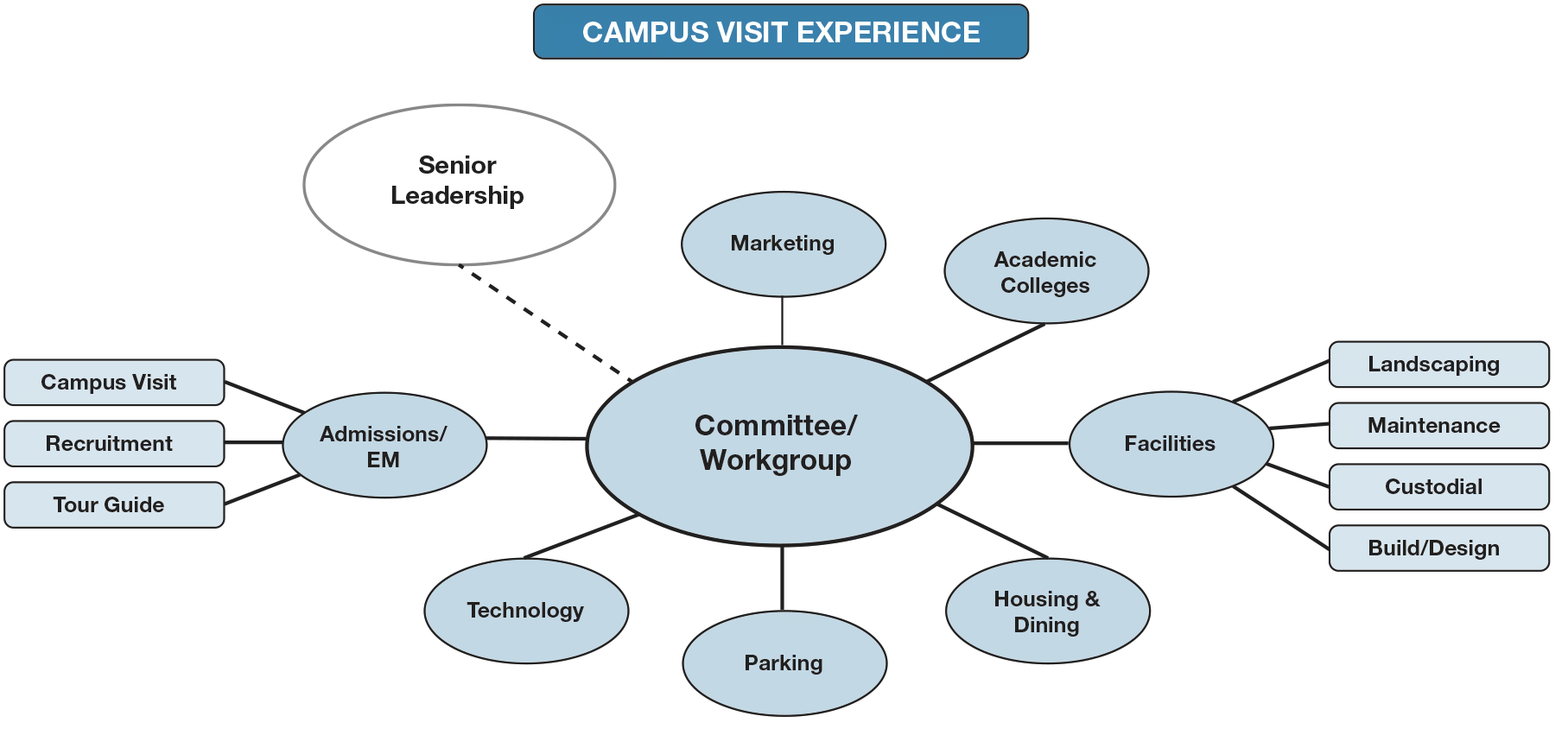
Work-Group Tasks. Once established, the first group initiative is to evaluate the current tour via both quantitative and qualitative approaches. Determine application, admission, and enrollment rates of prospective students who take a campus tour and consider any survey data. Then, compare these outcomes to national benchmarks and best practices. This establishes common understanding among committee members and a baseline for future assessment.
An informal qualitative analysis from the represented departmentis also recommended. This helps identify what is working well and where pain points occur with the current visit experience.
Tour Route. Given the importance of facilities in students’ college decision, it is important to have visitors navigate the best possible path as they experience campus. Starting from which entrance they use to enter campus, consider all items on the tour route and make sure they are well maintained, are welcoming, and provide the best backdrop possible. This includes guest parking, presentation spaces, and tour path and stops. Routes should avoid eyesores and include buildings that best provide talking points that support the university mission, highlight unique or desirable features, and consider guest needs (e.g., mobility, sense of belonging, etc.). Once the route is identified, walk it daily using a critical lens. This is a key role for facilities management, who are best positioned to immediately respond to maintenance, cleanliness, and landscaping needs.
Identify Areas of Strength and Improvement Of course, part of developing the route includes highlighting areas that are campus strengths and avoiding areas that need improvement. However, there may be areas that need to or should be included that are less than ideal. Acknowledge and note these items, as they likely will become the project list for maintenance, renovations, and other improvements. The committee can help prioritize these items and, if needed, adjust the tour route while projects are completed.
Design with the Campus Tour in Mind. While buildings and spaces are built for current students and other campus community members, prospective students can also be considered in the build and renovation processes. The committee can help identify features that can enhance the visit experience. For example, RNL + Render, a campus visit consulting firm, encourages the use of “wallestate” (Kallay & Joyce, 2020). In short, wallestate is the use of indoor and outdoor displays that help tell the institutional story. Beyond, consider how to design spaces to promote campus activity and sense of belonging. This allows prospective students to get a sense of campus life.
Measure and Evaluate. While it is important for the campus visit workgroup to start with evaluating campus tour effectiveness, evaluation is an iterative process. The committee can develop a post-visit survey to capture the overall guest experience and ensure it supports the institutional mission and brand. Other forms of evaluation are more qualitative. Committee members can tour other campuses to recognize the larger environment and how it may impact their own campus visit outcomes. Qualitative evaluation can also come via focus groups to gain understanding of how the visit resonates with prospective students and generate ideas to create a competitive advantage. This is especially helpful as campus, students, and the outside environment continue to evolve.
Conclusion
Constructing and executing a strong campus visit is complex. However, given the importance to both students and institutions, it is a necessary one. Recognizing that enrollment management and facilities management are primary stakeholders while including other key departments will ensure that prospective students have a positive visit experience. This practice brief outlines how typically unrelated departments can work together to achieve this goal. Only through collaborative efforts will campuses craft a strong and impactful visit experience, which is imperative if an institution wants to mitigate the risk of decreased enrollment and/or grow their market share amongst competitors.
References
- Delaney JA, Doyle WR. (2018). Patterns and volatility in state funding for higher education, 1951 – 2006. Teachers College Record, 120, 1-42.
- Klein MW. (2015). Settling a U.S. Senatorial debate: Understanding declines in state higher education funding. Journal of Education Finance, 41(1), 1-29.
- Boris, R. (2013). Positive collaboration: Beyond labor conflict and labor peace. Journal of Collective Bargaining in the Academy, 15(1), 1–8.
- Secore S. 2018). The significance of campus visitations to college choice and strategic enrollment management. Strategic Enrollment Management Quarterly, 5(4), 150-158.
- Ruffalo Noel Levitz. (2019). 2019 recruitment and yield rate benchmarks for four-year institutions. https://learn.ruffalonl.com/rs/395-EOG-
- Andrew DPS, Martinez[JM, Flavell, S. (2016). Examining college choice among NCAA student-athletes: An exploration of gender differences. Journal of Contemporary Athletics, 10(3), 201-214.
- Czekanski, WA, Branhill, CR. (2015). Recruiting the student-athlete: An examination of the college decision process. Journal for the Study of Sports and Athletes in Education, 9(3), 133-144.
- Pauline J. (2010). Factors influencing college selection by NCAA Division I, II, and III lacrosse players. Journal of Research, 5(2), 62-69.
- Eckert E. (2012). Assessment and the outdoor campus environment: Using a survey to measure student satisfaction with the outdoor physical campus. Planning for Higher Education, 41(1), 141-158.
- Gonzalez LD, Kanhai, D, Hall K. (2018). Reimagining organizational theory for the critical study of higher education. In M. B. Paulsen (Ed.), Higher Education: Handbook of Theory and Research (pp. 505-558). Springer Nature. https://doi.org/10.17/978-3-319-72490-4_11
- Hendrickson RM, Lane JE, Harris, JT, Dorman RH. (2013). Academic leadership and governance of higher education. Stylus Publishing.
- Reynolds GL. (2007). The impact of facilities on recruitment and retention of students. Wiley InterScience, 2007(135), 63-80.
- Kotter JP. (2014). Accelerate: Building strategic agility for a faster-moving world. Harvard Business Review Press.