

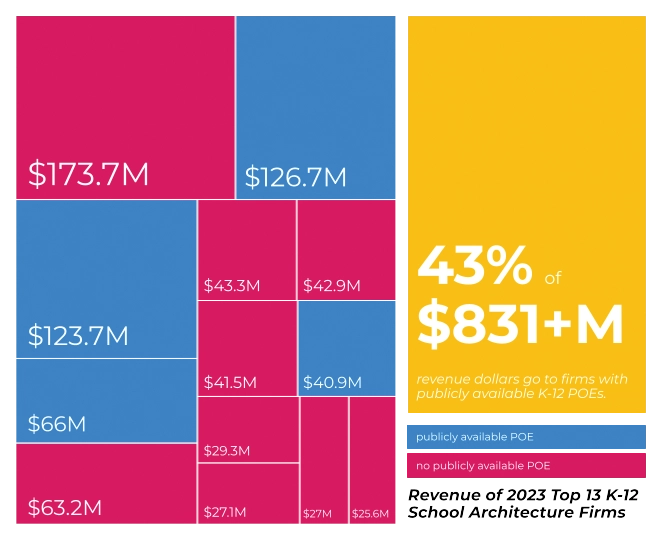
Every dollar invested in modernized schools is an opportunity to have a positive impact on students and teachers. How often do we in the education design industry actually measure that impact and trace it back to specific design strategies to maximize our understanding for continuous improvement? Despite widespread acknowledgement that more research is needed on the impact of various design strategies, there is currently no industry consensus on what post-occupancy evaluation (POE) tools project teams should use to evaluate the effectiveness of K–12 learning spaces. As part of a collaborative industry-led effort to standardize evaluation practices in K–12 design research, researchers from the Coalition for the Advanced Understanding of School Environments (CAUSE) conducted a review of K–12 POE practices among the firms doing the largest shares of K–12 work in 2023.
2023 CAUSE K–12 Industry Review
There are a variety of barriers to conducting project POEs, which include access to firm expertise in research and the project fee to fund the effort. For many smaller firms where designers and architects function in many organizational roles simultaneously, these barriers are very difficult to overcome. However, it is becoming more commonplace for larger firms to have dedicated Research teams. Similarly, the scale at which they work can allow them to have access to projects with fees to support POEs—not every project can include it, but the size of their portfolio makes it more viable to identify some projects. Very big firms also may be able to absorb research costs within their general overhead budgets. For these reasons, we chose to investigate the K–12 POE practices of the largest firms who have the best chance to engage in POEs.
We started with Building Design + Construction’s list of Top 170 K–12 School Architecture Firms for 2023. That list is created from the BD+C Giants 400 AEC rankings, a project in its 48th year that compiles data from participating firms that is compiled, vetted for accuracy, and reported publicly as a state-of-the-industry overview. A CAUSE researcher identified the 13 firms in 2023 who reported $25 million in K–12 school revenue to review. We then searched each firm’s web presence, including their full website and supplemental web searches for material hosted elsewhere, to describe and classify what K–12 POE materials they provided for public access. After the initial review, we sent each firm communication with the preliminary findings and an opportunity to suggest corrections. Some firms chose to respond and offer more information, and some did not. Our team then compiled and finalized the industry review results.
We Need More K–12 POEs
Only 4 of the top 13 firms had publicly available K–12 POEs of any kind in the review window. That translates to 43% of the over $831 million in total revenue of the top 13 firms combined going to firms with publicly available—POEs. Some firms simply do not appear to conduct POEs, others conduct them only in other markets, and still more keep them locked behind confidentiality barriers or focus on other kinds of design research.
The reasons are quite varied, but the end result is the same: the benefit from the largest fraction of K–12 projects to teachers and students stays largely unavailable to the public.
These findings underscore the need for standardized, open-source POE tools specific to K–12 facilities that can capture educational outcomes and environmental exposures. Initiatives like CAUSE strive to increase all these numbers, because the design industry has a responsibility to be more accountable for the impact of school projects on the community.