


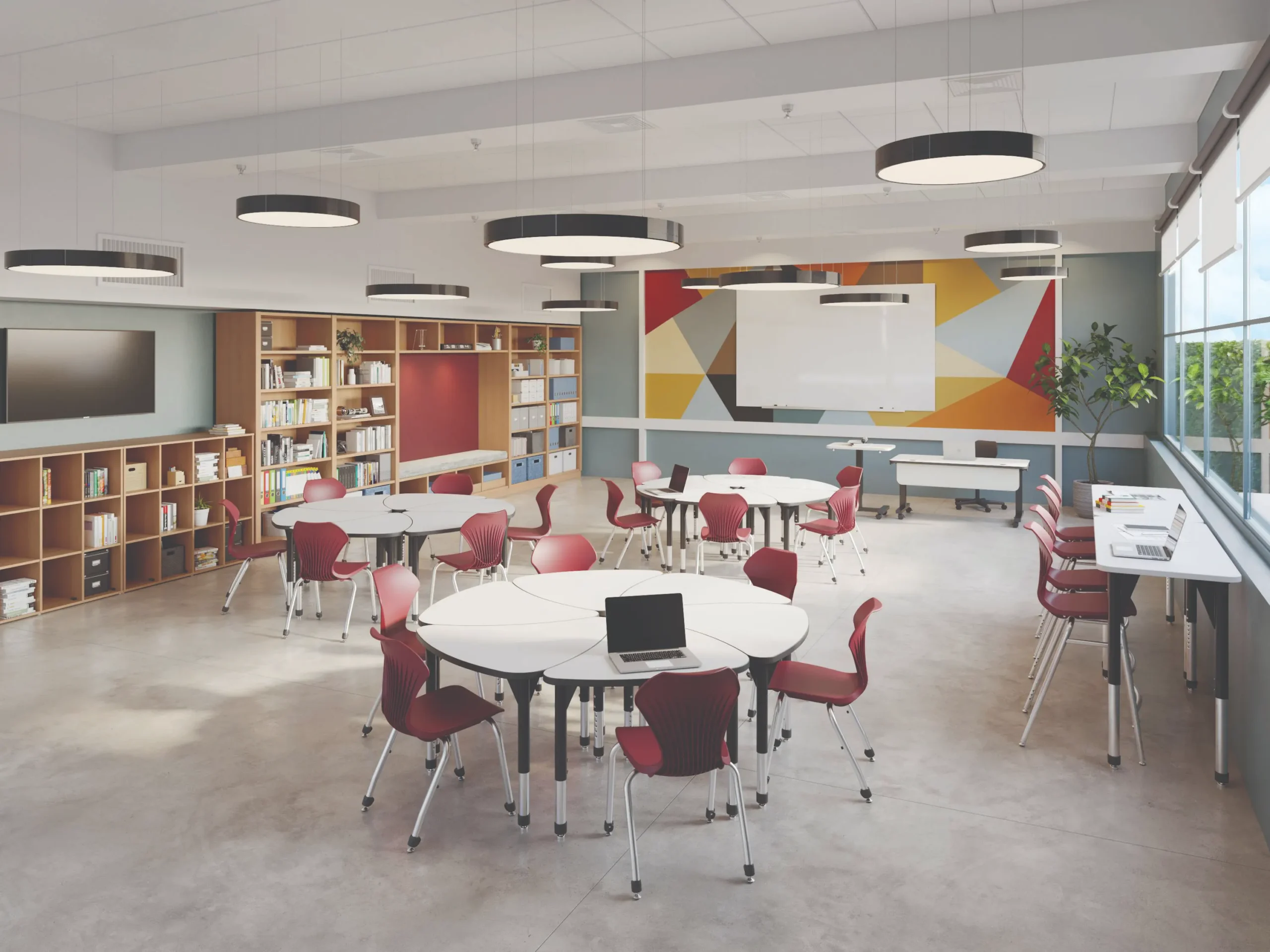
Start with Purpose, Not Products
Educational furniture conversations have traditionally started with products: desks, chairs, finishes, budgets and specifications. Richard Davidson, CEO of educational furnishings manufacturer Marco, believes they should start somewhere else. Before asking what belongs in a classroom, schools, designers and manufacturers should first ask what learners and educators need to experience and accomplish there.
That distinction is more than a matter of process. It changes the role of the physical environment from a backdrop for instruction to an active participant in learning. The space begins influencing behavior, expectations and interaction before instruction even starts. In that sense, the environment itself can become a silent teacher.
For Davidson, the importance of listening goes back to one of Marco’s earliest education projects. When the company built new band room cabinets for his former local high school, the solution began not with a catalog, but with a conversation with the band director about what the space and its users actually required.
“No matter what we manufacture, understanding how, where, and what the learner or educator is doing when they are using that piece of furniture is the most important factor in making successful recommendations on the size, shape, and functionality of it,” Davidson says. Marco’s objective is to evolve from simply being a source for school furnishings into an insight-led resource for informed purchasing and product innovation.
From Shape to the Full Learning Experience
As Marco began exploring the impact of shape in learning environments, Davidson wanted to validate the company’s emerging point of view beyond a manufacturer’s perspective. He sought a partner who could connect expertise in education and neuroscience with expertise in design. That search led Marco to Dr. Lennie Scott-Webber, Ph.D., whose decades of academic research and real-world consulting focus on the relationship between the built environment, human behavior and learning. Her research-grounded perspective both validated the direction and challenged Marco to deepen the exploration with its team and the broader education and design community.
Together, Marco and Dr. Lennie are translating research into practical questions that educators, designers and decision-makers can use before products are selected. “Design matters. Understanding the functional workflows intended to take place within any space is critical to filling the space with furnishings that help meet those objectives,” Dr. Lennie says. “Together with Marco, we are developing tools and curating research on design for educational spaces meant to help decision-makers ask and answer the right questions before buying new school furnishings.”
The catalyst for much of this discovery was Shaping Spaces, Shaping Minds: The Psychology of Shape in Learning Spaces, a Continuing Education Unit written by Marco CMO and Head of Marketing Libby Ferin. What began as Ferin’s examination of curves, angles and human response quickly opened a much broader conversation about how every part of an environment can support—or inhibit—what learners need to do.
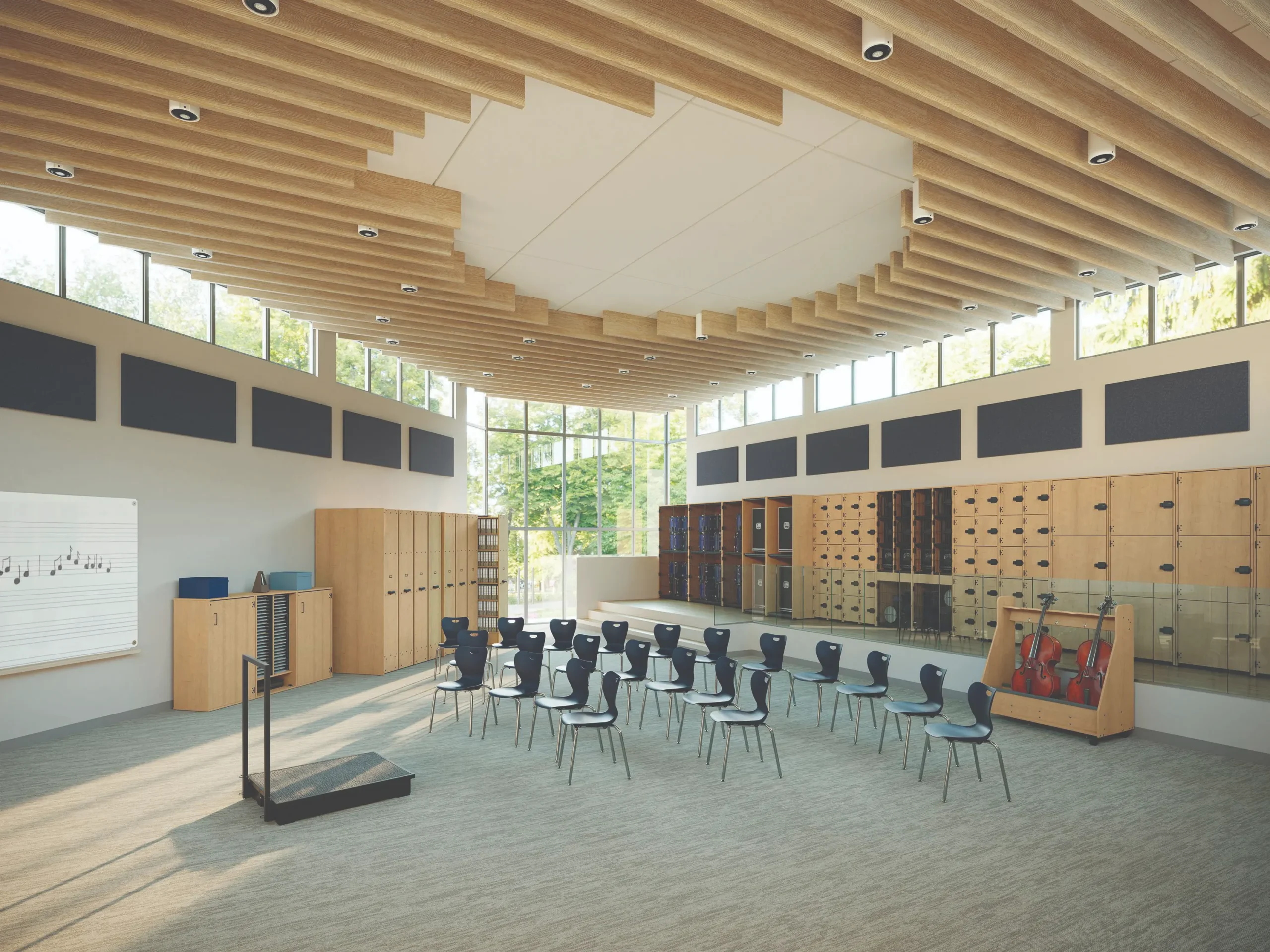
Shape remains one part of that story. Curved forms can communicate comfort and approachability, while angles may introduce energy, direction or focus. But no single shape or piece of furniture creates a successful classroom. Learning environments work as complete ecosystems in which space, experience and performance must be considered together.
Research reinforces the importance of that broader view. A widely cited University of Salford study1 found that classroom design could account for up to 16 percent of variation in students’ learning progress. Universal Design for Learning (UDL), an educational framework that guides the design of flexible learning environments likewise emphasizes learner choice and agency, while evidence-based research on movement and varied posture connects the physical environment to attention and engagement. The practical question is not simply whether a classroom looks different, but whether it gives learners meaningful ways to focus, move, collaborate and participate.
“Learning-centered design seeks to understand what is happening in the classroom from the student’s perspective,” Dr. Lennie explains. “Children need to be able to move around during the day, so the furnishings need to be flexible. This helps them establish agency by bringing novelty to the room, which builds a sense of pride. It is important to establish the natural circuit and rhythm of learning particular to each subject and class over time.”
Designing for Choice, Movement and Change
That rhythm can change repeatedly throughout a single day. Learners may need a place for individual focus, a setting for working with a partner, room for group collaboration or an opportunity to change posture and movement. Rather than choosing one supposedly ideal classroom configuration, learning-centered design provides a palette of place and posture that can respond to what learners need to do next.
Educators must also be part of that conversation. “A teacher, especially in elementary school, may be in the same classroom for 10 years or more. So, they deserve a voice in furniture selection as well as a better understanding of how to use furnishings as learning tools,” Dr. Lennie says. Her role in the partnership is to curate peer-reviewed research and translate it into language that educators, designers and buyers can readily apply.
Marco is extending that thinking through its Learning Lab, Perspectives white papers and CEUs2. These resources are not intended to prescribe one universal answer. They are designed to help people ask more informed questions: What is the learning intent? Who will use the space? What behaviors should it support? Where are choice, movement, focus and connection needed? How must the environment flex over time?
For Davidson, the answers should influence both recommendations and manufacturing. “What we’re trying to do is bring design, education, and manufacturing together into a conversation aimed at making the functionally best classroom furniture we can,” he says.
Marco’s ability to adjust dimensions, forms, functions and finishes becomes most valuable when those capabilities are connected to a clearly understood educational purpose.
This approach also asks manufacturers to accept broader responsibility. Their role is not simply to fill an order or place individual products into a room. It is to listen, understand and help connect the physical environment to the experiences and outcomes a school is trying to create.
“Marco wants to facilitate intentional, design-driven furniture selection to improve learning outcomes, not just fill orders,” Davidson says. The furniture remains important, but it is the response—not the starting point. The best learning environments begin with better questions.
References:
- Barrett, P., Davies, F., Zhang, Y., & Barrett, L. (2015). The impact of classroom design on pupils’ learning: Final results of a holistic, multi-level analysis. Building and Environment, 89, 118–133. https DOI: 10.1016/j.buildenv.2015.02.013.
- Marco Group, Inc. Learning Lab: Perspectives white papers and continuing education resources (CEUs). Marco Group, Inc. https:// madebymarco.net/learning-lab/