Though making a comeback isn’t always easy, few things feel better than proving doubters wrong. Some call it grit, others call it grind, but no matter how you put it, the ability to bounce back from hardship isn’t a trend; resilience is fundamental to survival. In education, where resources are often inadequate, funding is constricted, and time marches on, resilience means making decisions that impact generations of learners for decades to come. For Troy Hill, AIA, ALEP, an architect specializing in K-12 practicing at Blackney Hayes Architects in Philadelphia, the chance to brighten lives through excellence in educational design makes the struggle worthwhile

“Coming from a background in historic preservation and adaptive reuse, I had a chance to work on the gut renovation of a K-12 charter school in 2005,” begins Hill, a Principal at Blackney Hayes who has been practicing for 29 years. “When the school opened, the students were so happy and proud. I fell in love with their reaction. I’ve been exclusive to K-12 ever since.”
One of Hill’s latest proud moments is Thomas M. Peirce Elementary in North Philadelphia, a school that embodies the best of 21st-century education: open, intuitive, collaborative, and exploratory.
“Thomas M. Peirce Elementary was the first new elementary school built in North Philly by the Philadelphia School District in the last 70 years,” continues Hill. In 2020, the District shut down the old T.M. Peirce after inspectors from the Philadelphia Federation of Teachers identified asbestos in the 110-year-old building. “The District decided to replace the school with a new 77,000 square foot, LEED Gold PreK-5 elementary school. We won this commission right before COVID hit. So, our team had to design the entire project with no-contact restrictions between stakeholders. Blackney Hayes takes pride in treating every client as the only client. Doing that via Zoom for the first time was a challenging, eyeopening experience.”
Hill and his team had to coordinate everything from placing the building on the site, making room for a small playground, and sorting through building materials with District officials, school leadership, teachers, and the community by screen. With the old school scheduled to be razed, the site was a blank slate. The design brief called for a fully modern school predicated on scaled spaces and collaboration.
“Though the District was interested in modernizing, they hadn’t built a new school in so long, they were used to the cells and bells model,” says Hill. “We intended to create bright collaboration areas filled with natural light and vibrant, durable materials.”
While many decisions on products or building materials for a LEED Gold building require calculated scrutiny, the flooring choice was simple.
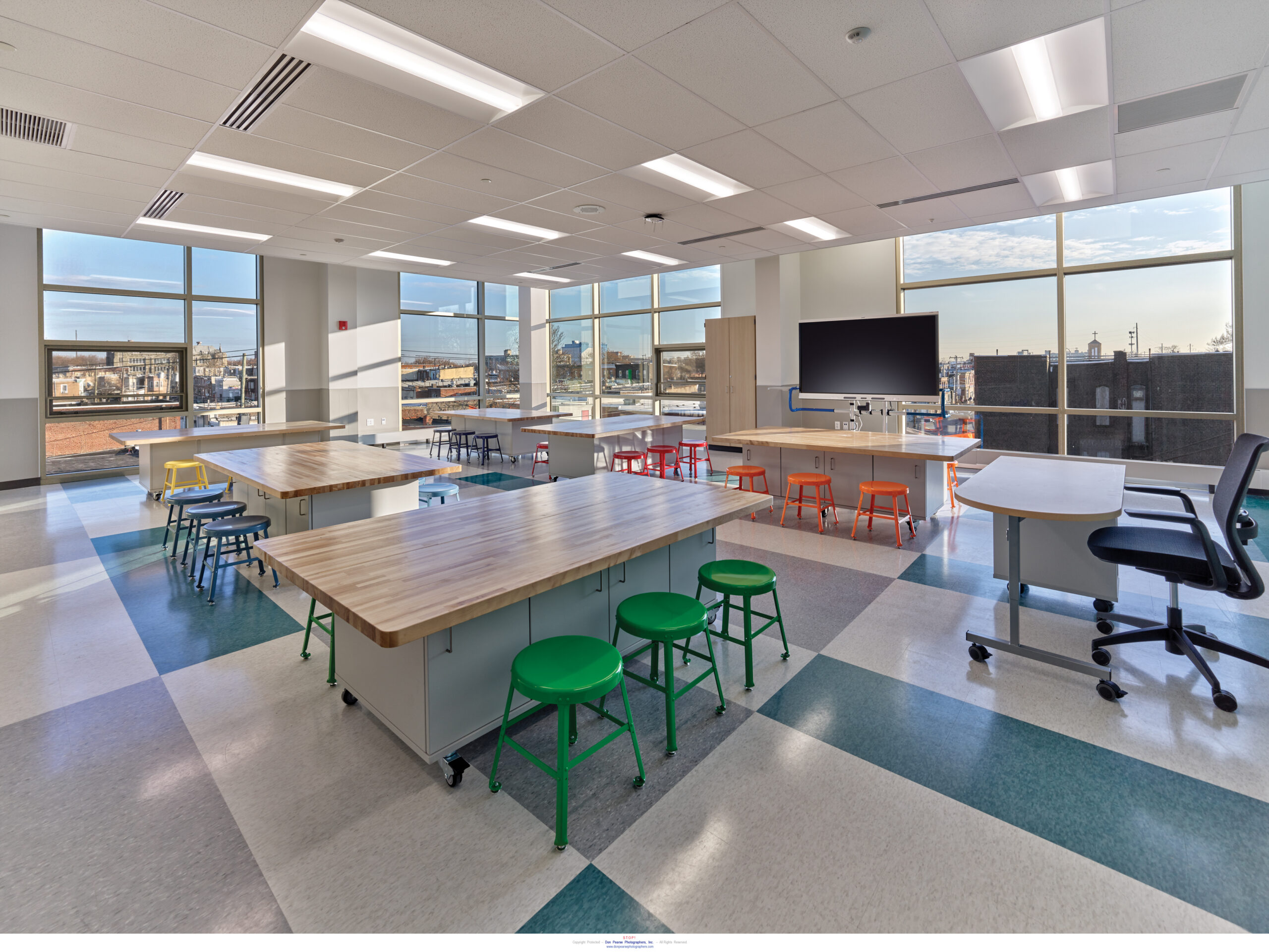
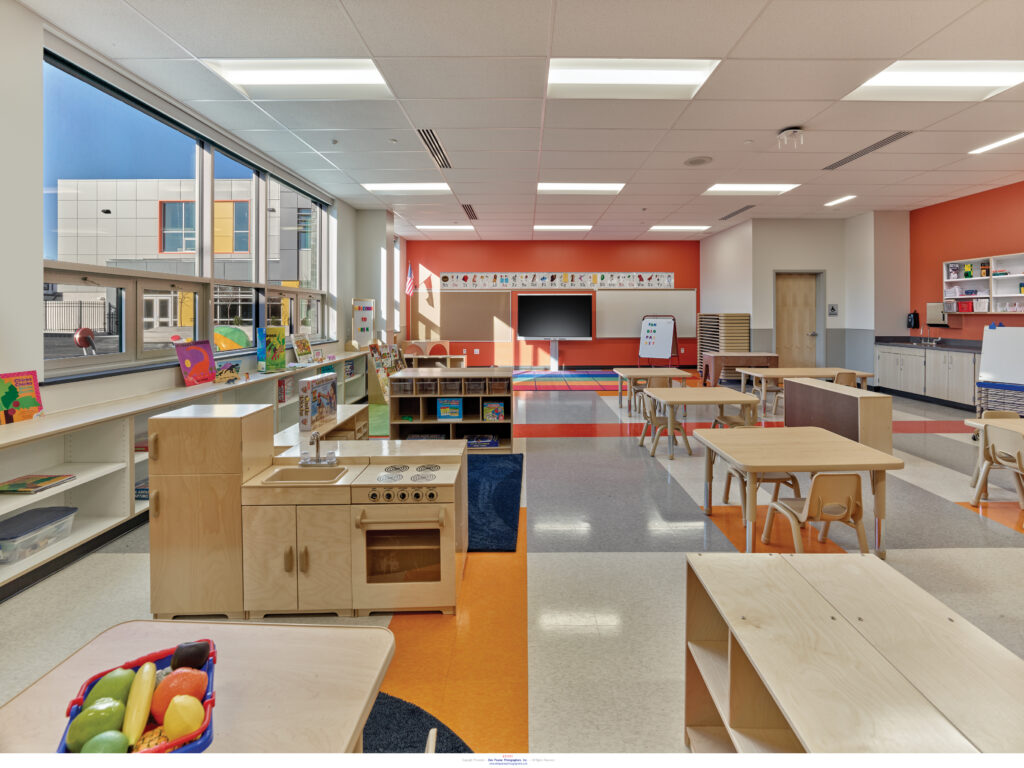
“We used Vinyl Composition Tile or VCT to create bright, colorful floors that enliven the space and serve as a wayfinding mechanism for the young learners,” shares Hill. “There are three different floor colors – blue, green, and orange – discerning different levels of learning. VCT is economical and durable. With the amazing array of colors and patterns from Armstrong Flooring, we created floors that will look great forever.”
Fred Reitz, Senior Vice President of Commercial for AHF Products, the parent company of Armstrong Flooring®, is passionate about VCT. He was born into it.
“I’m a third-generation floorer,” shares Reitz. “My father and grandfather both worked with VCT. I spent my teenage summers working in the warehouse, pulling VCT orders for projects like T.M. Peirce.”
Today, as part of AHF’s founding leadership, Reitz is putting his lifetime of flooring knowledge to good use.
“I like building relationships and supporting problem-solving where I can bring value to the equation,” says Reitz. “Probably one of the most durable commercial building materials ever, VCT is mainly composed of limestone, an abundant natural resource. Due to its true-through color, with a little maintenance, a VCT floor can last the building’s lifetime, without renovations or adding waste to landfills.”
Though VCT has been the flooring of choice in educational spaces, hospitals, recreation centers, and other high-traffic environments since the late 1940s, demand declined in the 21st century. Reitz explains.
“School districts were sold on the idea of maintenance-free floors and the ability to customize surfaces by using Luxury Vinyl Tile (LVT) instead,” he says. However, school desks and chairs can scratch and damage LVT floors, which have a 10-year limited warranty. So, the school must either add a topcoat or replace the floor all together. As such, VCT is now experiencing a resurgence in high traffic situations where other options were used. It’s a boomerang effect.”
“When LVT is used in high-traffic school corridors, the topcoat wears out in a few years. Consequently, VCT is now experiencing a resurgence, in high traffic situations where LVT was used. It’s a boomerang effect.”
VCT from AHF Products (sold under brands like Armstrong Flooring and AHF Contract®), is domestically made — the only VCT still made in the USA today. AHF Products can scale production up significantly as the VCT market rebounds. AHF provides Environmental Product Declarations (EPD) on all products to ensure buyers and specifiers know what’s in it, where it comes from, how it performs, and how it’s disposed of.
“Product declarations are important, especially on a LEED Gold building,” says Hill. “VCT is easy to clean. A child can’t peel it up and a chair can’t dent it. Mixing in a friction material adds extra grip for a gym floor or cafeteria. The kitchen is probably the only place in a school where VCT isn’t ideal. Blackney Hayes is passionate about enduring educational architecture. We specify VCT because it will look as good in 20 or 30 years as the day the school opened.”