


Belonging is the feeling of being welcome, respected, included, and valued regardless of who you are. It is not just a buzzword. Studies have shown time and again that students who develop a sense of belonging in higher education are more likely to persist to graduation, engage actively with their studies, and experience a better sense of well-being. However, belonging does not simply impact a person’s behavioral, affective, and social success while in school. It carries over into their post-graduation life as well.
Traditionally, belonging has been studied across two domains: academic and social integration. These refer, respectively, to a student’s feeling of membership in their discipline and development of friendship networks. A recent study of social belonging in higher education has identified two additional domains: personal space and surroundings.2 “Personal space” includes students’ personal interests, life satisfaction, and identity, while “surroundings” includes students’ living spaces and the geographical and cultural locations around the institution. Surroundings is particularly important here. When students feel comfortable and welcome in physical campus spaces, they extend the meaning of the university beyond a place of teaching and learning and consider it a home—a phenomenon known as “Place Attachment”. This can influence a student’s decision on which institution to attend and, in the long term, to stay. As such, the institution can play a significant part in fostering belonging (and student success through the design of campus spaces.
Principles of Neuroarchitecture
In observing campuses across North America that are being redesigned not only to look more modern but to facilitate social interactions within an academic context, we have noted that principles of neuroarchitecture are being incorporated in these spaces. Neuroarchitecture is a discipline which examines the relationship between the built environment and human responses to it. Such design choices are significant on their own; research supports the importance of, e.g., natural lighting for productivity, shapes with soft edges for promoting a state of psychological security and calmness, and so forth. When architects take the time to purposefully include these elements, as well as make EDIA-informed choices to produce a sense of welcome and inclusivity, the feelings of safety and comfort that this creates means that a place where students learn, live, and socialize can transcend inclusivity and come to be regarded as a second home. Which is to say, these sorts of design choices promote Place Attachment.
Campus spaces intended for broad academic-social interactions which feature this constellation of EDIA-informed and neuroarchitecture design choices have only appeared relatively recently. We have termed these spaces “Innovative Learning Spaces”. An Innovative Learning Space is a study and lounge area that is open to the institution at large, regardless of discipline, level of study, or role at the institution. The design of these spaces is informed by insights from neuroarchitecture research, such as biophilic design, and pedagogical theories related to holistic engagement, such as embodied learning. They are often situated in a neutral or shared location on campus, such as a library. Innovative Learning Spaces consist of group study areas and independent study spaces with varying degrees of privacy, all with moveable furniture and an assortment of orientations to accommodate diverse physical abilities and neurodiversities. Study areas may also be outfitted with educational technology, such as smartboards and plug-and-play stations, and there may be rooms for hosting bimodal events.
What should be immediately apparent in this description is the variety in the representation of identities in these spaces. To be sure, elements such as natural light, soft tones, natural shapes, and other biophilic features make the space more inviting and positively influence cognition for users in general. Other elements, however, can be essential for students who prioritize customizability of experiences and configuration of the space. For instance, moveable furniture like adjustable desks and seating can increase comfort levels for those with different sensory profiles or physical abilities.2 Quiet zones and sound-absorbing panels can be crucial for neurodiverse types that are hypersensitive to noise.3 And something as basic as large tables in open areas where students can work independently and at their own pace but still feel connected to their peers has recently been shown to benefit students with dyslexia.4
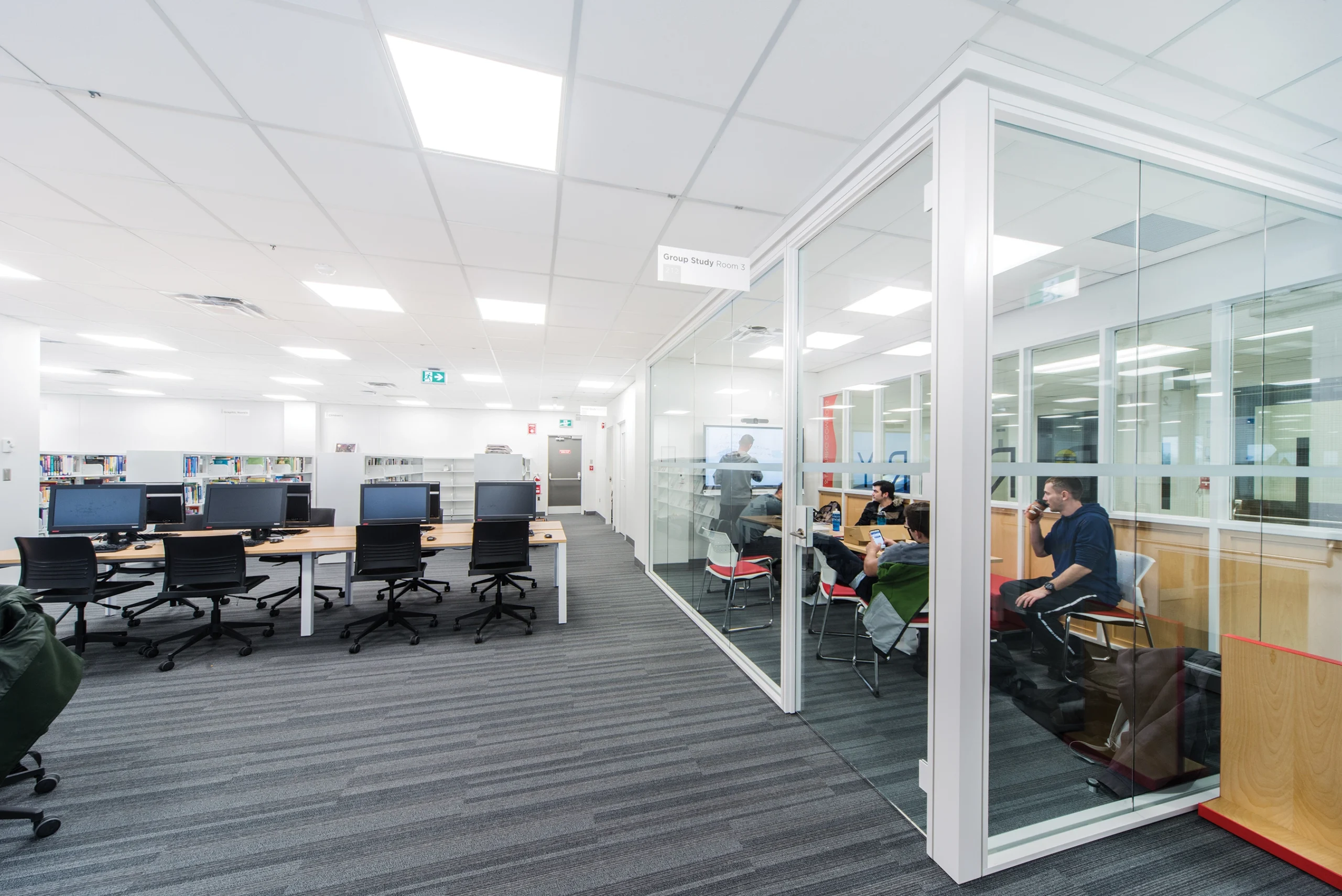
Photos: Courtesy of St. Lawrence College
Such design considerations are effective for fostering belonging, precisely because they function as identity markers. For students to feel welcome, they need not only to see part of themselves in the space but also to feel as though they can make it their own. Spaces which are flexible and can be personalized provide a sense of ownership and control, much as the student might associate with a personal space like home. What impacts Place Attachment here is not so much trying to incentivize the broadest range of students to spend time in campus spaces. Rather, it is conveying to each user that the space has been created with them in mind, as opposed to proffering an environment they must adapt to. (Somewhat ironically, designing spaces with accessibility first is not “accommodation,” because no accommodations are then required.) And as to building campus community, these spaces personify the institution’s values and communicate to students that they matter.
An additional benefit of spaces of this type is the other forms of belonging in addition to Place Attachment that might be fostered. The location and purposing of these spaces as areas for studying, as well as the feeling of control over their learning, can promote students’ identification of the institution as contributing meaningfully to their intellectual development, engendering academic belonging. Additionally, the variety in physical orientation and privacy, in addition again to the central location on campus, enables interactions to take place that are primarily social, nurturing that domain of belonging. We have observed several forms of this type of engagement, from students using group tables in open areas for eating, semi-private group study rooms to practice dance routines, and even one group seated around a plug-and-play station watching a soccer game. As we gleaned, some members of these groups knew each other from their disciplinary studies, which brings us to the importance of the overlap of domains of belonging in these spaces.
Students Choose the Way They Learn
Whatever a student’s motivation for entering the space, since Innovative Learning Spaces are purposed for both academic and social uses they can effectively act as a bridge between these two domains of belonging. They enable social interactions to take place in an academic context, but also academic interactions to take place in a social context. A particular instance that we observed was a group of Muslim students performing Salaat Al-Jameih in a semiprivate group study room. Afterwards, they continued to use that space but for a different purpose and in an interesting manner. People came and left, as they pleased. Initially, we were amused at the “revolving door” that this study room had seemed to become. Paying closer attention, we were amazed at the depth and breadth of the interactions taking place. It was apparent that not everybody knew one another. There were introductions, chitchat, talk about weekend plans, and the like. But there was also much conversation between the students about homework, what was going on in their studies, making plans for study sessions, talking about midterm exams, and so forth—yet it was evident also that not everyone was taking the same classes or even in the same discipline! A true blending of academic and social interactions was taking place. Moreover, the space had also taken on the character that one would expect more in a multicultural center—somewhat surprising, considering that the campus was not lacking those sorts of spaces.
Observations
The organic infusion of academic and social interactions in a space outfitted to promote Place Attachment makes for a powerful combination that is more likely to foster a holistic sense of belonging. Whether that process begins with Place Attachment, academic belonging, or social belonging matters little in this regard. What is important to consider is that design can matter more than just providing students with an attractive place to occupy. It can make the difference for student success, be it behavioral, affective, social—or, as we have outlined, all of the above.
Sarah Langridge is a faculty member in the School of Interdisciplinary Studies and Pathways at St. Lawrence College in Ontario, CA. She has been independently studying belonging and how spatial orientations affect students’ development of social and academic belonging with her research partner Raj for the past few years. Sarah is currently completing her PhD of Education at the University of Saskatchewan, CA.
Rajiv K. Bholadan is an Educational Developer and Educational Technologist and previously taught in the Arts and Humanities at the post-secondary level. He is currently pursuing a graduate certificate in SoTL at the University of Saskatchewan. Together with Sarah, he has been researching the intersections of academic, social, and place-based belonging in higher education campuses and how the intentional design of campus spaces can foster belonging. He is also a specialist of the use of Generative AI as a teaching and learning tool.
References
- Ahn, MY, Davis, HH. (2020). Four domains of students’ sense of belonging to university. Studies in Higher Education, 45(3), 622- 634.Available at: https://doi.org/10.1080/03075079.2018.1564902
- Dowling, S. (2022). The planning and design of diverse, equitable & inclusive campus environments. Society for College and University Planning. Available at: https://www.scup.org/resource/fellows-report-the-planning-and-design-of-diverse-equitable-and-inclusive-campus-environments/
- Sadia, T. (2020). Exploring the design preferences of neurodivergent populations for quiet spaces [Master’s thesis, University College London]. Engrxiv. Available at: https://engrxiv.org/preprint/view/1424/2953
- Nieminen, JH, Pesonen, HV. (2022). Politicising inclusive learning environments: How to foster belonging and challenge ableism? Higher Education Research & Development, 41(6), 2020–2033. Available at: https://doi.org/10.1080/07294360.2021.1945547