

Everyone involved in architecture for education understands that people come in all sizes and abilities, spread over a vast range of physical, mental, and emotional capabilities. What is true for one can hardly be said to be true for all. The impact on learning is of particular interest, specifically furnishings which serve a critical function in a learning environment. Learning By Design recently attended a webinar on Body-Conscious Design hosted by BIFMA (www.bifma.org), the not-for-profit trade association for business and institutional furniture manufacturers. Facilitated by Jennifer Wammack, BIFMA Director of Outreach & Learning, the program featured Eva Neri, NCIDQ, ABCD, IIDA Designer IV at Corgan, and Wilson Chow, President and CEO of OM Seating, an institutional furniture manufacturer.
Eva Neri, whose graduate work at Florida State University focused on attention restoration, begins by explaining what is meant by Body-Conscious Design.
“I’ll start by saying that in general, there has been an increase in diagnoses of ADD and ADHD in children and adults. Looking at the broader scale of neurodiversity, cognitive diversity, and physical diversity, we’re all on a scale. Considering and accounting for this scale in architecture and furnishings is the basis of Body-Conscious Design,” says Neri. “Having multiple seating options helps all types of people, all the time. Comfort is not static. If a person is injured, they may require a different posture during recovery.” Neri added, “Teaching is also changing. We’re seeing less lecture-based and more project-based, interactive teaching in 2025. New teaching styles require flexible, adaptable spaces and furnishings.”
Body-Conscious Design Basics
- Align environments –architecture and furnishings – with the needs and movements of the body.
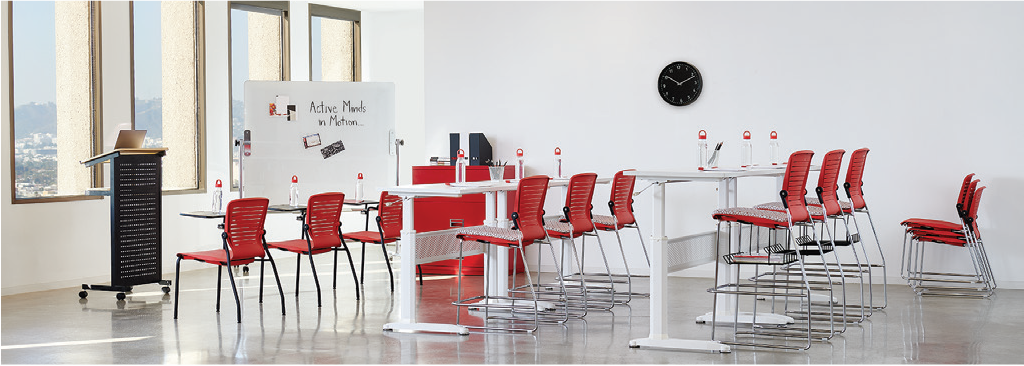
- Allow users to solve the personal comfort-to-task equation by providing an abundance of situationally appropriate seating, standing, and perching choices.
- Understand common tasks within the space – sitting, standing, walking, waiting, queuing, meeting, gathering – and design to accommodate affordances for various body types and emotional moods, completing those tasks.
Neri reveals that her interest in Body-Conscious Design took root after reading The Chair by Galen Cranz, which explores the evolution of the chair and its impact on human health.
“Chairs reflect culture and society. From the throne to the executive chair, sometimes furniture may be saying more than it is doing,” continues Neri. “The book criticizes the 90-degree sitting posture that we see a lot in schools. Cranz prefers a 130-degree-sit, which distributes our weight better. Details like the edges of seats being curved so the sides don’t dig into a person’s thighs are intrinsic to Body-Conscious Design.”
Wilson Chow joins the conversation from the manufacturing perspective, where good intentions aren’t always enough to make a product successful.
“Body-Conscious Design encourages the entire body to be engaged. Building on what was said about neurodiversity, we’re all somewhere along the same spectrum. Many of us are overstimulated. We have a lot of things going on, too much noise and distraction, affecting our concentration,” says Chow. “At OM Seating, there are times when we obsess over the sound and function of a backrest ratchet. Is it too loud? Does it give you a good sense that something is happening when it clicks into place? Even the tactile qualities of a lever can make a difference in people’s comfort when they use it. So, Body-Conscious Design is not about accommodating a fringe population. This is good for everyone.”
Chow points out that OM Seating strives to design for the entire continuum of human form and ability and that the furniture industry has standards. BIFMA, as an accredited standards writing organization, develops and maintains voluntary standards for the commercial furniture industry focused on safety, performance and sustainability.
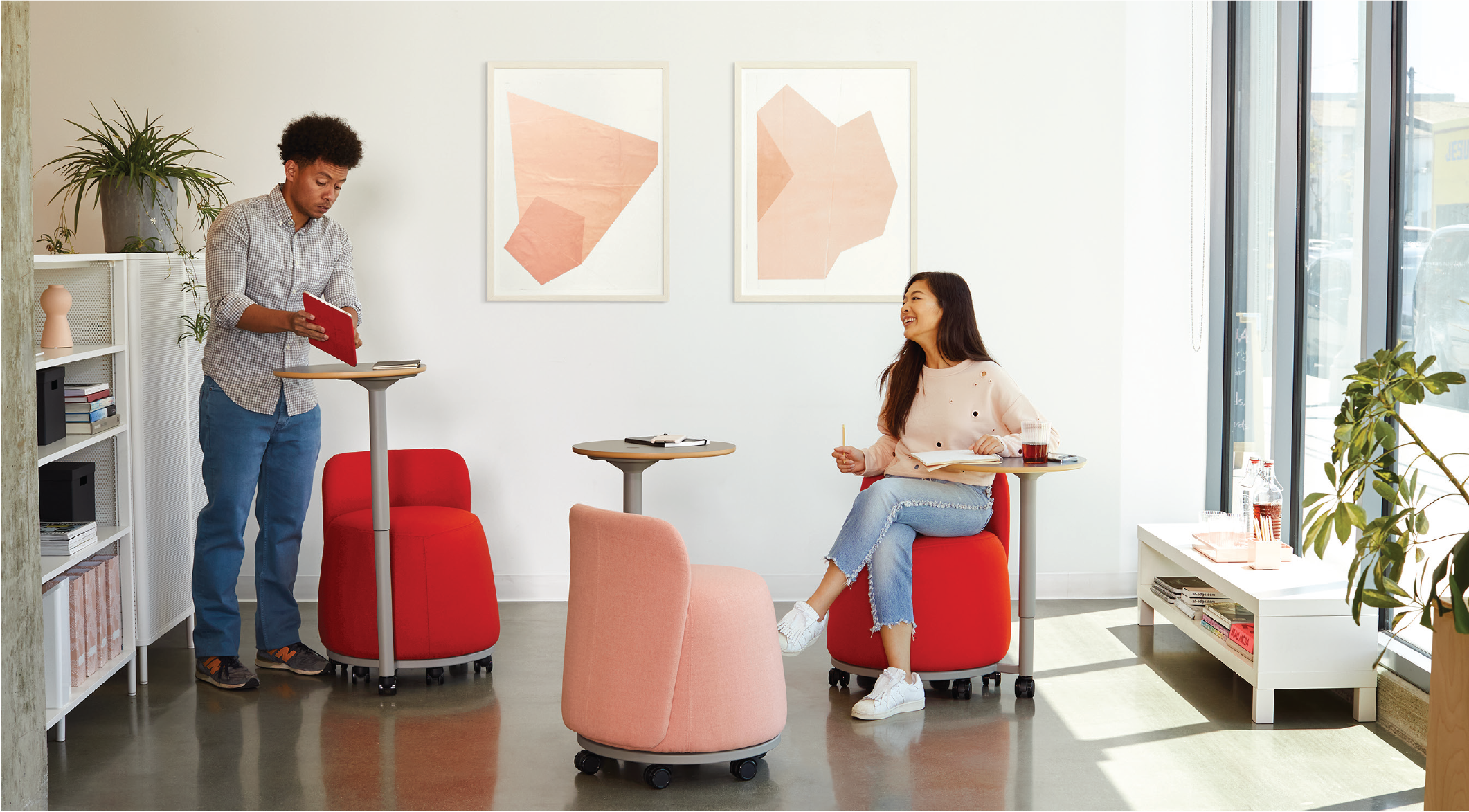
“Sitting is a collaboration between a human and the chair. This is not a single act. The same student likely has different modes of operating situationally throughout their learning day,” continues Chow. “So, it’s important to develop a system of seating options. Different chairs that move and operate in different ways invite people to explore options and find a comfortable seat for the task they intend to undertake. Let the system solution be in play. Stitch together multiple seating options that give users inherent choice.”
Body-Conscious Design Roadmap
- Design as though everyone is on a neurodivergent continuum. Subtle details matter.
- Allow for play with safety and purpose.
- Engage a system solution.
- Recognize that educational furniture and design inform future work habits and expectations.
“As a market, we understand that education is budget-conscious and space needy,” continues Chow. Good furnishings must be stackable, durable, easy to clean, and serve several purposes. To be profitable, limited parts and assembly are ideal in producing solutions that comfortably accommodate people of many sizes in multiple postures. “In designing for education, there is a further purpose. What children experience in education establishes expectations for the working world they will face in the years to come. So, we need to look at things like noise attenuation, color choices, and variations in workplace environments to inform educational spaces, so that expectations align with modern workplace realities.”
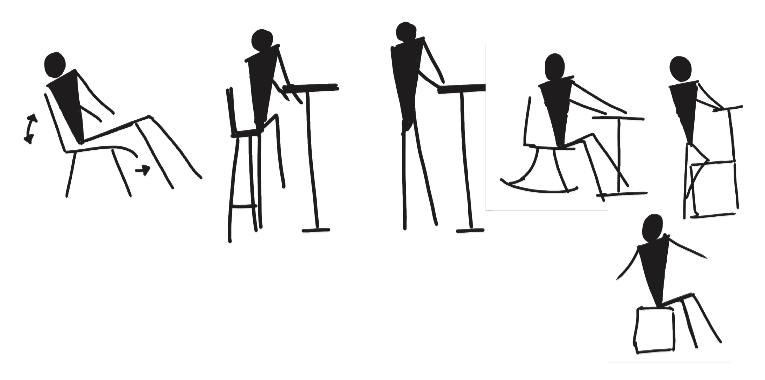
Neri suggests the simplest path to understanding how space is used is to observe it in action.
“When I begin a project, I like to think about the potential postures that might be engaged within that space by going to an example and observing people using it,” says Neri. “I’m looking for five or six different postures at a minimum. Different things people commonly do. From there, I begin to think about how the architecture, interiors, and furnishings can respond to those postures and tasks over a wide range of body types while facilitating choice for the user.”
IT’S IMPORTANT TO DEVELOP A SYSTEM OF SEATING OPTIONS. DIFFERENT CHAIRS THAT MOVE AND OPERATE IN DIFFERENT WAYS INVITE PEOPLE TO EXPLORE OPTIONS AND FIND A COMFORTABLE SEAT FOR THE TASK THEY INTEND TO UNDERTAKE.
Body-Conscious Design Wrap Up
- Human beings are not static. Movement is a natural and necessary part of task management.
- Learning requires multiple postures. Design for five or more, whenever possible.
- Variations accommodate people of different sizes and abilities. Consider secondary users – teachers, parents, visitors, and custodians.
- Consider all senses. How it looks, sounds, feels, clicks into place, stacks, and solves multiple uses makes a huge difference in practical effectiveness.