

In many classrooms, the day follows a frustrating pattern: rooms feel too cold when the first bell rings, then become uncomfortably warm by mid-afternoon. These temperature swings disrupt student attention, increase comfort complaints, and force facility teams into a reactive cycle of thermostat adjustments during peak utility hours.
Education leaders face unique constraints: aging HVAC systems, tight budgets, and construction schedules that must work around instruction. Consequently, districts are seeking solutions that improve Indoor Environmental Quality without major disruption or full mechanical replacement. One innovative approach is rethinking the ceiling to provide thermal mass that stabilizes temperatures and reduces peak HVAC demand.
Comfort is Multi-Dimensional: Acoustics and Temperature
In an occupant dissatisfaction survey from the Center for the Built Environment, acoustics were the most common source of dissatisfaction, followed by temperature. In education settings, students and teachers need classrooms that support speech intelligibility and concentration and maintain stable comfort conditions. While ceilings are traditionally viewed as acoustic tools, they can also influence thermal comfort when they incorporate Phase Change Material (PCM).
The Science of Lightweight Thermal Mass
Thermal mass is a material’s ability to store and release heat. While traditional buildings used heavy materials like brick or concrete to moderate temperature, modern lightweight construction often lacks this passive benefit.
PCM restores thermal mass in a lightweight format. It works by storing heat as it changes phase (typically from solid to liquid) at a targeted temperature. Much like ice absorbing heat as it melts, PCM is engineered to activate at temperatures relevant to human comfort— roughly 72°F. One Ultima® Templok® tile provides the thermal mass equivalent to 11 bricks without the structural weight.
How PCM Works in a Ceiling
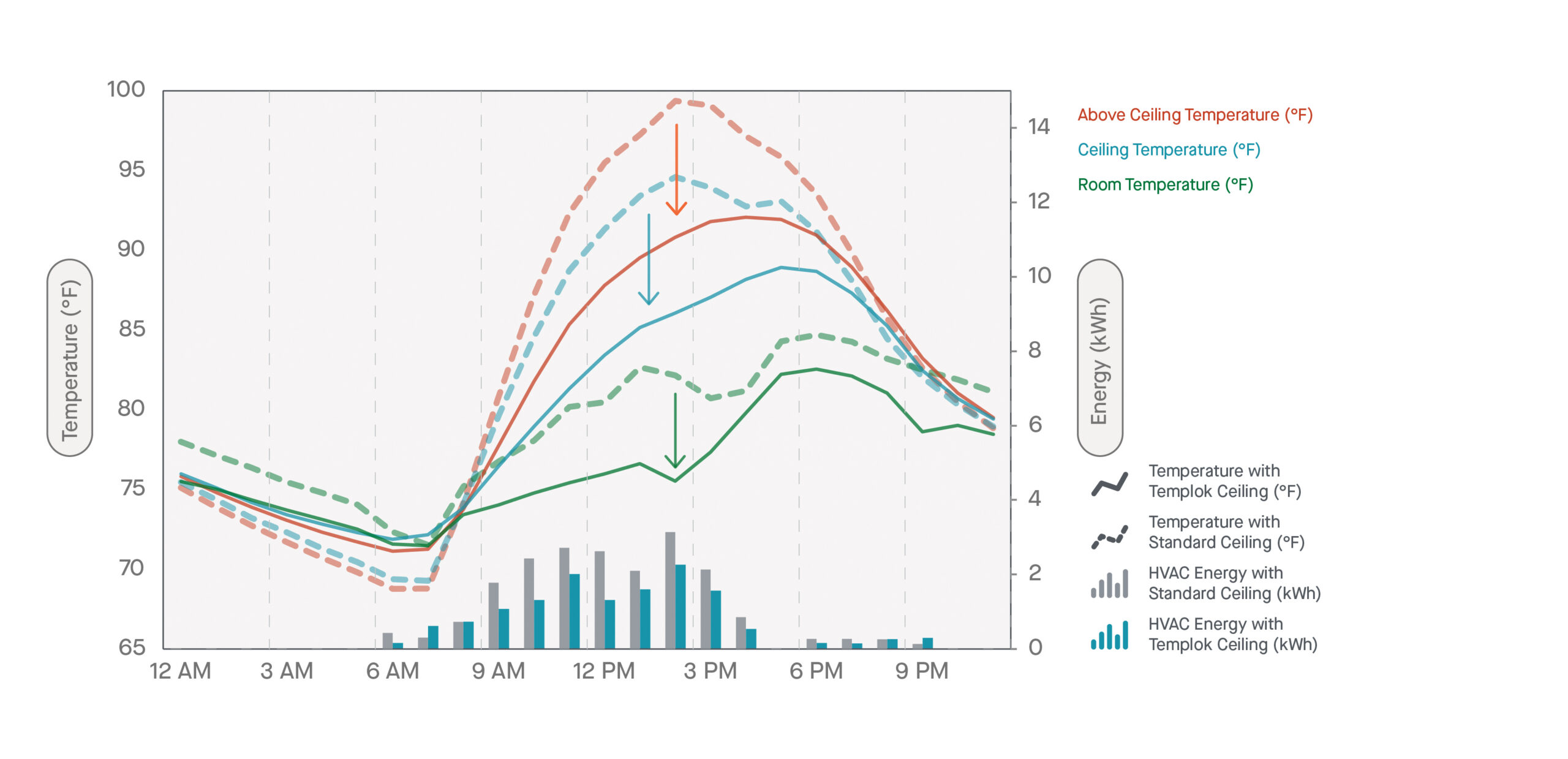
As temperatures rise during the day due to occupants, lighting, and equipment, the PCM in the ceiling tiles absorb excess heat rather than allowing it to elevate the room temperature. At night, when the building cools, the stored heat is released, “recharging” the PCM for the next day. This “flattening” effect is crucial because it mitigates comfort complaints during peak load periods when the grid is stressed and energy is most expensive.
Data-backed Performance: What Testing Shows
Armstrong evaluated PCM ceiling performance in controlled laboratory conditions in Lancaster, PA. The testing demonstrated:
- A 1-hour, 48-minute delay in AC usage compared to baseline conditions
- Reduced cooling energy consumption measured in thousands of BTUs
- Passive heat transfer that matched the expected thermal absorption capacity of the room
Real-World Results: Palm Springs Unified School District
In hot climates, the value of smoothing temperature swings is even more evident. A classroom retrofit in the Palm Springs Unified School District using Templok ceilings with PCM technology delivered significant results:
- Classrooms stayed 1–4°F cooler during peak school hours
- Afternoon HVAC demand was reduced by up to 20%
- Installation was completed over a single weekend, proving the retrofit-friendly nature of the technology
Operational Strategy: Passive Upgrades, Active Plans
PCM ceilings are most effective when integrated into a broader facility strategy:
- Nighttime Recharge: Utilizing night setbacks or ventilation schedules helps reset the material
- Demand Response: Lowering afternoon demand supports district-level energy goals
- Right-Sizing Equipment: Reducing peak loads can allow for more strategic, smaller-scale HVAC upgrades in the future
Incentives and Economics
Education projects are often judged on both performance and payback.
Beyond the comfort and energy benefits, districts and owners may be able to improve project economics through available programs, such as Investment Tax Credit (ITC) 48E.
An ITC is a tax incentive that allows eligible taxpayers to reduce their tax liability by a certain percentage of the investment cost, provided by the IRS. Section 48E is part of the ITC and can help offset the costs associated with qualified energy properties and facilities. ITCs are a part of the Inflation Reduction Act, which is a federal law that invests in domestic energy production while promoting clean energy. 48E specifically mentions thermal energy storage and solid-liquid phase change materials.
The purchase and installation of Templok Energy Saving Ceiling tiles (including support such as grid and labor) may qualify for a federal investment tax credit of 40% or 50%* because Templok ceiling tiles have thermal energy storage properties, i.e., phase change material in the ceiling.
Learn more about Templok Energy Saving Ceilings at www.armstrong.com/templok.
* Most Templok ceiling projects may qualify for 40% tax credits, and if the ceilings are deployed in an Energy Community (a Brownfields site or certain fossil fuel dependent communities) an additional 10% tax credit may be available.