



Introduction
Research consistently shows that classroom lighting plays a meaningful role in how students focus, process information, and learn. Well-designed lighting—balanced for brightness, color temperature, and visual comfort—has been linked to improved attention, reading performance, and overall academic outcomes. In contrast, outdated lighting can contribute to fatigue, visual discomfort, and distraction.
Recognizing lighting as more than a basic infrastructure upgrade, the Clark County School District (CCSD), the fifth-largest school district in the United States, undertook a large-scale lighting modernization effort designed to support both educational outcomes and long-term operational efficiency. CCSD serves a highly diverse student population across more than 360 campuses throughout Southern Nevada.
Spanning more than 8,000 square miles and encompassing urban, suburban, and rural communities, the district faces unique challenges related to facility consistency, system reliability, and long-term infrastructure maintainability—particularly for lighting systems that directly affect learning environments.
For CCSD, improving lighting became a district-wide initiative to give educators greater control over classroom environments and provide students with visually comfortable, adaptable spaces that support sustained focus throughout the school day. By standardizing light levels, reducing glare, and simplifying controls, the district minimized visual distractions that interrupt instruction and student engagement. Consistent lighting performance across campuses helps ensure equitable learning conditions regardless of school location or building age.
Implementation
Between 2012 and 2018, CCSD implemented lighting upgrades across more than 150 campuses through utility-funded energy-efficiency programs. In parallel, the district piloted Energy Savings Performance Contract (ESPC) projects with two Energy Service Companies (ESCOs), extending improvements to an additional fifty schools.
An ESPC is a financing mechanism in which an ESCO designs and implements energy-efficiency upgrades, with project costs repaid over time through guaranteed energy savings. This approach allows public entities to modernize facilities without upfront capital investment, while reducing operating costs and retaining all savings after the contract term concludes.
Overcoming Obstacles
While these early efforts produced measurable energy reductions, the parallel implementation paths introduced district-wide challenges. Earlier de-lamping programs offered limited additional savings, while ESPC pilot projects resulted in inconsistent product selections across campuses. Variations in fixture brands, types, wattages, color temperatures, and control platforms increased system complexity.
In many cases, this lack of standardization made lighting systems more difficult for school staff to operate and maintain. Over time, usability declined, and some advanced features were underutilized or abandoned altogether.
To address these challenges, CCSD engaged Willdan Performance Engineering to help re-establish a unified lighting and advanced controls strategy. The focus shifted toward developing consistent, repeatable sequences of operation that balanced energy performance with ease of use. By prioritizing intuitive controls, standardized performance across space types, and scalability across all 205 campuses, the modernization effort was structured to support both daily school operations and long-term district sustainability goals.
Thoughtfully designed lighting plays a fundamental role in student learning, supporting focus, attention, and academic performance.
Project Framework and Goals
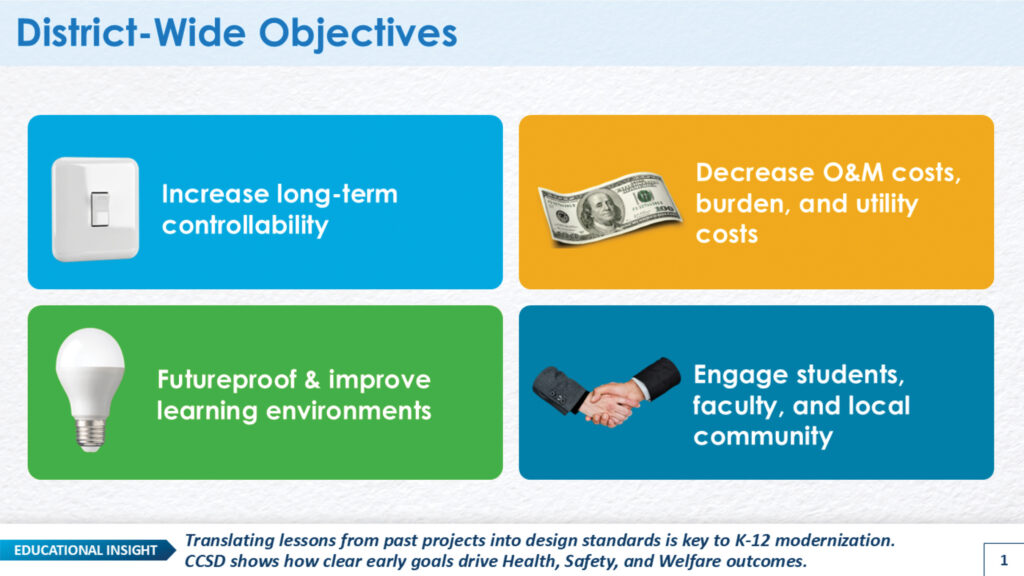
The lighting and advanced controls modernization established a unified, district-wide platform designed to improve learning environments, enhance campus safety, and reduce long-term maintenance demands across all CCSD schools. Delivered through an ESPC, the project emphasized standardized system performance, intuitive controls, and visual comfort while balancing energy savings with operational efficiency.
Project goals included:
- Driving system standardization and equity across all campuses
- Improving controllability, safety, and ease of use
- Supporting visual comfort aligned with Illuminating Engineering Society (IES) standards and the district’s design manual
- Establishing a future-ready lighting framework
- Balancing energy performance, operations, and educational outcomes
Lighting design decisions—ranging from fixture retrofits to adherence to IES standards—helped deliver measurable energy savings while improving visual comfort, student focus, and occupant safety.
Addressing Scale and Complexity
The scale of the project presented significant logistical challenges, including auditing and designing lighting systems across more than 200 campuses and managing over 100,000 individual data points. Compressed audit timelines, extreme seasonal weather, and the need to minimize disruption to students required careful coordination.
Equally challenging was developing standardized lighting and control strategies capable of performing consistently across campuses with diverse layouts, uses, and legacy systems. To manage more than 485,000 lighting and controls components—including luminaires, control devices, emergency battery systems, and custom wall stations—CCSD and Willdan implemented a standardized, yet flexible design framework supported by phased installation and consistent quality control.
Lighting and controls were designed by space type using simplified sequences of operation that support time-of-day use, visual comfort, and ease of operation. This consistency allows classrooms to function predictably throughout the day, supporting transitions between instruction, collaboration, and assessment without visual disruption.
Design Strategies by Space Type
Lighting strategies were tailored by space type and instructional use:
- Classrooms: Standardized color temperature balancing brightness and neutral tone to support focus while reducing glare on whiteboards and digital displays
- Corridors and hallways: High-uniformity lighting with responsive motion controls to enhance safety and conserve energy
- Cafeterias and multipurpose rooms: Scene-based controls adaptable for dining, assemblies, and custodial use
- Gyms and athletic spaces: High-lumen lighting paired with daylight harvesting to balance performance and efficiency
- Libraries: Consistent color temperature supporting visual comfort and aesthetic continuity
- Exteriors and entryways: Adaptive dimming to improve perimeter visibility and after-hours security
Rather than full decommissioning, the project employed a one-for-one replacement strategy, preserving design flexibility while minimizing emergency rewiring. This approach supports consistent photometric performance as spaces evolve and prioritizes long-term adaptability over short-term savings.
Conclusion
Thoughtfully designed lighting plays a fundamental role in student learning, supporting focus, attention, and academic performance. The CCSD lighting and advanced controls modernization demonstrates how large, geographically diverse school districts can leverage standardized design, intuitive controls, and performance-based delivery to create healthier learning environments while building more resilient, future-ready infrastructure.
Annual savings of approximately 59 million kilowatt-hours and $6.8 million strengthen the project’s impact, allowing the district to redirect critical resources toward its highest-priority educational needs.