


Welcome to the third installment of What Gets Measured Gets Better, a series focused on how evidence-based decision- making can meaningfully enhance educational experiences. This issue explores thermal comfort—and its impact on both students and teachers—an area of growing attention as schools seek to improve learning environments through design, operations, and policy.
To begin, imagine a classroom where everyone feels comfortable: not too cold, not too warm, but balanced enough to remain focused. Students are engaged, teachers feel energized, and occupants understand how to adapt their environment to meet their comfort needs. This is what a thermally comfortable classroom looks like—and it is far more than a matter of convenience.
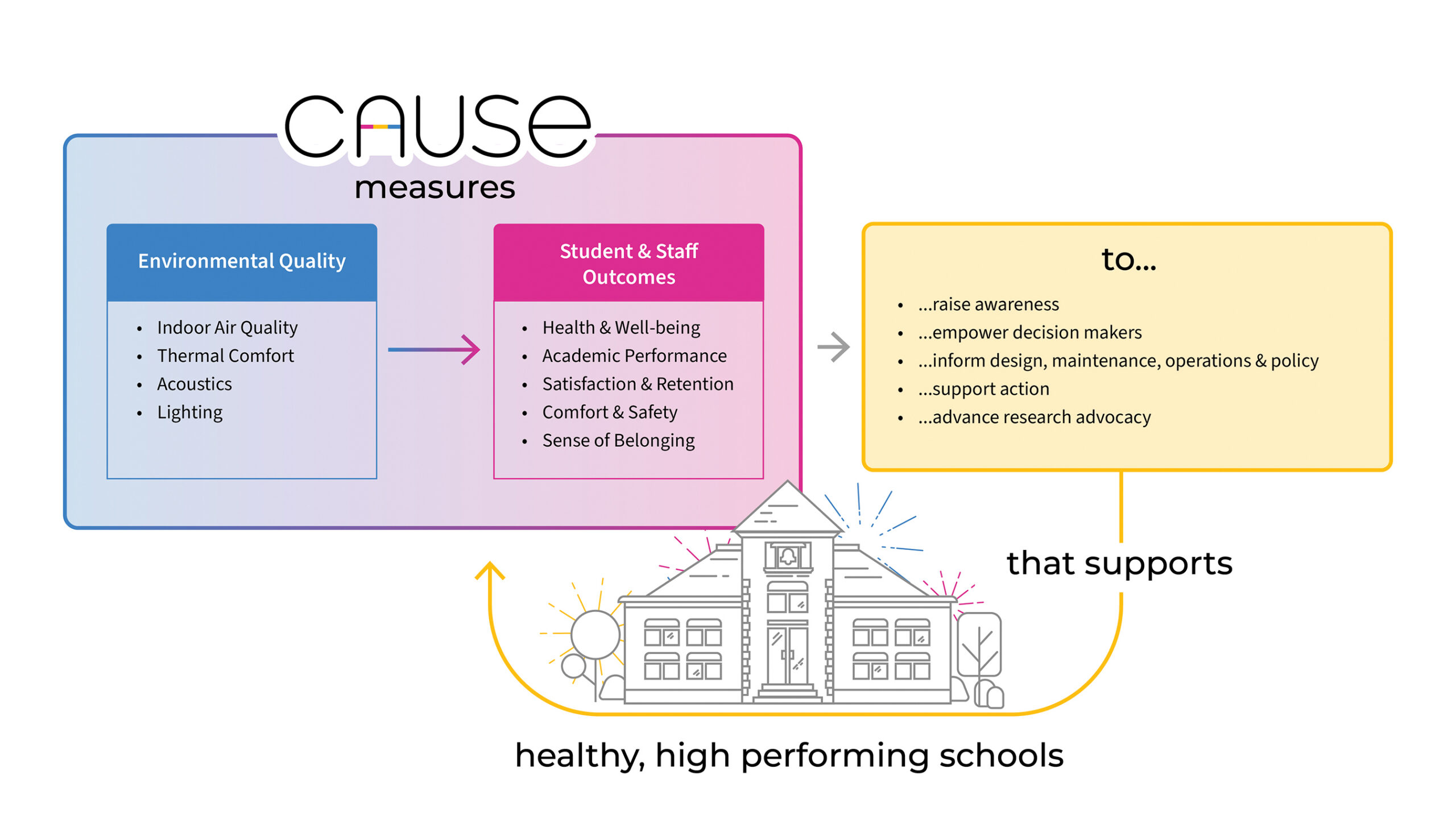
Aligned with the mission of the Coalition for the Advanced Understanding of School Environments (CAUSE), the following five principles serve as a practical framework for school planners, designers, and operators seeking to create learning environments where students and teachers can focus on what matters most: learning, connecting, and thriving.
1. Comfort Drives Learning Performance
Know the facts: Thermal comfort in classrooms has been shown to enhance students’ academic success.
2. One Size Does Not Fit All
Thermal comfort is highly subjective, meaning individuals can experience the same temperature very differently. Age, sex, activity level, clothing, physiological conditions, personal preferences5, and cultural and climatic backgrounds6 all influence comfort perception. Unless schools are designed and operated with these factors in mind, a significant number of occupants will remain thermally uncomfortable7.
Providing occupants with a range of adaptive options—such as operable windows, ceiling fans, blinds or shades, dimmable lighting, or the ability to relocate within or between spaces—allows individuals to meet their own comfort needs. This adaptability not only improves physical comfort, but also offers psychological benefits associated with perceived control. It enables occupants to respond to environmental, personal, and social comfort factors more effectively.
Know the facts: A “one-size-fits-all” temperature often leaves many students and teachers uncomfortable.
3. Educate and Empower Teachers and Students to Control Their Thermal Comfort
Know the facts: Providing agency over classroom environments, paired with education and attention to socio-economic impacts, improves thermal comfort outcomes.
4. Balance Comfort and Energy Efficiency Through Collaboration
Achieving both thermal comfort and energy-efficiency goals requires early and sustained collaboration among a wide range of stakeholders, including administrators, facility managers, custodians, teachers, students, and engineers. Engaging these groups early in the planning and design process helps ensure that solutions support occupant comfort while also meeting operational and energy performance targets.
A human-centric, integrated design process is essential to successfully address the first three principles. Collaboration that involves all relevant constituents is critical for establishing effective policies, empowering occupants, and balancing comfort with long-term operational goals. It’s the only way to meet the goals of agency, empowerment, education, and effective policies related to the building’s design and operations.
Know the facts: Early collaboration across constituents is essential for optimizing thermal comfort while meeting energy, operational, and learning goals.
5. Measure Comfort for Continuous Improvement
As Peter Drucker noted, “You can’t improve what you don’t measure.” Objective tools, such as temperature and relative humidity sensors, provide valuable data—but they do not tell the whole story. Pairing sensor and system data with qualitative inputs from surveys, interviews, observations, or focus groups involving students, teachers, custodians, and operations staff creates a more complete understanding of thermal experience in schools12.
For example, a temperature sensor may indicate conditions within an acceptable comfort range, yet occupants may still report discomfort. Additional feedback may reveal that high air velocity from supply vents is creating a drafty sensation. Insights like these enable targeted HVAC adjustments and informed follow-up evaluations across seasons to verify improved comfort.
Know the facts: The most effective comfort strategies combine objective system data with subjective feedback from multiple constituents.
Moving Forward
Improving thermal comfort in schools requires intentional, flexible design and operations, ongoing constituent engagement, education, and regular occupant feedback, including pre- and post-occupancy evaluation. When these strategies work together, schools become more adaptable and inclusive learning environments that support diverse comfort needs.
Continuously measuring and validating thermal comfort from multiple perspectives informs better decision-making and helps create classrooms where teachers and students are well-positioned to teach, learn, connect, and thrive.
References
- Jiang, J., Wang, D., Liu, Y., Xu, Y., and Liu, J. (2018). A study on pupils’ learning performance and thermal comfort of primary schools in China. Building and Environment, 134:102–113.
- Frontczak, M. and Wargocki, P., (2011). Literature Survey on how Different Factors Influence Human Comfort in Indoor Environments. Building and Environment 46 (4): 922-937.
- Dias, M., Bernardo, H., Ramos, J. and Egido. M., (2011). Indoor Environment and Energy Efficiency in School Buildings – Part 1: Indoor Air Quality. IEEE, Jul 2011.
- 4. Mendell, M. J. and Heath, G. A., (2005). Do Indoor Pollutants and Thermal Conditions in Schools Influence Student Performance? A Critical Review of Literature. Indoor Air 15 (1): 27-52.
- ANSI/ASHRAE. (2023). ANSI/ASHRAE Standard 55-2023 Thermal Environmental Conditions for Human Occupancy. Peachtree Corners, GA: American Society of Heating, Refrigerating and Air-Conditioning Engineers (ASHRAE).
- Wheeler, A. (2017). Post Occupancy Evaluation of Sustainable Schools and Children’s Ways of Knowing: New Directions in Teaching and Research. Journal of Green Building 12 (3): 125–35. https://doi.org/10.3992/1943-4618.12.3.125
- Harmon, M. and Shell, S. (2025, September 24-26). Why Thermal Comfort is Elusive – The Role of Socio-Cultural Factors. Paper presented at the IEQ 2025 Conference, Co-Organized by ASHRAE and AIVC, Montreal, Quebec, Canada. https://www.ashrae.org/conferences/topical-conferences/ieq-2025-conference.
- Brager, G., Paliaga, G., de Dear, R., (2004), Operable windows, personal control and occupant comfort, American Society of Heating, Refrigerating and Air-Conditioning Engineers (ASHRAE), Vol 110, Part 2. 17-35.
- Zierke, O., Goerke, P., Maier, J., Hoermann, H.J. (2023). Influence of personal control on thermal comfort: A psychological effect or just the “right” temperature? Energy and Buildings, vol 295, 113334, https://doi.org/10.1016/j.enbuild.2023.113334.
- Taheri, H. (2022). Human-Building Interaction, Thermal Comfort and Indoor Air Quality in K-12 Schools (Before and During Covid-19): Suggestions for Stakeholders and Future Studies. Doctoral Dissertation, North Carolina State University.
- Stazi, F., Naspi, F., Ulpiani, G., Di Perna, C., (2017). Indoor air quality and thermal comfort optimization in classrooms developing an automatic system for windows opening and closing, Energy and Buildings 139, 732-746.
- Balvedi, B.F., Ghisi, E., Lamberts, R., (2018), A Review of Occupant Behavior in Residential Buildings, Energy and Buildings 174, 495-505.