

If you’ve ever used Siri to answer a question (natural language processing), GPS to find the fastest route home (prescriptive analytics), or facial recognition to unlock your phone (computer vision), then you already engaged with AI as part of your daily life. Since 1966, when ELIZA—the first chatbot designed to act as a psychologist—was introduced, these tools have quietly reshaped our daily routines, blending into the background while improving quality, speed, and convenience. For educational design professionals, AI represents not just a technological shift but a behavioral one. It challenges us to rethink how we approach our work, enabling us to prioritize meaningful connections, visionary planning, and better outcomes for students and educators.
From Speed to Quality: The Power of AI Literacy
AI literacy equips individuals to adapt to technological advancements while enhancing their ability to navigate a world of constant change. Like the introduction of the washing machine revolutionized domestic life, AI is transforming how we work. It’s not just a tool; it’s a pathway to reclaiming time and energy for tasks that matter most.
A recent study conducted by Harvard Business School and Boston Consulting Group revealed that individuals trained in using GPT-4 were significantly more productive compared to the control group, completing tasks 25.1% more quickly with 40% higher quality. When thinking about this amplification in regard to creativity, research published in Nature Human Behavior found that ChatGPT can help support human creativity. Through its capability to connect disparate ideas into a more cohesive and articulate form, often providing stimuli to react to and build on, which further drives creative human thought. This isn’t about replacing human expertise, it’s about amplifying it.
Starting Small with AI as a Strategic Tool
Leveraging AI doesn’t have to be disruptive; we can start with bringing AI into the loop in responsible and supportive ways that create value and impact without extensive investment and a steep learning curve.
Begin by reflecting on your strengths and what you most enjoy about your work. Then, consider: What prevents you from dedicating more time and energy to those activities? This question can guide you in identifying areas where AI might help.
Using accessible tools like OpenAI’s ChatGPT or enterprise AI solutions, you can start with simple applications:
- Clarify your objectives: Use AI to organize thoughts and refine the outcomes you want to achieve.
- Brainstorm solutions: Generate ideas to address challenges creatively.
- Find resources: Discover tools and strategies to maximize your impact.
- Improve communication: Enhance clarity and tone, interpret stakeholder feedback or legal documents, and provide constructive feedback to colleagues or clients.
Viewing AI as Your Collaborative Partner
The key to leveraging AI lies in a mindset shift. Rather than seeing AI as a threat or shortcut, embrace it as a collaborative partner that enhances your expertise. AI doesn’t limit your abilities—it broadens them.
Begin by reflecting on your strengths and what you most enjoy about your work. Then, consider: What prevents you from dedicating more time and energy to those activities? This question can guide you in identifying areas where AI might help.
Start Small, Think Big: Your Call to Action
Integrating AI into your work doesn’t require a complete overhaul. Start with small, practical steps in your preferred AI tool (ChatGPT, CoPilot, etc.):
- Copy a non-sensitive email and ask, “How can I improve this email?”
- Describe a problem, like deferred maintenance on school facilities, and ask, “What are some potential solutions?”
- Share your role (e.g., “I’m a senior principal at an architectural design firm”) and ask how it could assist you.
These explorations build confidence and competence, paving the way for broader integration and innovation. Remember, AI is a tool to enhance your work so you can focus on what matters most: connecting, designing, and innovating for the students and educators you serve.
Scaling Impact through Steady, Compounding Gains
One of the most accessible and impactful ways to scale AI is by fostering AI literacy and upskilling across teams. Even small improvements—just 1% more effective each week—can compound into a 67% improvement over a year. These incremental gains ripple through workflows, enhancing existing processes, optimizing technology use, and improving decision-making.
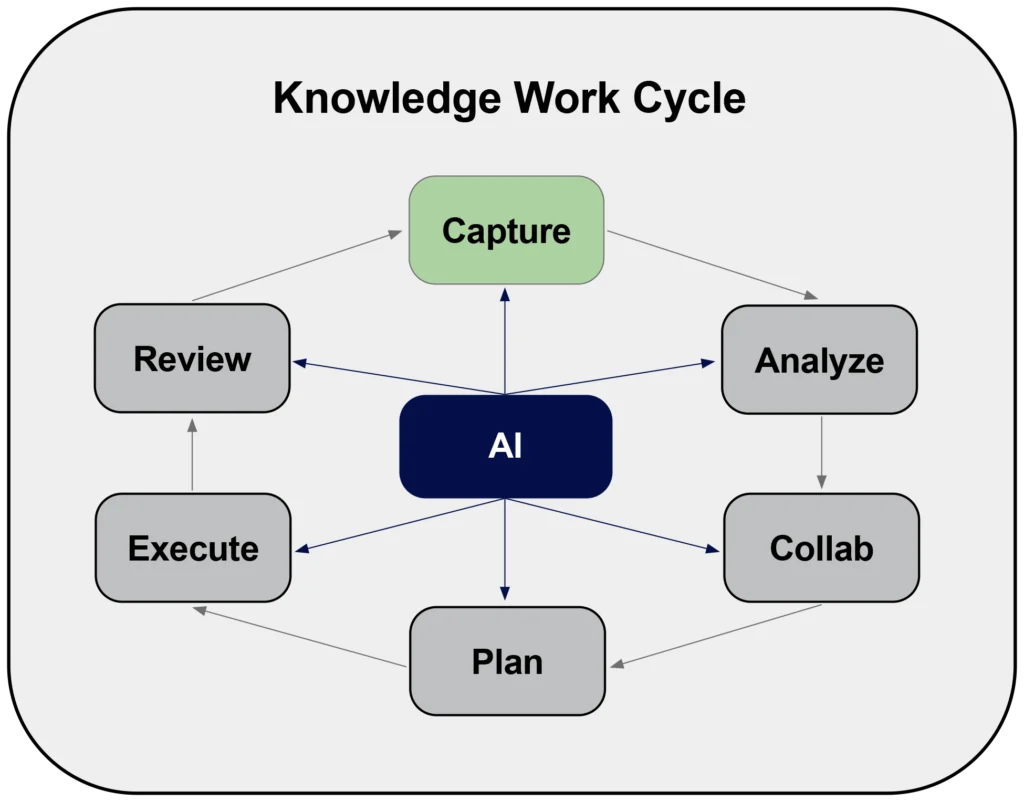
For example, at the heart of creative and strategic work lies a simple cycle: capturing a signal to act (a request, challenge, or new idea), analyzing its meaning, collaborating to develop solutions, creating a plan, executing it, and reviewing the results. Each step in this process benefits from AI’s support, increasing speed and improving quality.
Reimagining Learning Space Visioning with AI
Integrating AI into workflows like learning space visioning sessions enables teams to achieve practical, impactful improvements at every stage without disrupting existing methodologies. Tools like Microsoft Copilot and ChatGPT are intuitive, affordable, and adaptable, making them ideal co-creators in these processes.
Here are examples of how AI can support your visioning process:
- Capture: Use AI to draft pre-session surveys, transcribe stakeholder interviews, or uncover relevant educational research.
- Analyze: Summarize stakeholder feedback, flag areas of alignment or conflict with learning space designs, and compile lessons learned from past post-occupancy evaluations.
- Collaborate: Support teamwork by generating targeted discussion prompts, transcribing session notes (even from analog exercises like post-it notes), aiding brainstorming in real-time, or simulating user feedback to expand thinking.
- Plan: Customize session agendas, create checklists, or draft breakout activities tailored to session goals.
- Execute: Summarize key discussion points during the session for alignment and focus, while capturing and categorizing participant ideas to iterate on concepts in real-time.
- Review: Analyze session feedback, identify trends in participant responses, and suggest improvements for future sessions.
Each phase builds on the previous, demonstrating the compounding benefits of AI-supported improvements. Over time, these incremental gains ripple across the organization, elevating not only just the visioning process but also other complex workflows like project management, RFPs and strategic planning.
Integrating AI into workflows like learning space visioning sessions enables teams to achieve practical, impactful improvements at every stage without disrupting existing methodologies.
By embedding AI usage into everyday tasks, teams can leverage the full potential as a supportive tool. The result? A more agile, efficient, and high-performing organization.
Conclusion: Designing the Future Together
As leaders in education design, you have the power to shape the future through your creativity, vision, and connections. By embracing AI as a collaborative partner, you can reclaim time for what matters most—designing innovative spaces and fostering meaningful relationships. Starting with accessible tools like ChatGPT, you can explore how AI enhances your workflows, build confidence, and uncover practical use cases that amplify your expertise. With each step forward, you expand your impact, driving meaningful change for students, educators, and communities.
Resources
- Dell’Acqua, Fabrizio, Edward McFowland III, Ethan Mollick, Hila Lifshitz-Assaf, Katherine C. Kellogg, Saran Rajendran, Lisa Krayer, François Candelon, and Karim R. Lakhani. “Navigating the Jagged Technological Frontier: Field Experimental Evidence of the Effects of AI on Knowledge Worker Productivity and Quality.” Harvard Business School Working Paper, No. 24-013, September 2023.
https://www.hbs.edu/ris/Publication%20Files/24-013_d9b45b68-9e74-42d6-a1c6-c72fb70c7282.pdf - Lee, Byung Cheol, and Jaeyeon (Jae) Chung. “An Empirical Investigation of the Impact of ChatGPT on Creativity.” Nature Human Behaviour 8, no. 10 (October 2024): 1906–1914. https://www.nature.com/articles/s41562-024-01953-1