



”We shape our buildings, and afterwards our buildings shape us.”
— Winston Churchill, House of Commons
October 28, 1943
For those of us whose practice is devoted to creating learning environments, we have a weighty and noble calling. The landscapes, buildings, and spaces we create with our clients will shape several generations of students, faculty, staff, and families over their serviceable lives. The stakes behind that work are quite enormous: the average K-12 student, for example, will spend more than 1,000 hours inside a school building this year alone. As stewards of the built environment, we have the opportunity and the responsibility to advocate for learning spaces that support the academic and pedagogical vision of an institution while bolstering the well-being of all individuals, neurodivergent and neurotypical. Incorporating the practice of biophilic design into our learning environments offers a scientific, sensitive approach to creating functional, beautiful spaces that prioritize human performance and health.
What Is Biophilic Design?
Biophilic design is the practice of incorporating natural elements, materials, and patterns into the built environment to satisfy biophilia, our innate and evolutionary affinity for the living world, a term the biologist E.O. Wilson popularized in 1984.1 The impact of this human-centered design approach is overwhelmingly positive, both psychologically and physiologically: reduced stress, lower blood pressure, improved mental acuity, and elevated mood are among the benefits. In application, it moves well beyond a plant in the lobby and asks how the experience of moving through and occupying a space can foster people’s instinctive connection to nature by enlivening the senses.
“In every walk with nature one receives far more than he seeks.”
— John Muir
Tangible Benefits
Approaching educational environments through the lens of biophilic design involves weaving its principles into every facet of a project, from site and landscape to building form and material expression. When architects guide school leaders through a holistic visioning and programming process, the result can be a unique and thoughtful balance of indoor and outdoor spaces that nurture learning, performance, health, and well-being. This design approach also recognizes and supports the neurodiversity of learners at any stage of their education.
A growing body of research shows that learning environments enriched through employing biophilic strategies across the three categories offer measurable value for students, faculty, and staff, including:
- Improved Academic Performance 3
- Enhanced Cognitive Development
- Reduced Stress Levels and Improved Mood
- Higher Test Scores 4
- Reduced Absenteeism 5
- Increased Staff Retention Rates 5
Importantly, both current research and building certification programs like LEED (usgbc.org), Living Building Challenge (Living Futures), and WELL (WELL Building Standard) that emphasize biophilic design point to the same truth: quality matters more than quantity.6 A room with a window overlooking green space offers a deeper benefit than a single plant placed nearby. When biophilic aspirations are established at the outset, they can shape more purposeful, cohesive buildings and places where nature is not an afterthought but an organizing presence. The following projects are some examples of successful approaches to shaping learning environments through the three categories: Nature in the Space, Natural Analogues, and Nature of the Space.
NATURE IN THE SPACE
- Visual Connection with Nature
- Non-Visual Connection with Nature
- Non-Rhythmic Sensory Stimuli
- Thermal & Airflow Variaability
- Presence of Water
- Dynamic & Diffuse Light
- Connection with Natural Systems
NATURAL ANALOGS
- Biomorphic Forms & Patterns
- Material Connection with Nature
- Complexity & Order
NATURE OF THE SPACE
- Prospect
- Refuge
- Mystery
- Risk/Peril
- Awe
Terrapin Bright Green’s widely used framework, ”14 Patterns of Biophilic Design, “ offers strategies for effectively bringing nature into built environments through three broader categories: Nature in the Space, Natural Analogues, and Nature of the Space. First published as 14 Patterns, the framework grew to 15 Patterns in 2022, with the addition of Awe, the shift in perception produced by an encounter with scale, light, depth, or age that defies expectation.2 Photo: Terrapin Bright Green
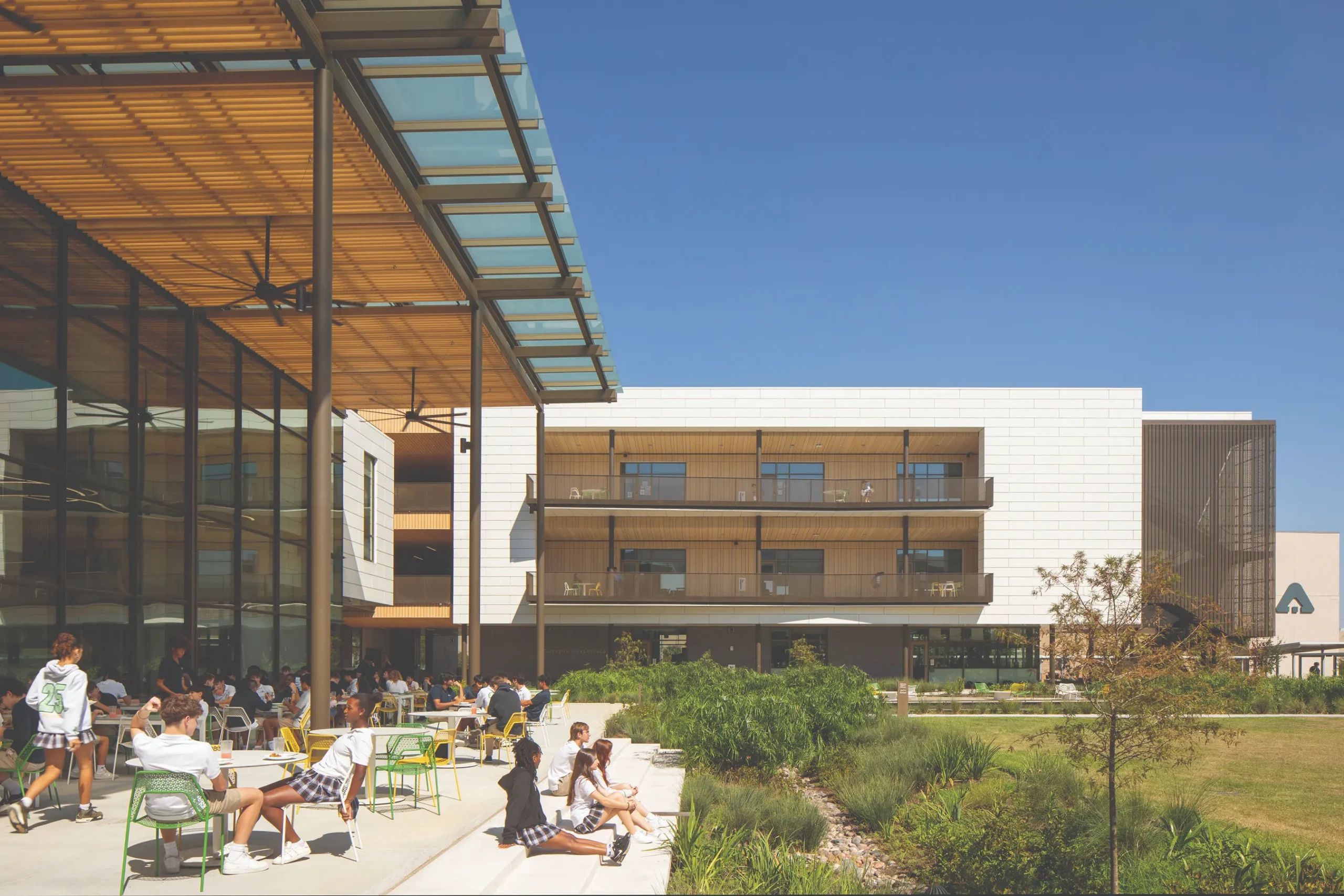
Nature in the Space: Awty International School
“Nature in the Space creates direct, meaningful connections to nature through elements such as plants, water, daylight, views, air movement, sounds, scents, and seasonal change. The strongest examples are diverse, dynamic, and multi-sensory.”
At the Awty International School Student Center in Houston, TX, “Nature in the Space” is on full display. A three-story structure serves as the backdrop to a new, awe-inspiring campus green. The U-shaped configuration frames the green, offering occupants visual connections to nature from every classroom, corridor, and gathering space. Deep overhangs and shaded walkways expose students to thermal variability and airflow throughout their day. Rain gardens and bioswales featuring native plantings display water throughout the site and remind visitors daily of the rhythm of the seasons, a living connection with natural systems that changes visibly through the year.7
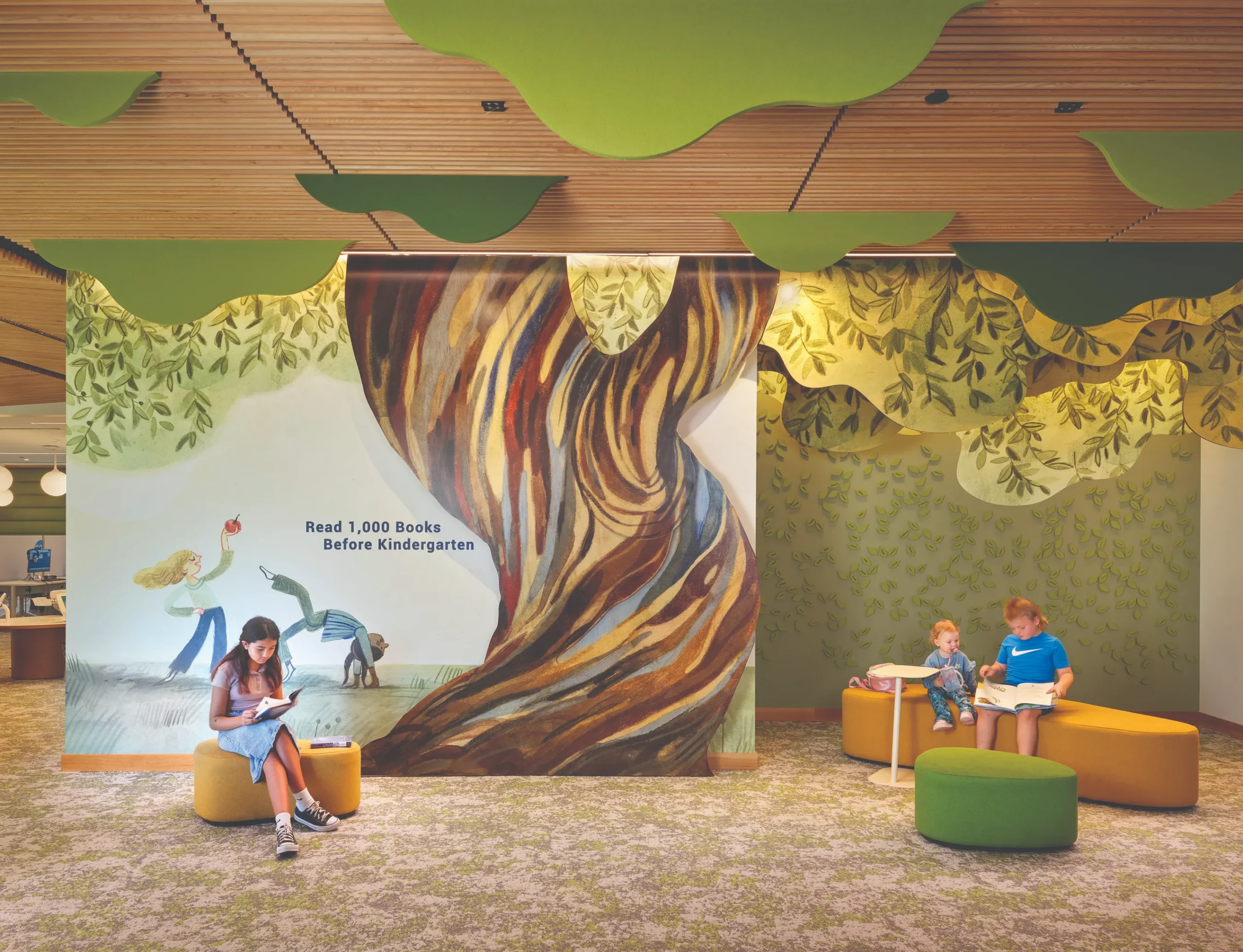
Natural Analogues: Cedar Park Public Library, Children’s Collection
“Natural Analogues evoke nature indirectly through using organic forms, materials, colors, patterns, and processed natural elements. The strongest examples provide rich, organized, and sometimes evolving connections to the natural world.”
The design of the Children’s Collection Area at the new Cedar Park Public Library is inspired by the children’s book Be a Tree! (by Maria Gianferrari). In the library, this playful storybook comes to life with biomorphic forms and patterns, and material connections
to nature that encourage young readers to imagine the children’s area as a forest. Inspired by the book’s original illustrations, custom wall coverings reinterpret the story’s iconic imagery, culminating in an artful tree installation with green acoustic panels that form a lush canopy. The carpet pattern recalls the dappled light of a forest floor, while playful seating nooks inspired by hollows in a tree trunk invite children to curl up with a book.8
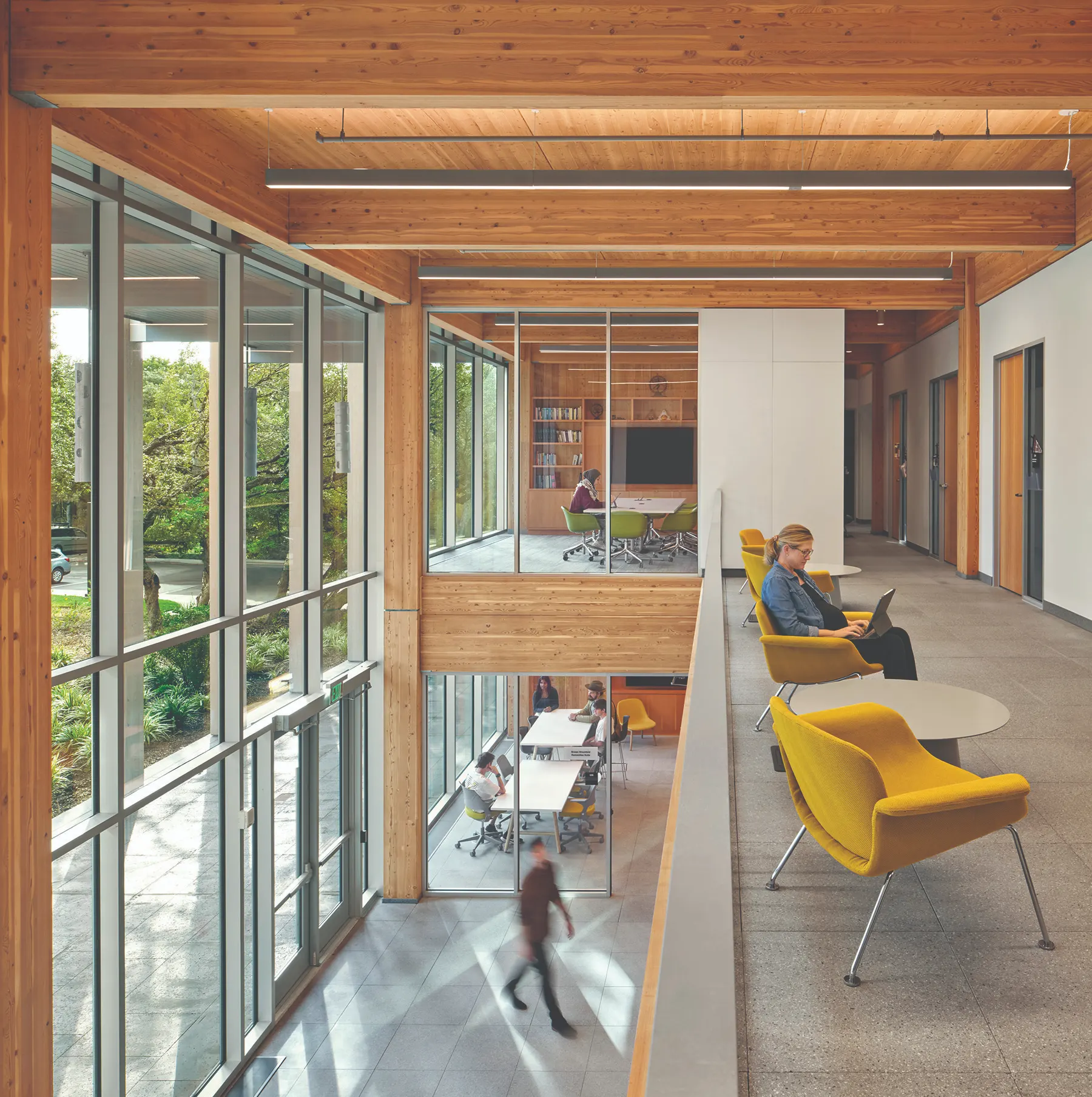
Nature of the Space: Trinity University, Dicke Hall
“Nature of the Space reflects spatial patterns found in nature, including prospect, mystery, refuge, risk, and discovery. The strongest examples use deliberate, engaging spatial configurations to shape how people move through and experience a place.”
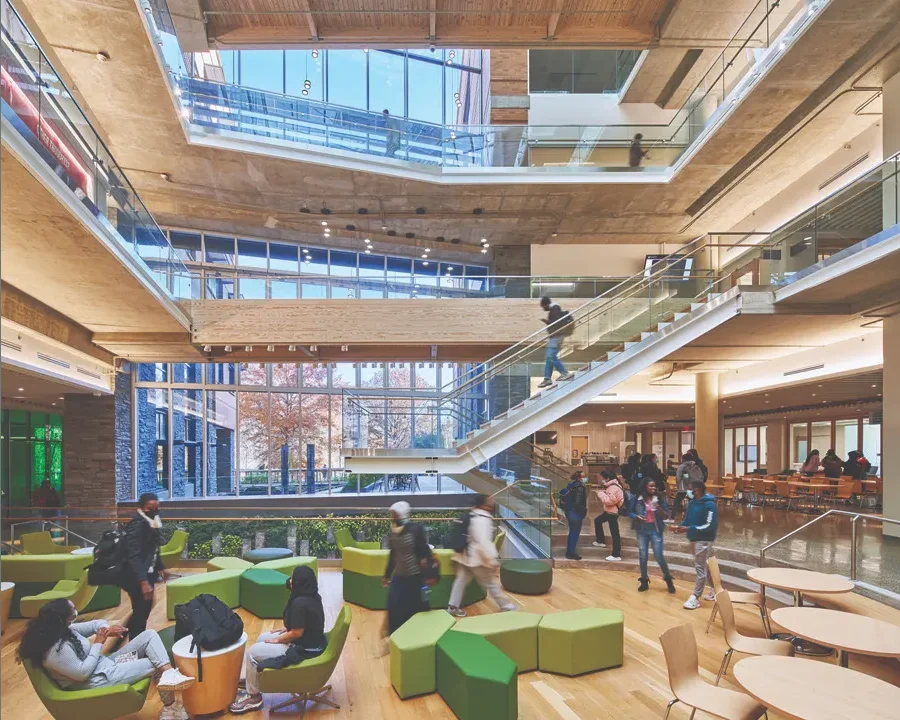
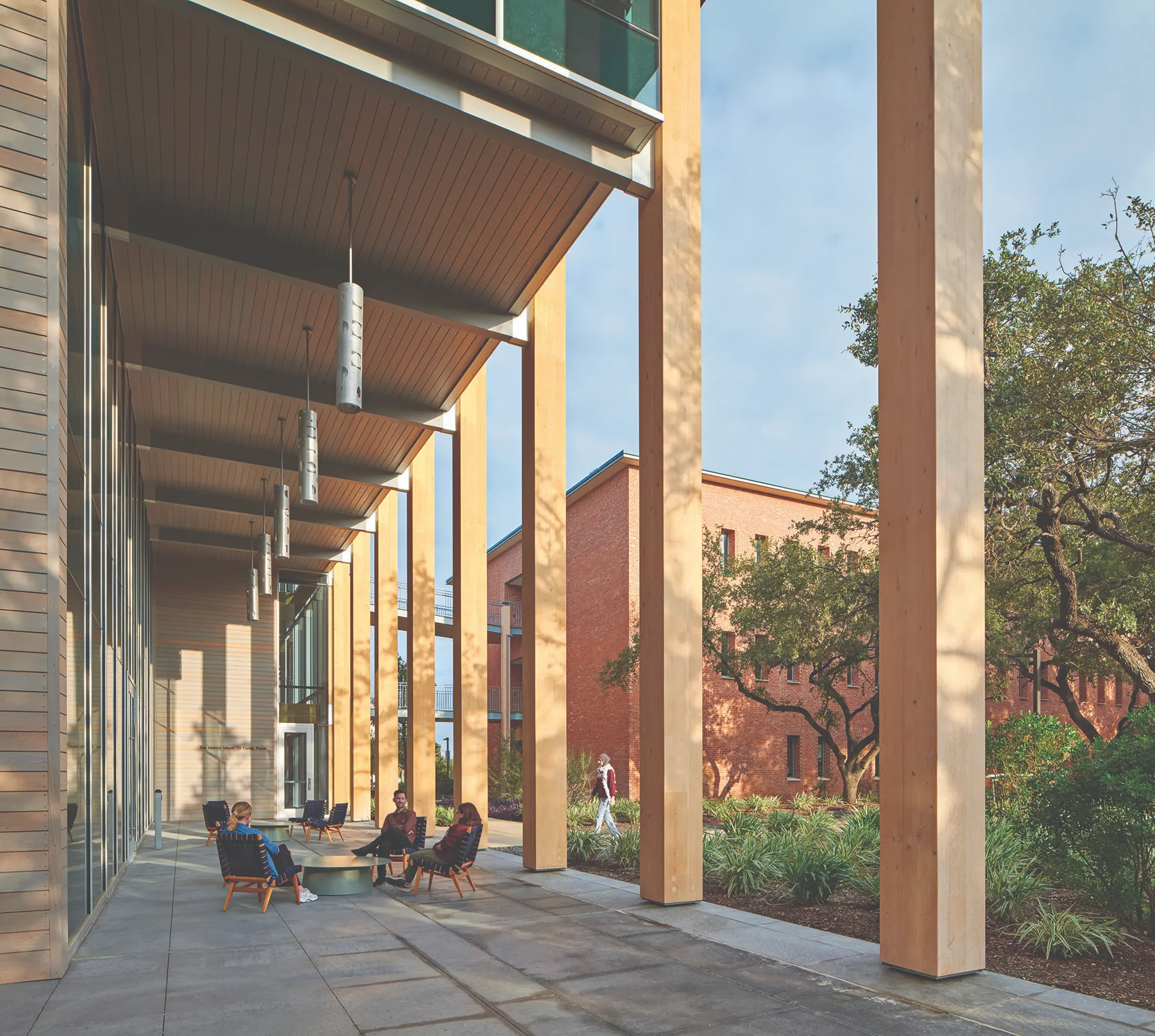
Trinity University’s Business and Humanities District gathers three buildings, two historic and one new, around a single idea: an academic spine that opens onto a shared courtyard, with the new three-story mass timber Dicke Hall anchoring the corner of campus. Here, biophilic design extends beyond materiality and landscape to shape the architecture of movement itself, using spatial sequences that reflect Nature of the Space patterns. The vertically oriented building features overlooks and balconies that provide students with a sense of Prospect as they survey views of the campus and collaboration spaces below, while shielding wood walls offer Mystery by partially veiling movement along the connecting stairs. Sheltering porches framed by a colonnade of wood glulam columns allow students to find Refuge from the sun as well as experience the Awe of the courtyard with its 100-year-old live oak trees. Dicke Hall is a well composed symphony of biophilic design and a place where students find inspiration and restoration.
Over the past several decades, priorities in school design have evolved from viewing schools as collections of classrooms focused primarily on academic achievement to recognizing that a diverse range of spaces—defined by variations in scale, materiality, daylight, and connection to nature—is essential to fostering holistic learning and supporting the well-being of every learner. By integrating biophilic principles into educational environments, designers can shape not only the experiences of generations of students but also the health and vitality of the communities they serve. LBD
References
- Wilson, E.O. (1984). Biophilia. Harvard University Press.
- Browning, W.D., Ryan, C.O., & Clancy, J.O. (2014). 14 Patterns of Biophilic Design. Terrapin Bright Green; Kellert, S.R., Heerwagen, J., & Mador, M. (2011). Biophilic Design: The Theory, Science, and Practice of Bringing Buildings to Life. John Wiley & Sons. Terrapin Bright Green added Awe as a 15th pattern in 2022.
- Barrett, P., Davies, F., Zhang, Y., & Barrett, L. (2015). Clever Classrooms: Summary Report of the HEAD Project. University of Salford.
- Determan, J., et al. The Impact of Biophilic Learning Spaces on Student Success. Terrapin Bright Green, in partnership with the Center for Green Schools.
- Children & Nature Network. “Biophilic design interventions can enhance learning and improve teacher retention, student attendance and behavior.” Research Digest, research.childrenandnature.org.
- U.S. Green Building Council. LEED Pilot Credit: Biophilic Design., Biophilia I – qualitative | WELL Standard, Biophilic Design Initiative – Living Future
- Lake Flato Architects, Awty International School Student Center, AIA Committee on Architecture for Education Award submission, 2025.
- Lake Flato Architects, Cedar Park Public Library project documentation, lakeflato.com.
- Lake Flato Architects, Trinity University Business & Humanities District / Dicke Hall, project presentation and AIA COTE Top Ten submission materials.