

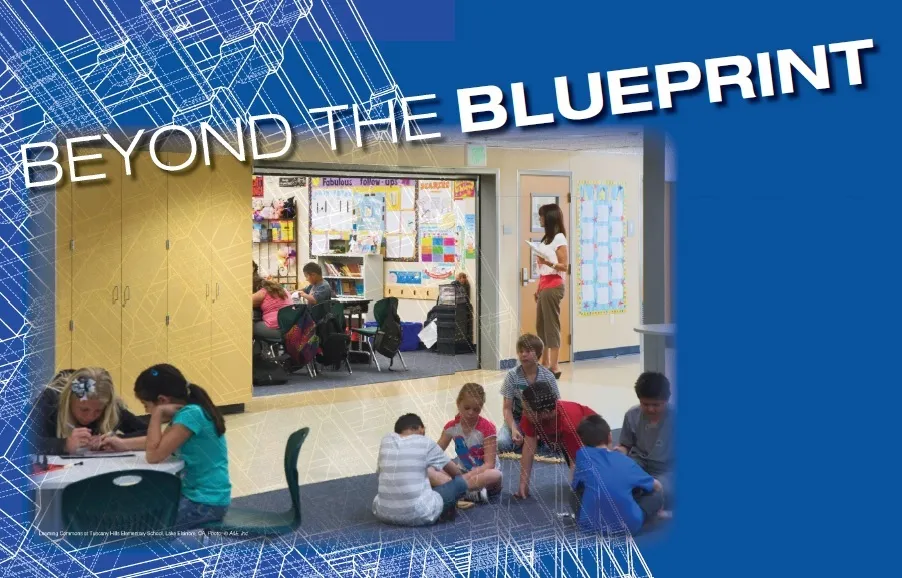
In the realm of educational facility planning and design, Educational Specifications (Ed Specs) rarely receive the attention they deserve. Too often, Ed Specs are treated as a compliance exercise rather than a chance to articulate a district’s pedagogical vision. But what if we approached them not merely as legal documents, but as living frameworks that center agency, equity, and responsiveness to evolving educational needs? Ed Specs should be documents where aspirations first become architecture—the thread that ties vision to space, pedagogy to place, and strategy to design.
Beyond outlining key design parameters such as square footages, room types, and district standards, Ed Specs are foundational to aligning a district’s educational mission with the built environment. They define the pedagogical functions and operational expectations of each space, and how it can further a district’s ethos for excellence in teaching and learning. Successful Ed Specs encapsulate community values, instructional philosophies, and future ambitions in a format that informs every subsequent design decision. When authored thoughtfully and collaboratively, Ed Specs become dynamic roadmaps, evolving with the needs of students, teachers, and the broader communities they serve.
This article explores the purpose, process, and impact of Ed Specs in shaping educational environments that promote agency, foster well-being, and embody a true love of learning. It outlines their core functions, delves into how they bridge vision and design, and examines their critical role in shaping flexible, future-ready schools. A case study from Lake Elsinore Unified School District will illustrate these principles in action, emphasizing how investing in the development of pedagogically centered and forward-thinking Ed Specs can exponentially improve district planning outcomes.
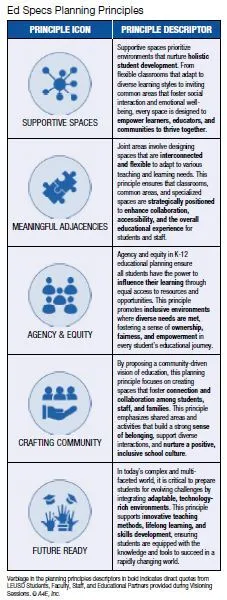
Verbiage in the planning principles descriptors in bold indicates direct quotes from LEUSD Students, Faculty, Staff, and Educational Partners provided during Visioning Sessions. © A4E, Inc.
Understanding the Role of Ed Specs in School Planning
At their core, Educational Specifications are planning tools that articulate a district’s educational goals, space needs, and programmatic requirements. They provide architects and designers with an in-depth understanding of the envisioned use of school facilities, going beyond a list of rooms to encompass pedagogical priorities, alignment to LCAP goals, differentiated learner needs, and desired instructional outcomes. However, Ed Specs are often misunderstood as prescriptive documents that limit creative solutions, or static, one-size-fits-all templates devoid of nuance or innovation. These assumptions miss the larger point: When developed collaboratively, Ed Specs become the narrative of a district’s aspirations—translated into space.
In the 21st century, Ed Specs have evolved into multidimensional tools. They integrate input from a broader range of stakeholders, leverage cutting-edge educational research, and incorporate new learning modalities including visual, auditory, kinesthetic, and collaborative strategies. They anticipate trends in technology, wellness, and sustainability, and include reference imagery that illustrates what’s possible within a space—whether through new construction, modernization, or even special mock-up and proof-of-concept spaces. Ed Specs increasingly serve as the connective tissue between a district’s vision for learning and its capacity to build environments that support it with the help of architects, designers, and allied professionals.
From Educational Goals to Spatial Realities
Strong Ed Specs serve as the bridge between the abstract ideals expressed during visioning and the concrete realities of architectural design. They translate broad educational goals—such as a focus on interdisciplinary instruction, inquiry-based learning, or career and technical pathways—into tangible design drivers that inform programming, layout, and spatial relationships. Effective Ed Specs also reflect a district’s identity and values. They help articulate what a community believes education should look and feel like. Whether it’s a commitment to inclusivity, a culture of innovation, or an emphasis on student well-being, these values find expression in design through careful translation of programmatic needs into spatial solutions.
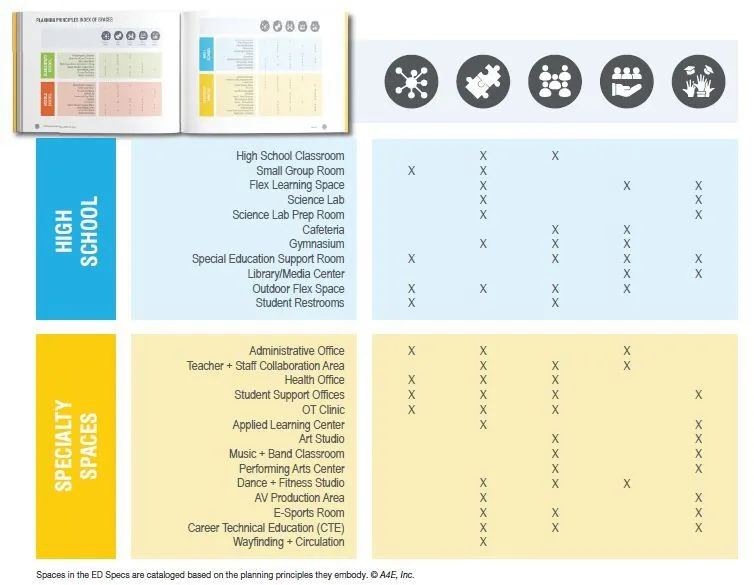
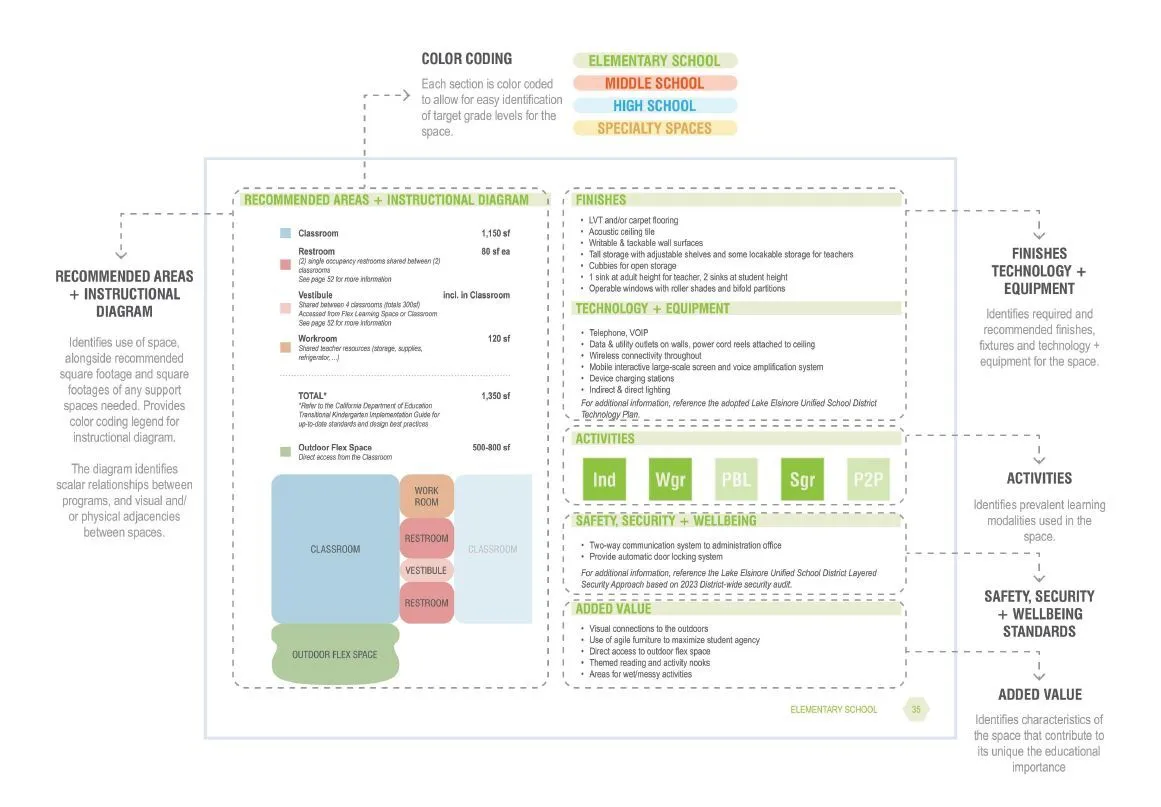
Key elements of a robust Ed Spec include explorations of each space’s learning potential, a deep understanding of learning modalities, illustrations of spatial adjacencies, furniture and technology standards, environmental performance goals, and operational priorities. These are not simply technical data points—they are insights that directly shape architectural outcomes. For instance, a district that prioritizes collaboration may include a higher proportion of shared breakout areas, project labs, or open commons. A community focused on wellness may call for natural light, improved indoor air quality, outdoor learning spaces, and acoustic comfort.
Critically, this process must be inclusive. Teachers, students, administrators, families, and community partners all bring valuable lived experience and perspectives. When these voices are authentically engaged—through workshops, surveys, focus groups, and iterative feedback—the resulting Ed Spec becomes more than a document. It becomes a unifying vision that drives alignment from early planning through to occupancy and long-term use.
Flexibility, Functionality, and Future-Readiness
Schools today must respond not only to the needs of the present, but to the uncertainties of the future. Instructional methods are evolving, technological integration is deepening, and expectations for equity, wellness, and environmental responsibility are rising. In this dynamic context, Educational Specifications must strike a careful balance: offering clear, actionable guidance while enabling the flexibility to adapt over time.
A well-developed Ed Spec does not prescribe a single solution or layout. Rather, it offers a flexible framework that anticipates change and supports a diversity of uses. While this idea might manifest in design elements like operable partitions, mobile furniture, and multi-use commons, it also resides in broader policy and planning approaches—such as establishing design principles that allow for repurposing spaces, or planning for modular expansion to accommodate enrollment shifts. This adaptability is especially important in an era of educational disruption. The rise of interdisciplinary learning, inclusive and trauma-informed approaches, and AI integration all demand expansive, responsive design thinking.
When Ed Specs are grounded in guiding principles rather than rigid typologies, they empower school systems to meet these challenges with agility and confidence. In this way, Educational Specifications become instruments of resilience. They allow districts to remain true to their educational mission while embracing innovation and transformation. They ensure that facilities not only meet the needs of today’s learners, but also evolve to support those of tomorrow.
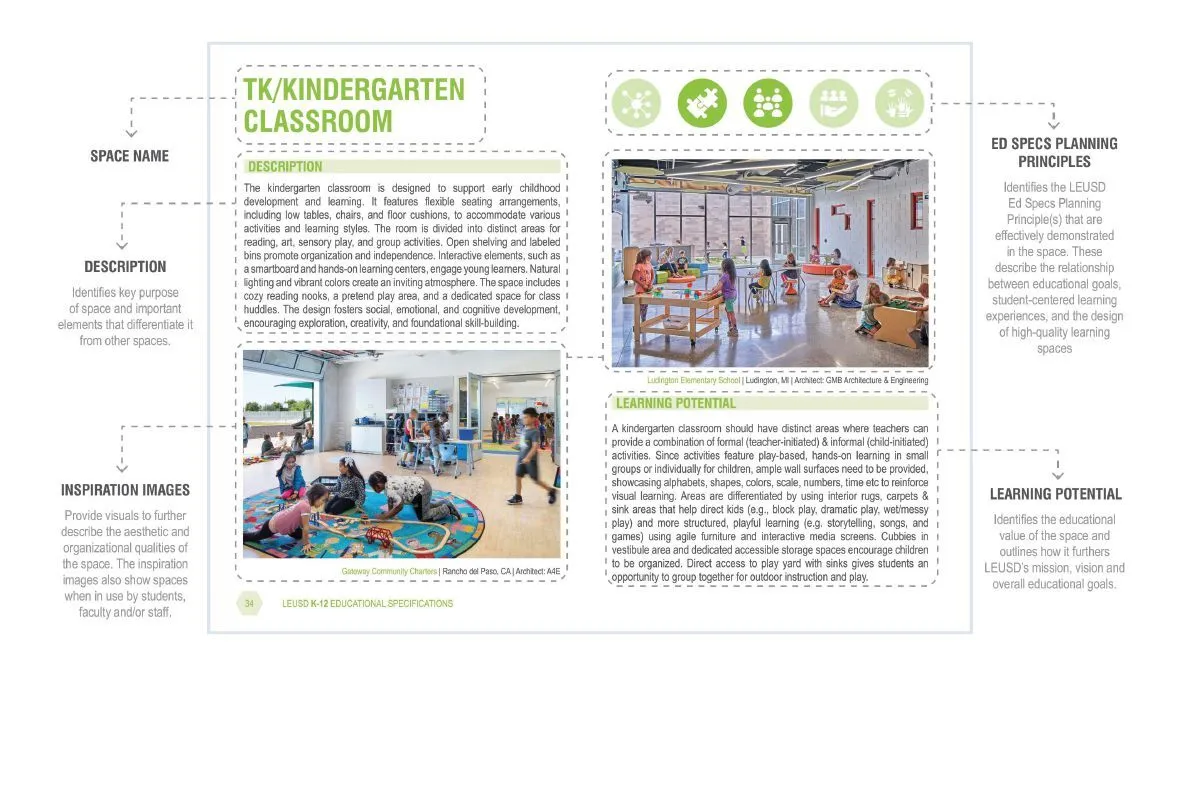
“Where students learn goes hand in hand with what and how they learn. A purposefully aligned educational environment enhances student engagement and gives teachers greater ability to impact learning, with the space acting as a supportive element in its own right. As LEUSD looks to improve, enhance, and build new facilities, the Ed Specs allow our community and design partners a framework to go from vision to reality. This framework is flexible to the educational needs of the facilities and encourages a throughline of alignment between what we need now and what we’ll need in the future.”
Through this effort, the district was able to build a unified approach that guided decision-making across multiple projects. The Educational Specifications thoroughly document all spaces planned across the district, referring planning decisions back to it’s goals and pedagogical approaches, and serve as a touchstone during design phases to help ensure consistency and equity across school sites.
“One of the most powerful outcomes of engaging in the Ed Spec effort was the opportunity to educate our students, staff, and greater community on what an Ed Spec is meant to be. It’s a partner document to our Facilities Master Plan. The Master Plan spells out what facilities our learners need while the Ed Spec details what those learning environments will look and feel like. Both are meant to be living documents that will adapt appropriately to the ever-changing needs of our students and staff. I believe a well planned and executed Ed Spec can be a path for a District to develop equity among both school sites and socioeconomically diverse areas within a district. The educational experience at any one school should be equitable with any other school site across a district. An Ed Spec can be a catalyst for the spaces that students occupy to be both unique to the needs of the community but also achieve district goals as a whole. It makes no difference why a district chooses to embark on an Ed Spec development effort, be it from a compliance or alignment mindset or combination of both. The process can become truly transformational if buy-in across curricular and operational perspectives is achieved.”
LEUSD’s experience underscores the essential value of Educational Specifications as both a product and a process worth investing in. When developed with intention and inclusivity, Ed Specs become powerful tools—not just for architects and planners, but for educators and communities striving to shape environments that truly support student success. In the words of the LEUSD Mission Statement: “Educate, Equip, and Empower – Every Student, Every Day.”
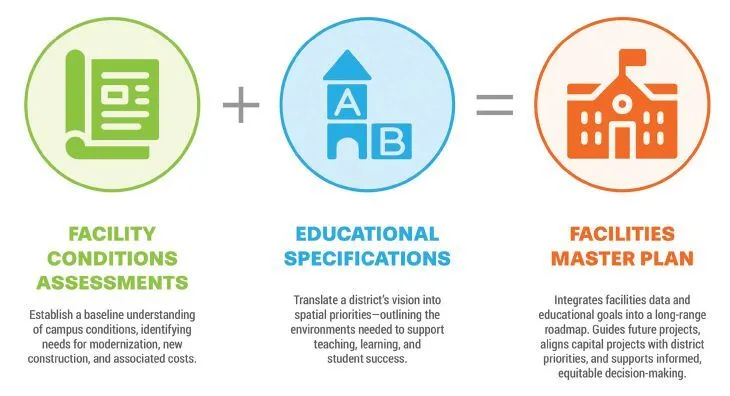
The Facilities Master Planning Process. © A4E, Inc.
In Conclusion
As demonstrated by both the opening premise of this article and the tangible benefits experienced by a district like LEUSD, we must recognize that Ed Specs are far more than static documents—they are declarations of intent. They ask districts to define not just what they are building, but why. As public education continues to face unprecedented challenges—from enrollment shifts to mental health crises and widening opportunity gaps—we cannot afford to rely on static, boilerplate documents to design spaces for present and future generations of learners.
“Educate, Equip, and Empower – Every Student, Every Day.”
To treat Ed Specs as a mere formality is to squander their potential. To embrace them as tools for advocacy—not just administration— is to open the door to more equitable, engaging, and future-ready schools. This is a call to action for architects, designers, and district leaders alike: if Ed Specs are where the blueprint of a school begins, then they must carry the full weight of that responsibility— with clarity, vision, and community voice. Let’s stop accepting documents that merely check boxes, and start crafting ones authored for transformation. Let’s bring educators, students, and families into the process—not as a gesture, but as a practice. The future of public education depends not just on constructing new buildings, but on embedding within these capital projects shared goals, best practices, and community values. When we approach Educational Specifications as declarations of belief in every child’s potential, we lay the foundation for schools that honor each community’s purpose, promise, and people—today, and for generations to come.