


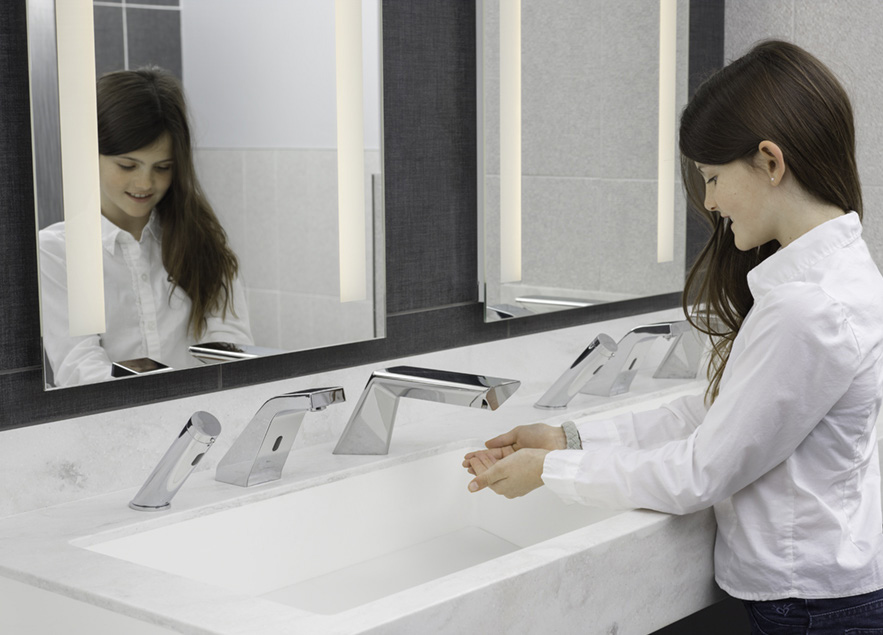
Design professionals, facility managers and administrators share a common goal: to create a complete, exceptional and uniform experience for their visitors, students and faculty. From entryways and lobbies to shared areas, offices, classrooms and lecture halls, the singular personality and unique values of the institution should be represented. Restrooms are no exception to that standard.
User perceptions of a restroom can affect the overall perception of your institution to a surprising degree. A restroom that is clean, well maintained and carries the institution’s aesthetic through to its décor elevates the user’s experience and displays a commitment on behalf of the institution to maintaining its identity, even in the smallest detail. These days, restrooms also serve as opportunities to display a commitment to ecological responsibility. Choices in materials and fixtures can contribute significantly to an institution’s climate goals, including high-profile certifications like LEED and WELL.
Achieving this level of quality and consistency requires focus from the ground up. Elevated and branded look-and-feel depends heavily on decisions made at the design stage, but so too does effective maintenance and perceptions of cleanliness and hygiene. Energy efficiency will depend on clear, upfront clarification of the institution’s goals for the designer, architect or specifier. From fixtures to hardware and materials, energy efficiency and carbon footprint reduction needs to be built into every choice and decision.
CLEANLINESS IS ABOUT MORE THAN PERCEPTION.
According to a recent global survey focusing on commercial restrooms post pandemic1, the majority (58%) of US consumers find that a dirty restroom makes them think much less of an establishment. Specifiers polled in the same survey place hygiene and cleanliness among their top considerations when planning a restroom. But what makes a restroom appear “dirty”? Primarily paper towels on the floor, according to 92% of facility managers surveyed. That’s not to mention overflowing wastebaskets and toilets clogged with improperly discarded paper towels.
That places a huge burden on facilities to choose the “right” hand-drying solution. It’s imperative to weigh the impact of a given option on perception of cleanliness while also focusing on hygiene. The public is far more sensitive to the topic of hygiene since the start of the COVID pandemic, and the more claims an institution can make regarding hygiene, the better. But in searching for data, we find that much of the science to this point has been muddy, to put it mildly. Hundreds of studies have been funded to determine the hygienic benefits of various hand-drying methods, but not all studies are created equal, and results have varied—sometimes wildly. To bring some cohesion to the data, in 2020, University of Arizona researchers published a review2 of the available material.
“Some of the top-ranking articles in our Google search were white papers authored or sponsored by paper companies,” said Dr. Kelly Reynolds, the director of the university’s Environment, Exposure Science & Risk Assessment Center. “Additionally, media reports frequently used sensationalized headlines. While such headlines may increase traffic, they sometimes overgeneralize or exaggerate research results. Consumers may only read the headlines, which can influence public opinion toward biased or erroneous conclusions. From a health and safety perspective, we found no empirical data to support one hand-drying method [hand dryers vs paper towels] over another.”
Starting on this relatively equal footing, a hand dryer with an electrostatic HEPA filtration system delivers clean, filtered, purified air fast and efficiently, and is proven to remove 99.999% of viruses from the airstream3. Installing an antimicrobial wall guard with a wall-mounted dryer will further contribute toward reducing viral transmission. There are additional hidden risks to paper towels, as well. Studies have shown that even unused paper towels made from recycled fibers can contain germs including E. coli4. Overflowing receptacles, waste on the counters and floor, and clogged toilets increase the risk of viral transmission.
COST SAVINGS, IN DOLLARS AND CO2.
The impact of restroom maintenance on an organization’s budget can be significant. School bathrooms are a high-use environment, usually averaging around 500 uses per day. Calculating at that usage rate and a $0.20 electricity price per kWh, hand dryers can save an institution $7,114 per restroom annually, realizing a return on investment within 10 months. Factoring in savings in maintenance hours, the benefits only continue to increase.
Ecological responsibility remains a top priority for educational facilities, and choosing hand dryers over paper towels could potentially reduce a typical school’s carbon footprint by around 3,814 kgs (based on the above example). However, not all hand dryers are equal in terms of sustainability. Design professionals often have sustainable and/or well-being goals for their projects. Consider a hand dryer that is BuildingGreen Approved®, contributes to LEED credits and even WELL points. Both the United States Green Building Council (USGBC) and the International Well Building Institute (IWBI) have benefits for projects that use hand dryers.
You’ll also want to look for an Environmental Product Declaration (EPD) certification, which assesses a product’s environmental impact from production to usage and disposal. Then there’s the HPD, or Health Product Declaration certification, which helps buyers and specifiers better understand the environmental and health impacts of a product’s materials, empowering them to make more informed product selections.
LOOKS AREN’T EVERYTHING, BUT THEY’RE A LOT.
We talked about perception of cleanliness, but what about the impact of design on user experience? Choices of fixtures and décor in bathrooms say a lot about an institution’s identity, and luckily, the wide variety of hand dryer designs now available include sleek, modern styles that integrate beautifully with any contemporary restroom design.
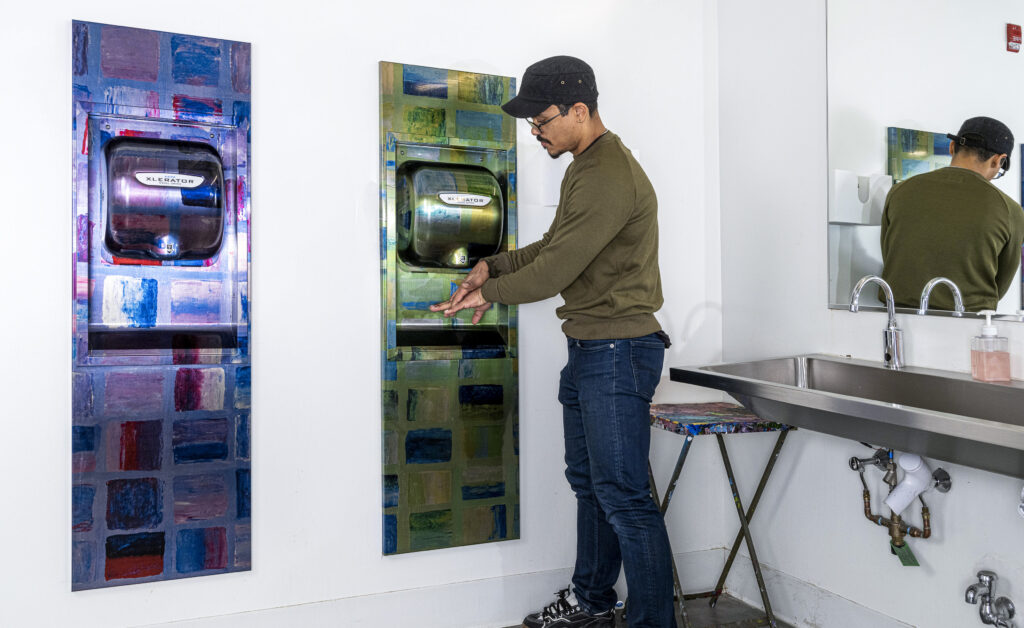
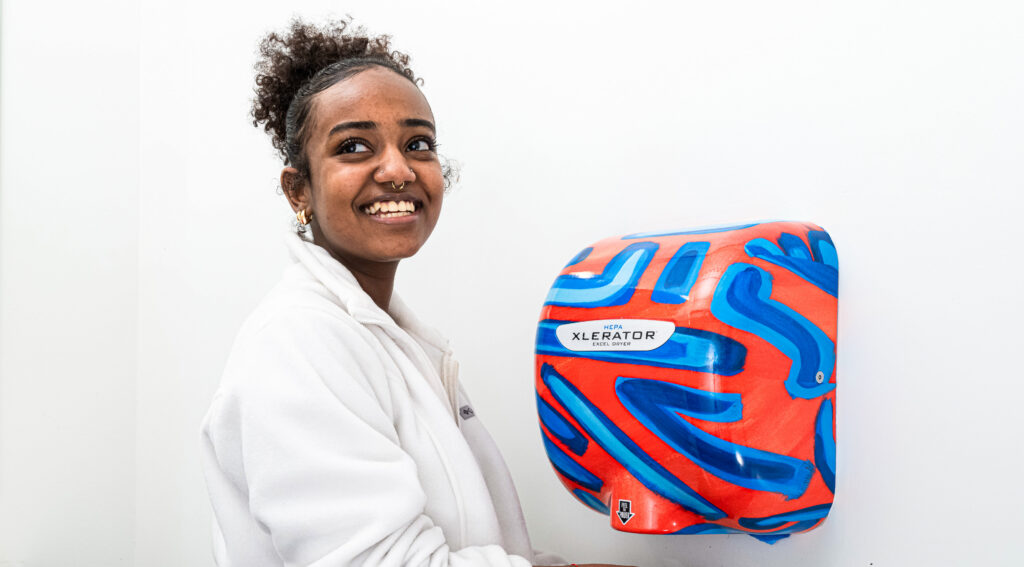
Hand dryers can also make dramatic statements of their own, providing surface area for logos, graphics and even student or faculty artwork! At Excel Dryer, we recently collaborated with Artists for Humanity (AFH) in Boston, which provides Boston teens opportunities to work on paid art and design projects while they prepare for college and careers. We created custom hand dryer covers featuring student art for the restrooms at AFH’s EpiCenter, the city’s first LEED Platinum-certified facility. It was a true feel-good project, saving AFH money, increasing sustainability, and engaging and empowering student artists.
Visually displaying a Green Statement on the hand dryer cover makes a powerful statement about an institution’s commitment to its climate goals. Digital image technology to customize hand dryer covers is great options for communicating school spirit. And whatever your institutional aesthetic, there is likely a hand dryer design option available to suit, including hand dryers built right into the sink unit. The ultimate user experience is a touchless hand washing and drying experience. Consider an integrated sink system with sensor activated wash, rinse and dry all in one place.
A MULTIPURPOSE SOLUTION.
Energy efficient, ecologically certified hand dryers with eHEPA filtration help meet your institution’s aesthetic, hygienic, economic and ecological requirements at once. They provide satisfaction from a subjective user perception, along with objective advantages backed by hard data, providing a solution that reflects positively on the institution in a significant and measurable way.

888.223.9060
EXCELDRYER.COM
SALES@EXCELDRYER.COM
TIME TO THROW IN THE TOWEL
- “What is Considered a Dirty Public Restroom in the United States? A Study of Key Stakeholders.” MetrixLab, 2023.
- https://ami-journals.onlinelibrary.wiley.com/doi/10.1111/jam.14796
- Based on testing performed by LMS Technologies, 2023
- https://www.ajicjournal.org/article/S0196-6553(11)00967-9/abstract
