


Like education, design is an opportunity. Be it through art, science, math, or music, an education gives us a chance to apply what we know to better the world around us in meaningful ways. Likewise, through enhanced form, function, and engagement, good design is also devoted to making our experience in the world better. Katy Lucas, RID gets it. As an interior designer, she’s been involved in developing K-12 educational facilities for nearly 20 years. She shares the importance of maximizing the impact of educational spaces in any and every way possible.
“Good educational design is about getting students and teachers excited about learning,” says Lucas. She is a Senior Interior Designer at Goodwyn Mills Cawood (GMC), a multi-disciplined architecture and engineering firm with more than 20 offices across the southeastern United States. With a goal of purposeful design that nurtures and develops the next generation, Lucas leads interior design in GMC’s Birmingham, Alabama office on commissions big and small. Given an opportunity to participate in GMC’s design for a new Intermediate School (3rd – 5th) in her hometown of Fort Payne, Alabama, Lucas was thrilled to give it her all.
“I grew up in Fort Payne. My mother was a teacher. So, when the chance to work on the Little Ridge Intermediate School came up, I was ecstatic,” she shares. Having worked with the Fort Payne City Schools and former Superintendent of Schools, Jim Cunningham, for some eight years before winning the Little Ridge commission, the GMC team appreciated the client’s desire for progressive educational facilities. Like many districts, Fort Payne was looking for ways to make the most of their budget. “As designers, we are continually challenged to be creative and use resources wisely.”
One way GMC maximized their resources was by rethinking the purpose and practicality of the school’s circulation and gathering spaces. Any school’s inherently high-traffic areas like hallways, cafeterias, and lobbies demand a resilient flooring solution. For generations, designers like Lucas have been specifying Vinyl Composite Tile (VCT), for a combination of value, durability, ease of maintenance, and long-lasting color. The Armstrong Flooring™ brand has been the biggest name in VCT for decades and by a significant margin, and is now the primary manufacturer of VCT in the U.S.
“We started seeing the hallways as an opportunity for interactive learning modalities,” says Lucas. “We went to each grade level and talked to teachers about what they work on with students throughout the school year. Together, we developed a series of core curriculum components to integrate into hallways connecting classrooms.”
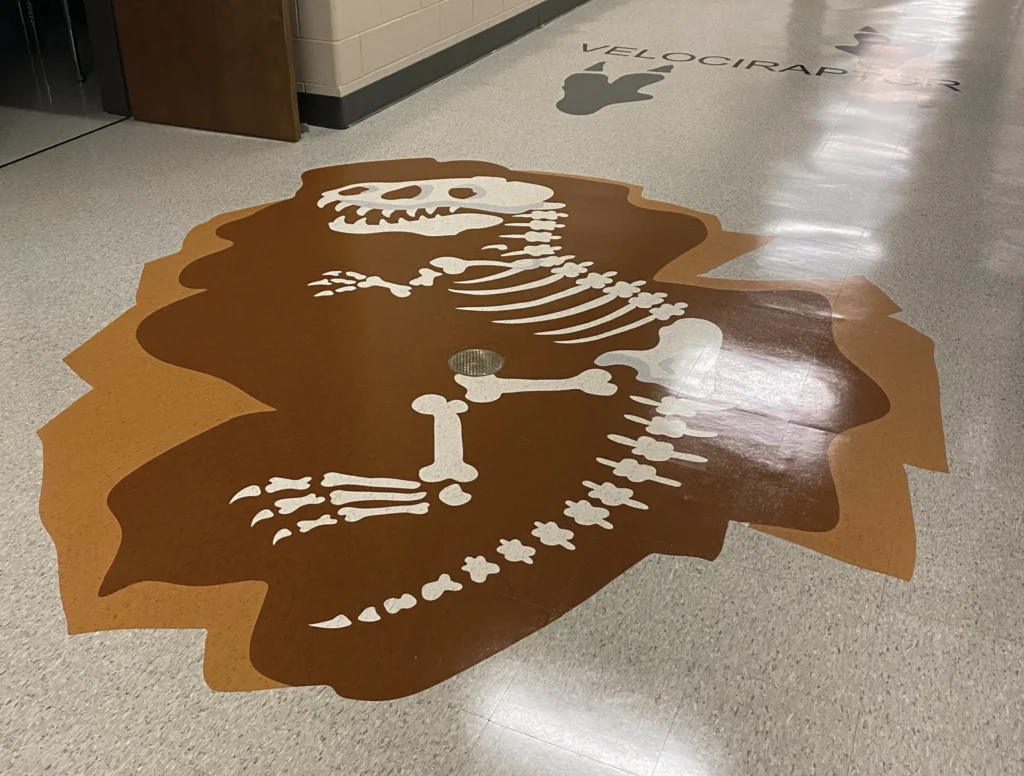
Armstrong Flooring’s VCT lineup affords designers almost infinite choices to create flowing linear patterns, organic looks, and visual navigation cues for spaces of any sort. At Fort Payne Intermediate School, the results are an eclectic articulation of everyday learning with thoughtful purpose and vibrant, engaging configurations. Primary colors race along the first-floor hallway in bold orange, bright yellow, earnest green, baby blue, and deep purple. The strata of the earth’s core are revealed in sections between a quadrant of classrooms on the second floor. The solar system populates an adjoining hall. Dinosaurs and their tracks, geometric shapes, multiplication tables, and fractions are vital building blocks to understanding the world around us. Each is effortlessly reinforced in the young learner’s everyday experience of simply getting from place to place within the building.
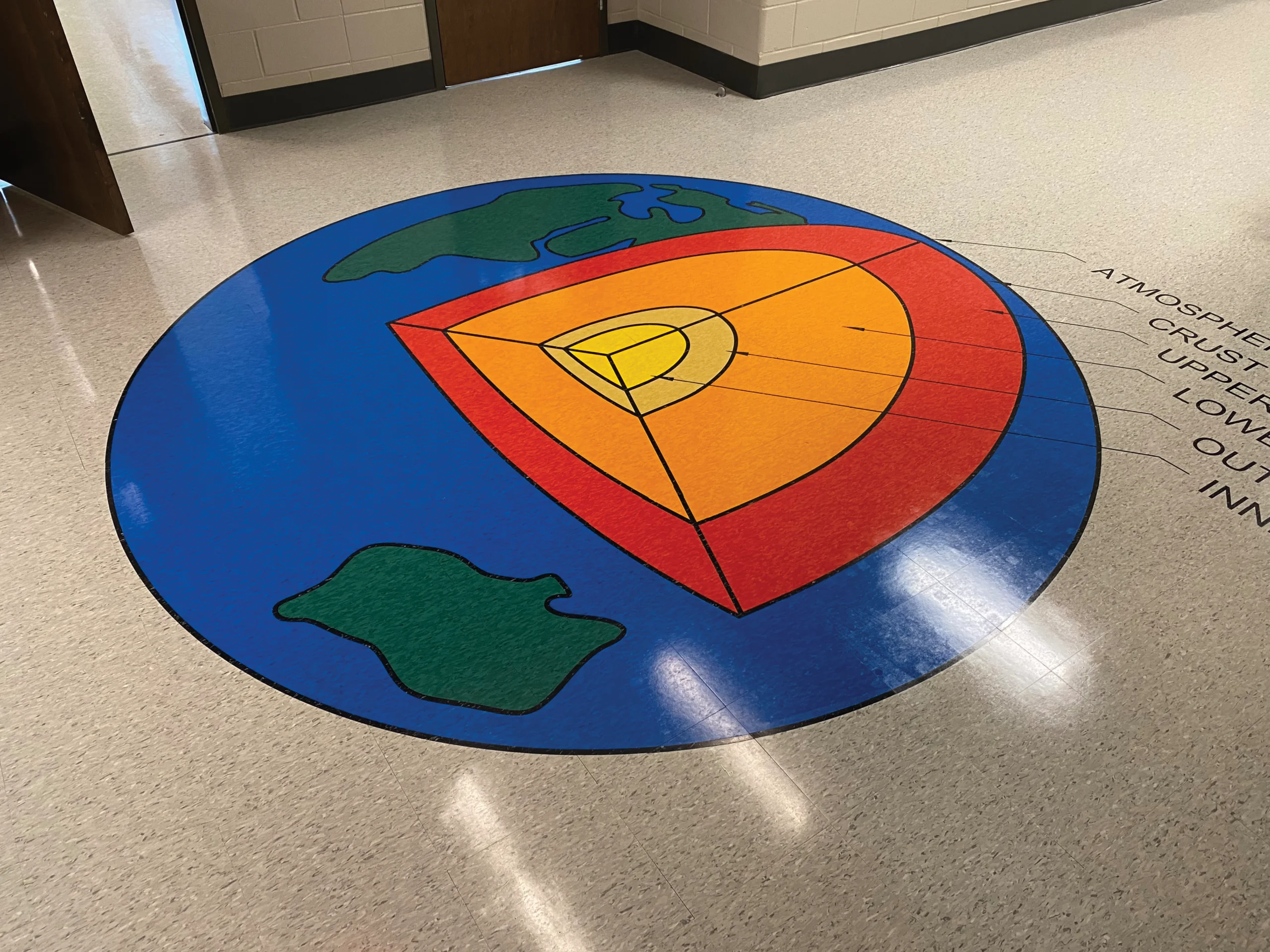
Armstrong Flooring’s VCT lineup affords designers almost infinite choices to create flowing linear patterns, organic looks, and visual navigation cues for spaces of any sort. At Fort Payne Intermediate School, the results are an eclectic articulation of everyday learning with thoughtful purpose and vibrant, engaging configurations. Primary colors race along the first-floor hallway in bold orange, bright yellow, earnest green, baby blue, and deep purple. The strata of the earth’s core are revealed in sections between a quadrant of classrooms on the second floor. The solar system populates an adjoining hall. Dinosaurs and their tracks, geometric shapes, multiplication tables, and fractions are vital building blocks to understanding the world around us. Each is effortlessly reinforced in the young learner’s everyday experience of simply getting from place to place within the building.
In making the magic happen, Lucas turned to a reliable process for transforming the standardized Armstrong Flooring™ VCT into crisp, vibrant, instructional animations on the hallway floors.
“When you start getting into detailed graphics in the flooring, process is very important. That is where water jet technology comes in,” says Lucas. The process involves using an industrial tool to produce a high-pressure jet of water capable of cutting a wide variety of materials. “Working with a local water jet provider, WaterJet Works, we draw the graphics in BIM and send over the files like any other detail. The manufacturer incorporates our design file into their machine programming, receives the Armstrong Flooring™ VCT the contractor purchased from AHF Products®, and develops the initial sample tiles for approval.”
Lucas touts the importance of partnerships and encourages peers to understand the water jet provider to be a design and constructability expert in their domain.
“What’s impressive to me is the precision and detail that they come back with for the VCT installation team,” shares Lucas. “When they arrive at the job site, the tiles are organized like a puzzle that is easy for the installer to follow. The colors and patterns match up to within less than an eighth of an inch. Upon close inspection, the lines are seamless.”
Asked what she might tell other designers about water jetting VCT, Lucas says there isn’t much to worry about other than line widths.
“You probably want to work with line weights of a half-an-inch or greater, but other than that there isn’t much limitation on what you can do with all the great colors,” she says. Made primarily of vinyl and limestone, Armstrong Flooring™ VCT tiles are constructed with integral color chips to produce a top-to-bottom true-through color pattern that allows the surface to remain the same even as the joys of learning take their toll on the school in general. A simple buff and polish are all that is required to make the floors at Fort Payne Intermediate look day-one new for the life of the building.
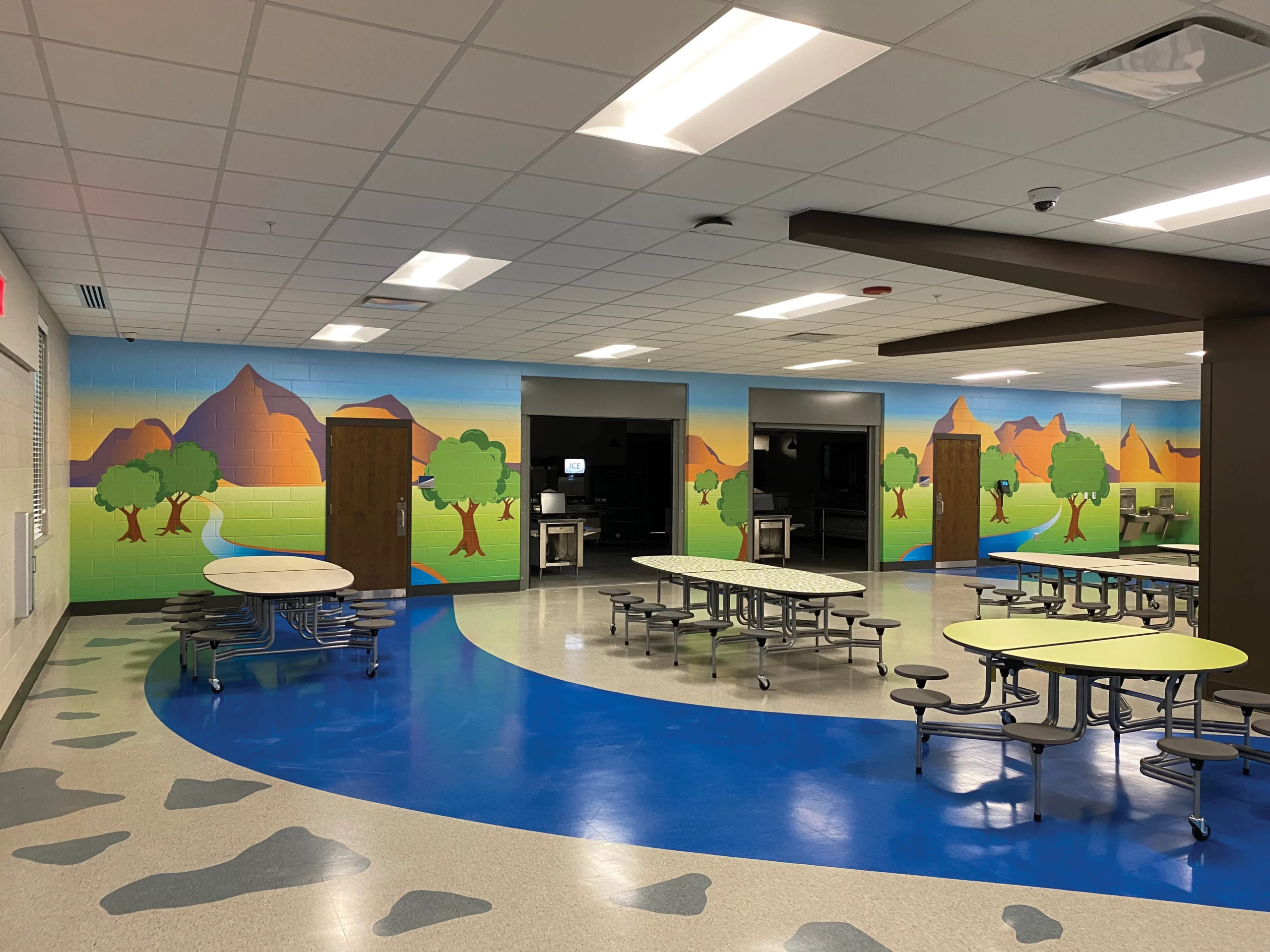
In addition to the learning moments infused into the hallway floors, GMC drew upon Fort Payne’s lush natural surroundings of hills and dales. “I enjoyed incorporating the Little River up on Lookout Mountain into the wayfinding. The river winds through the hallway leading to the cafeteria where it joins a large environmental graphic on the wall and fun boulders in the flooring.”
Asked what educators should know about water jetting VCT, Lucas is effusive about the ability to dynamically improve the aesthetics and use of learning environments for minimal upcharge.
“The most important thing in educational design is to get students excited about the learning environment,” finishes Lucas. “Water jet and Armstrong Flooring™ VCT offer a low-cost, high-impact way to add educationally useful depth, color, and character to high-traffic floors.”