


The commercial construction industry accounts for nearly 40 percent of energy-related carbon emissions annually while American K-12 schools account for about 8 percent of those spaces, according to the Sierra Club’s Clean School toolkit. The push towards a sustainable future is gaining momentum in school districts across the country – whether that be students recycling their waste at the end of the lunch period, composting in the school garden or, most importantly, school superintendents and facilities directors creating strategies to lower their schools’ carbon emissions.
A Focus on Operational Carbon
In addition to the benefits to the planet, schools that prioritize energy efficiency may save up to $100,000 per year in utility costs, according to the U.S. Department of Energy. Many school districts may find it hard to gain upfront funding, however, school districts can take advantage of federal funding included in the Inflation Reduction Act of 2022, which provides tax credits for schools that invest in clean energy or energy-saving projects, such as solar panels and heat pumps.
Embodied Carbon – The Other Piece of the Emissions Puzzle
Embodied carbon refers to the emissions associated with the full life cycle of a product – from raw material extraction, production, transportation, use, maintenance and end of life.
Even the U.S. Federal and select State governments are focusing more on embodied carbon. In 2022, the White House Administration initiated the Federal Buy Clean Initiative, marking the first time that American-made, low carbon construction materials will be prioritized in federal procurement and federally funded projects. Twelve states – California, Colorado, Hawaii, Illinois, Maine, Maryland, Massachusetts, Michigan, Minnestoa, New Jersey, New York, Oregon and Washington – adopted the initiative.
School districts should consider both the carbon impact of the exterior and interior products used in new construction or renovation.
Breakdown of Energy Use in K-12 Schools
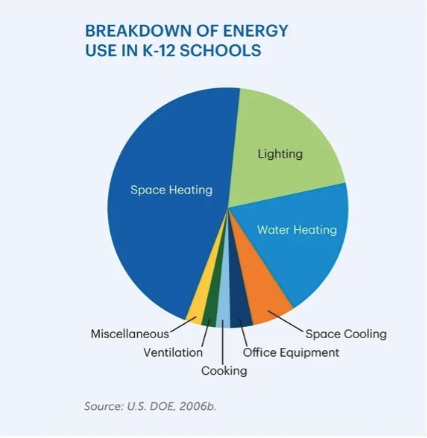
U.S. ENVIRONMENTAL PROTECTION AGENCY. (2011).
Energy Efficiency Programs in K-12 schools.
"...schools that prioritize energy efficiency may save up to $100,000 per year in utility costs, according to the U.S. Department of Energy."
Measuring Embodied Carbon
Focusing on reducing the impact of their products, manufacturers measure the emissions and are transparent about their environmental footprint. To measure a product’s embodied carbon, manufacturers conduct a Lifecycle Assessment. From this comprehensive document, an Environmental Product Declaration (EPD) can be created, which is a widely used tool to more easily understand the carbon impact of a product.
An EPD is a standardized, third-party verified document that offers transparent and credible data and information about a product’s environmental impact. EPDs report a Global Warming Potential (GWP) estimate for the life of the product, which is the amount of greenhouse gas impact.
The lower the GWP, the less impact the product has on a building’s embodied carbon footprint.
Shaw Contract makes it even easier for facilities professionals and designers to find low-carbon products through the “carbon impact” filter on our website. Additionally, the “sustainability report card” on the Shaw Contract website offers a quick overview of a product’s GWP and recyclability.
Recycling
Superintendents and facilities professionals should also consider whether a product can be recycled at the end of its useful life. Since 2006, Shaw has taken back and recycled over 1 billion pounds of carpet and began recycling all Shaw-manufactured resilient and their new PVC-free platform, EcoWorx® Resilient, as a part of Shaw’s re[TURN]® Reclamation Program. The more product returned to Shaw, the lower the carbon footprint of future flooring products.
Carbon is just one aspect of the environmental impact of a product. The materials needed to make a product and how the product impacts people should also be considered as part of a comprehensive approach to product sustainability. After all, what’s good for students and teachers can also be good for the planet.
Visit shawcontract.com to learn more.
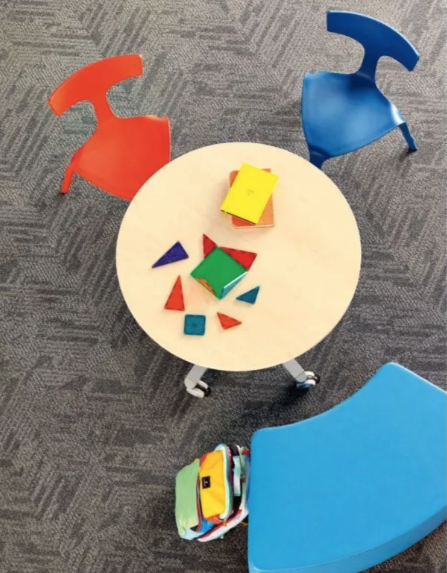
Images: Imagine (Carpet Tile 5T594) in Cultivate (93580) + Peptalk Orange (93668)
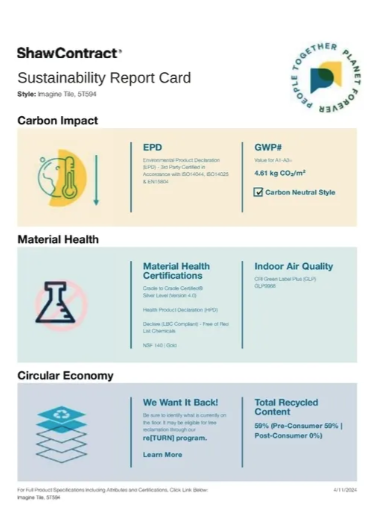
Images (Carpet Tile 5T594) Sustainability Report Card