

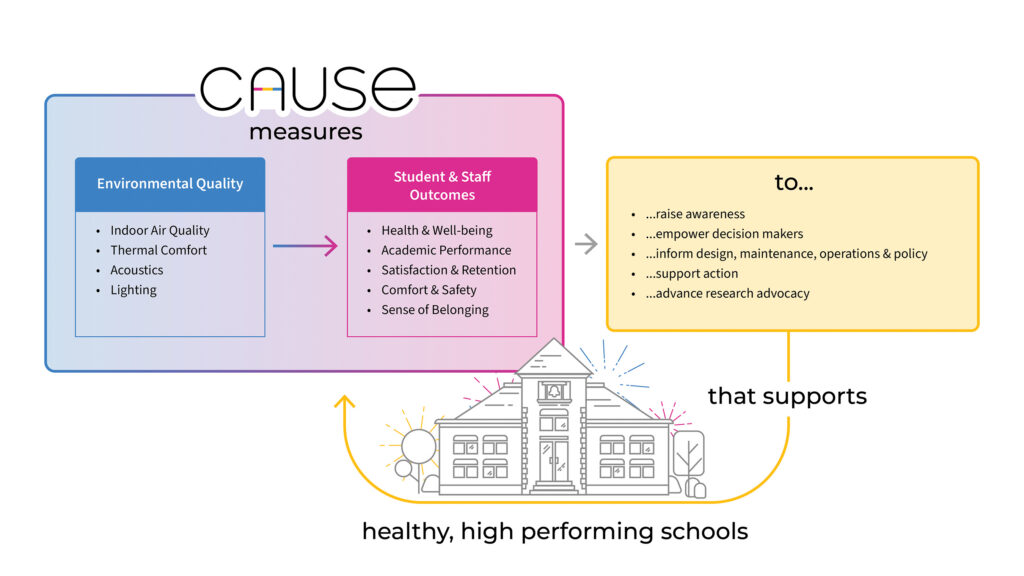
It’s no secret that a school’s environment plays a crucial role in student success. Yet, measuring that impact has been frustratingly elusive since there has been a persistent gap: the lack of standardized metrics and accessible evaluation tools. As James Baldwin said, “Not everything that is faced can be changed. But nothing can be changed until it is faced.” In this spirit, the Coalition for the Advanced Understanding of School Environments (CAUSE) launched an initiative to introduce an open-source post-occupancy evaluation (POE) assessment tool to empower people to directly address environmental optimization. (Learn more at www.causecoalition.org.)
The CAUSE initiative marks a pivotal shift for both schools and school advocates. It gives us the power to spread awareness about the importance of our physical environments, while finally giving us a way to consistently measure those environments. These objective evaluations, in turn, can inform strategic investments and meaningful facility improvements. With these kinds of POE-based, data-informed insights, we can turn good intentions into real, positive change, turning a school’s potential into measurable educational and well-being success.
Here are six powerful reasons why building better schools builds better futures.
1. You’re not alone, and this, unfortunately, is not new.
For years, the U.S. has faced a critical school modernization crisis, with half of public schools needing major repairs1 and an $85 billion annual underinvestment in maintenance and capital expenditures2. This funding shortfall also disproportionately affects high-poverty districts and urban areas3. Current legislative directions at the federal and some state levels suggest this underfunding may even get worse before it gets better. These outdated facilities, however, are exposing students and staff to poor environmental conditions, with 46% of schools reporting such issues4, which are linked to lower student attendance and higher dropout rates5,6. But unless we know what issues exist in our schools, through an assessment like a POE study, we cannot advocate for capital improvement funding, nor target the spending of what limited funds are available.
Know the facts: We need to dedicate funds to improve our school infrastructure – but we should first understand what expenditures will have the biggest return.
2. What’s it costing us? More than you think.
When we conduct a POE, using a tool like CAUSE’s, we not only deepen our understanding of a school building’s impact on education and well-being, we also become empowered to prioritize solutions relative to their cost and impact. The Centers for Disease Control and Prevention (CDC), for instance, has estimated that the cost of asthma in the U.S. —from direct medical costs, like hospital stays, to indirect costs, like school absences—adds up to over $56 billion a year7. Just think what improving our buildings’ indoor air quality could do to reduce those costs. If teacher absences were further curtailed by improving other environmental conditions in schools, the financial benefit could exceed $4 billion annually, largely from reducing the expense of substitute teachers. Even at the school level, cost savings are possible: In just one study, a school found that addressing building issues uncovered by its POE could cut annual energy expenses by 12%9, effectively covering a teacher’s salary.
Know the facts: When we invest in better schools, we invest in a better bottom line.
3. Schools aren’t built like they used to be—and that’s a good thing.
School design directly influences pedagogical strategies10 and extends beyond student learning to include teacher engagement and collaboration11. That means that, today, this encompasses not only what we traditionally think of as a classroom, but also other diverse spaces like incubator labs, project areas, and outdoor spaces12,13. Building schools to support 21st-century learning principles requires consideration of urbanization, climate change, health indicators, and infrastructure assessments14, with an emphasis on flexibility, sustainability, and community engagement15. When we are able to objectively evaluate the school environment, such as conducting a POE, we can identify where a facility no longer aligns with contemporary needs. The results may focus on how the building and grounds can better support modern pedagogical approaches or something like moving away from the windowless, cave-like classrooms of the 1960s and 70s, to sunlit spaces that improve performance by helping students and teachers stay alert throughout the day and sleep better at night16,17.
Know the facts: School design is expanding beyond the traditional classroom, evolving to meet the demands of 21st-century learning and the science of well-being.
4. Beyond the books: School buildings shape teaching and learning.
Education today emphasizes the “whole child,” an approach that interconnects students’ physical, cognitive, psychological, social, and emotional development within learning environments, while highlighting the significant impact of the built environment18. Research demonstrates that well-designed school buildings positively influence students’ social-emotional and physical health19,20,21,22,23, which is directly related to improved learning outcomes and students’ lifetime success24,25,26,27. Educational success relies on healthy and safe learning environments28. School environments have also been shown to affect teacher satisfaction, effectiveness, and retention29,30,31. For instance, classroom acoustics not only influence academic performance32 and students’ ability to hear their teachers but also the amount of fatigue a teacher experiences33. Continuing research in these and other areas strengthens the argument that school design matters.
Know the facts: To unlock the power of our schools, we must understand that buildings are key educational tools and invest in strengthening this vital resource.
5. The world is changing, teaching is changing…but schools? Not so much.
Recent years have seen a significant reshaping of U.S. schools and communities. Four events—the COVID-19 pandemic, progressing climate change, massive unemployment, and unrest derived from persistent social injustice—have concurrently influenced the country34, impacting not only students’ learning but also their social-emotional well-being35,36. The requirements of built infrastructure to meet the 21st-century learning demands have resulted in the prioritization of safe, healthy, and supportive environments for the whole child37. But as our world has changed and pedagogies have evolved, our school buildings have remained relatively the same. The average age of schools in the U.S. is 49 years old, with over a third built before 197038. Though some aspects of school design still have merit, such as operable windows for natural ventilation or being located at the heart of a community, others need to be reevaluated. For instance, the mechanical heating/ cooling of our schools needs to be reconsidered given the scarcity of natural resources, our better understanding of their ecological harm, and rising global temperatures. In fact, a large study found that students taking a test on a 90°F day versus a 75°F day resulted in a 12.3% higher likelihood of failing—equivalent to the Black- White achievement gap39. Whether by natural or mechanical means, regulating thermal comfort in schools can also reduce fatigue, irritability, and stress40 while minimizing wasted energy and funds. Continuing to evaluate environmental conditions like these will allow school design to catch up.
Know the facts: Documenting the impact of school buildings helps combat the long-standing undervaluing of, and recent attacks on, public education.
6. Schools are safe harbors and anchors for the community.
Schools offer refuge from the challenges and uncertainties of the outside world, offering students a secure and protective environment where they can feel safe, supported, and nurtured. Schools also provide stability and grounding for the community. They are central to a community’s identity and well-being, provide a sense of continuity and connection, and function as hubs for community activity, support, and resources. In addition to the traditional delivery of education, schools provide such resources as food distribution, social-emotional support, and health services. The value of schools is not only in their function as community resources41,42,43 but also as engines for social capital44,45,46, making them crucial for community development47. These benefits extend even further by impacting housing prices, local economies, and community wellness48,49,50,51,52,53,54. Accordingly, school evaluation initiatives, like CAUSE, can continue to expand the lens of school health and student achievement to a broader definition that includes assessing the overall health, engagement, and use of schools for community well-being55,56.
Know the facts: The value of schools extends far beyond their walls; they are vital hubs that foster strong communities.
Now you know the facts and are armed to advocate not only for better school environments but also the importance of assessing the impact of such environments. This information can serve as great conversation starters to engage school boards, district administrators, designers, engineers, and so on about the issues.The decisions made by these players have a ripple effect, from students to staff to the greater community. This is just the tip of the evidence-iceberg, though. We will continue this series, “What Gets Measured Gets Better,” to further explore four key environmental factors that were hinted at herein: lighting, acoustics, air quality, and thermal comfort. Even in the turmoil of today’s threats to public education, it is worth the time, resources, and energy to learn more and push for better school buildings since the promotion of our school environments leads to better learning, improved well-being, and stronger communities – setting the stage for the success and well-being of many.
References
Access this article along with all its references at https://www.causecoalition.org/